Get Full Government Meeting Transcripts, Videos, & Alerts Forever!
Get email alerts on the Correctional Campus Expansion topic
No spam. Unsubscribe anytime.
Sarasota commissioners direct staff to pursue jail expansion options, eyeing voter referendum in 2026
Summary
After months of study, the Board of County Commissioners voted unanimously to advance two development options for a new correctional facility and related courthouse replacement, directing staff to refine costs and prepare referendum materials for possible placement on the November 2026 ballot.
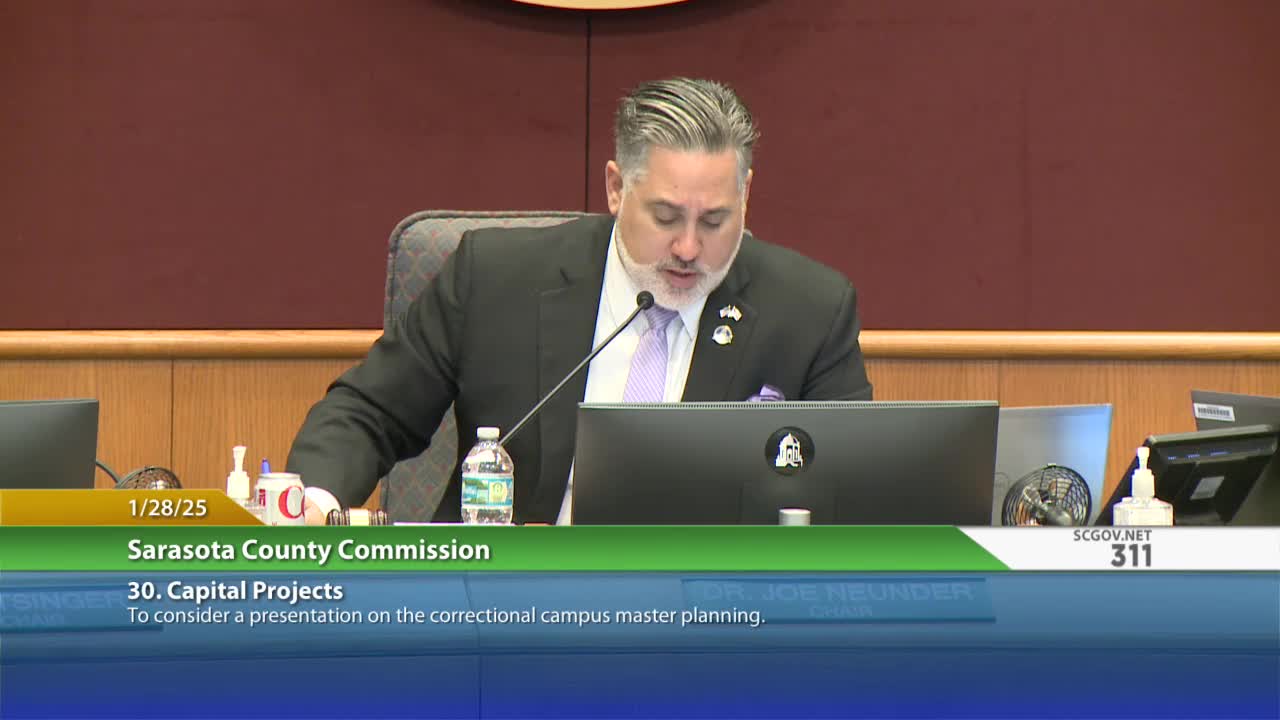
The Sarasota County Commission voted unanimously Jan. 28 to direct staff to continue detailed study of two options for replacing and expanding jail capacity at the county correctional campus and to prepare material for a possible 2026 voter referendum.
The commission’s action follows a presentation from County Capital Projects Director Brad Gobitz and corrections staff that summarized a months-long review of 14 scenarios and carried forward three favored approaches. The board instructed staff to drill down on “Option 2” and “Option 3” — both of which keep the new courthouse/jail work within the existing campus footprint while differing in where the criminal justice complex sits — and return with detailed cost estimates, financing analysis and referendum language.
Why it matters: County officials and the Sheriff’s Office said jail population growth and longer lengths of stay have left the county chronically short of secure beds. The Sheriff’s Office presented population projections showing the jail already operating hundreds of beds above its operational capacity and warned that building only a smaller reintegration facility (about 300 beds) would leave the county back under capacity within a decade. Staff told commissioners an approved voter referendum would be required to fund the larger campus replacement and jail expansion under the timelines shown.
What the board voted to do - Motion: proceed with further study of Options 2 and 3 for the correctional campus, with staff to refine cost estimates, return financial analysis and prepare referendum planning for board review. Motion by Commissioner Kutzinger; second by Commissioner Smith. The motion passed unanimously. - Direction to staff: return in detailed form in October (staff target) with tightened construction and escalation assumptions, a financial plan, and recommended referendum language and schedule leading toward a possible November 2026 ballot.
Key details presented - Project scope considered: replacement of the existing Criminal Justice Center (CJC), construction of a new multi-level correctional facility to replace the aging West Wing, and removal of the old West Wing once new housing is occupied. Options differed on the CJC location (on top of structured parking versus at-grade on an acquired parcel). - Capacity shown in the consultant materials: a new, five-level facility with four housing levels of 60-bed pods would yield a rated capacity around 2,400 beds; staff used an 85% operational factor to estimate practical operating capacity. With the proposed phased build-out staff estimated an operational capacity that would place the system into surplus in the longer term if the selected facility is built and the courthouse replacement proceeds as shown. - Jail population and timing: materials presented actual 2024 average population of about 1,096 and showed a deficit of roughly 323 beds under current capacity. The Sheriff’s Office said the county had reached roughly 360–400 inmates over operational capacity in recent months and cautioned that a 300-bed reintegration center alone would not stabilize capacity beyond the early 2030s under the office’s conservative projections. - Cost guidance: an initial high-level cost range was provided to the board. Using conservative escalation and contingency assumptions, staff showed a high-end range in the midhundreds of millions (presentation cited approximately $650–700 million depending on final scope, parking and site choices). Gobitz told commissioners staff expects to tighten those numbers during the next phase of work. - Funding and schedule: staff assumed a voter referendum would be required and indicated a planning path that could place final ballot language before voters in November 2026 if the board directs continued work. A high-level procurement and construction milestone sequence was shown with schematic‑design, final cost estimates and referendum steps through 2026 and into construction beginning thereafter if approved.
What the Sheriff’s Office told commissioners Major Brian Meinberg, the county’s courts-and-corrections division commander, said the jail population has climbed steadily and length of stay has increased. Meinberg said facility projections that assumed only a 300‑bed reintegration center would leave the county “underwater” again by about 2032–2033. He urged the board to consider a solution sized to avoid repeating chronic overcapacity.
Concerns raised by commissioners and staff - Price and timing: several commissioners called the headline budget figures “staggering” and urged staff to narrow escalation and contingency assumptions, search for cost efficiencies and evaluate property-purchase options that could reduce overall cost. Several asked for clearer scenarios showing the tax or debt-service impacts of different price points. - Tax and CIP interactions: commissioners and staff discussed how a large bond package would interact with existing and planned capital projects, and whether the board should re‑prioritize other CIP items if the jail referendum proceeds. - Near-term relief: commissioners asked whether smaller, earlier actions (for example, a reintegration center only) could reduce operational stress sooner; the Sheriff’s Office said smaller additions would help short term but would not prevent capacity shortfalls later in the 2030s.
Next steps and follow-up tasks - Staff to proceed to a Phase‑3 study on Options 2 and 3 (detailed schematic designs, refined cost estimates, traffic and operations analysis and tighter escalation/contingency figures). - Staff to prepare a financial analysis showing debt-service and property-tax impacts for multiple price points and to return to the board in October with recommended referendum language and schedule for potential November 2026 placement. - Staff to continue coordination with the city on any city‑owned parcels implicated by campus siting options.
Ending Commissioners said they wanted to move quickly but carefully: board members emphasized urgency because of current overcrowding while repeatedly asking staff to narrow cost uncertainty before asking voters to approve borrowing. The board’s unanimous vote authorized staff to continue detailed work on the two campus options and to prepare for a possible referendum in 2026.