Get Full Government Meeting Transcripts, Videos, & Alerts Forever!
Get email alerts on the Public Health topic
No spam. Unsubscribe anytime.
Alachua County commissioners direct restructure of community health worker program, ask fire rescue to lead expansion plan
Summary
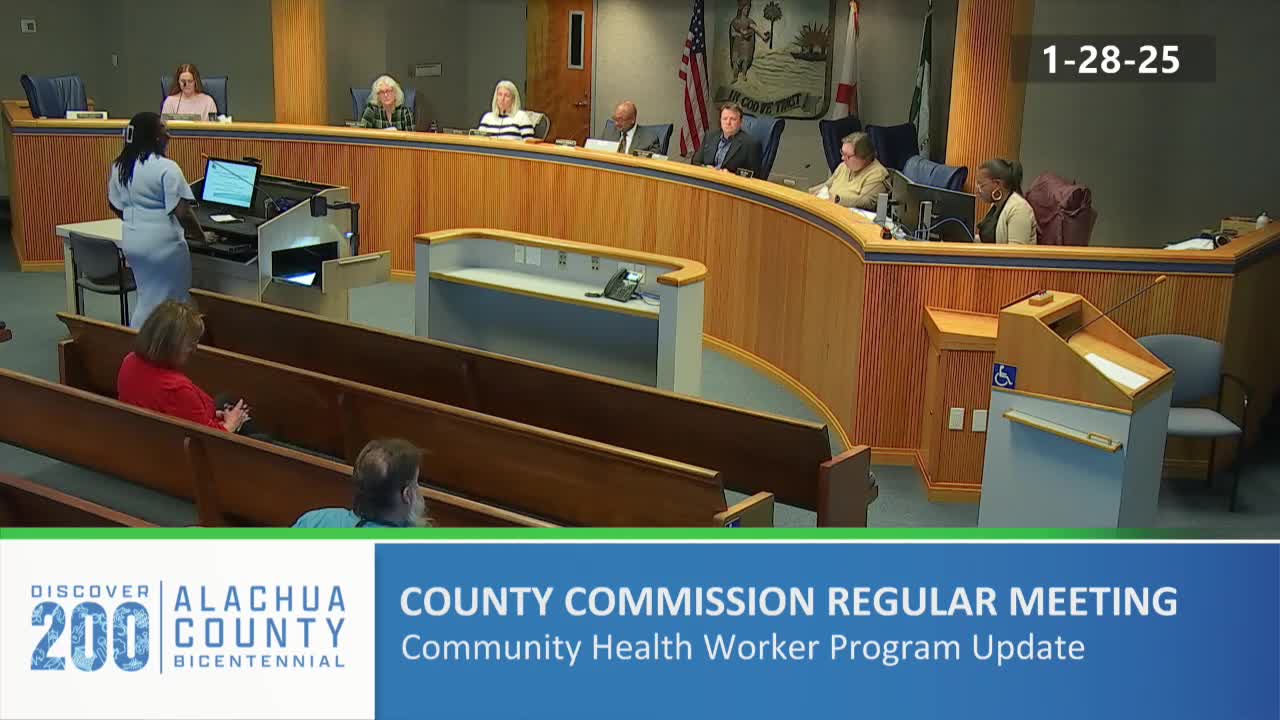
The Alachua County Board of County Commissioners voted unanimously on Jan. 28 to continue the Community Health Worker pilot through Sept. 30, 2025 and to direct staff to produce a plan to integrate geographically assigned CHWs with Fire Rescue’s Mobile Integrated Health unit for the FY2026 budget process.
The Alachua County Board of County Commissioners voted unanimously on Jan. 28 to continue the Community Health Worker (CHW) pilot through Sept. 30, 2025, and to direct staff to return during the budget cycle with a plan to integrate geographically assigned CHWs with Alachua County Fire Rescue’s Mobile Integrated Health (MIH) program.
The vote followed a presentation by Charice Britton, CHW program administrator, who outlined three options for sustaining the pilot: continuing CHWs under the Florida Department of Health in collaboration with County Community Support Services (Option 1); housing the program fully in Community Support Services (Option 2); or sunsetting the county CHW program while MIH absorbed two peer specialists and used MIH funds to train and pay peers (Option 3). Britton said Options 1 and 2 “align with federal recommendations” and that community interest exists for geographically assigned CHWs in smaller towns such as Hawthorne, Waldo and Newberry.
Commissioners and staff discussed strengths and limits of each option. Commissioner Prizia and others said they favored a hybrid approach: formally aligning program administration with Fire Rescue’s MIH while expanding county-funded, geographically assigned CHWs who could do proactive community outreach, attend events and coordinate with resource centers. MIH’s existing staffing is grant-funded and focused on substance-use response; commissioners asked staff to develop a budget and timeline for adding full CHW capacity that covers the county’s smaller municipalities.
Fire Rescue Chief Harold Theas confirmed the service model is feasible but said expansion would be a budget question. County Manager Andrew Lieberman told the board the recommendation from staff is to continue the current CHW structure through Sept. 30, 2025, to allow time for CHWs to complete certification and for staff to develop an integrated plan for the MIH-CHW model. The board’s motion instructed staff and Fire Rescue to return with recommended staffing levels, cost estimates, deployment options (including use of community resource centers), and performance metrics during the budget process.
The board also approved existing CHW contract renewals and related agreements on the consent agenda to maintain services through the funding period while staff develops the implementation plan.
The board’s direction aims to preserve the pilot’s case-management and referral services while building a countywide, place-based CHW presence coordinated with Fire Rescue’s MIH to improve follow‑up after emergent contacts and expand preventive community outreach.
Next steps: staff will (a) develop a combined MIH–CHW deployment and budget proposal for the FY2026 budget cycle, (b) produce a plan for geographically assigning CHWs to smaller municipalities and resource centers, (c) include measurable outcomes and data standards for consistent countywide reporting, and (d) return to the board with recommended staffing and funding options.
Ending — The board’s decision keeps the county program running through September and charges staff and Fire Rescue with producing a concrete staffing and budget plan for broader, geographically distributed CHW coverage to be considered in the 2026 budget process.