Get Full Government Meeting Transcripts, Videos, & Alerts Forever!
Get email alerts on the School Finance topic
No spam. Unsubscribe anytime.
Council hears bonding scenarios for school construction; financial adviser recommends two-issue approach to ease near-term tax pressure
Summary
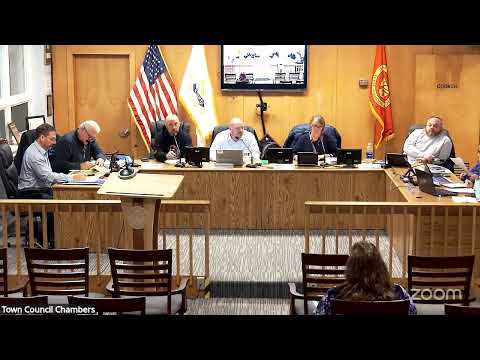
At its Jan. 21 meeting, the West Warwick Town Council heard a detailed presentation on financing options for a proposed school construction program, including scenarios for $55 million, $60 million and $65 million bond issues and potential reimbursements from the Rhode Island Department of Education.
At its Jan. 21 meeting, the West Warwick Town Council heard a detailed presentation on financing options for a proposed school construction program, including scenarios for $55 million, $60 million and $65 million bond issues and potential reimbursements from the Rhode Island Department of Education.
Matt Belace, financial adviser with Hilltop Securities, told the council the town could expect strong reimbursement from RIDE if the project is approved, and described tradeoffs between issuing a single bond and issuing two separate bonds. “One bond issue also has lower issuance costs,” Belace said. “The two bonds allow you to kind of layer in the debt service … so the budgetary impact is less upfront.”
The matter is tied to West Warwick’s Stage 2 submission to RIDE, due Feb. 15, and a joint meeting of the School Committee and Town Council on Feb. 12 was mentioned as the time when the council may act on the school committee’s recommendation. Belace said the council could seek authorization to bond for up to the total amount in RIDE’s Stage 2 approval without being required to issue the full amount immediately.
Why this matters: the size and timing of any bond issue affect town debt metrics, annual debt-service costs, and near-term tax pressure. Belace framed the question in the context of rating-agency and state debt-affordability considerations, noting West Warwick’s current general-obligation debt as a percentage of assessed value was low relative to common rating-agency thresholds but that pension and OPEB liabilities are a factor in overall stress metrics.
Belace outlined several specifics the council should consider: the choice between 20-year and 30-year amortizations (30 years lowers annual payments but increases total interest), the mechanics of RIDE reimbursement (reimbursement generally begins after substantial completion, creating a reimbursement “catch-up” year), and the potential benefits of market premium in municipal tax-exempt offerings, which can increase project proceeds without increasing the par amount issued. On timing, Belace used a tentative closing date of January 2026 for modeling purposes and said some pre-issuance costs can be reimbursed if a reimbursement resolution is adopted.
Councilors asked procedural and timing questions about putting a bond authorization to voters. A councilor asked whether the closing date required a ballot measure; town staff responded that a bond referendum would be treated as a Title 17 election and would trigger statutory election procedures, including early voting and related deadlines.
Belace urged a conservative approach to planning, saying the current reimbursement environment is “once in a lifetime” and that locking conservative assumptions would help avoid underestimating tax impacts. He also noted it is possible to request a larger authorization (for example, an $80 million authorization that would give the town flexibility) without issuing that full amount immediately.
Councilors were given an opportunity to ask questions and were directed to the School Building Committee’s ongoing community engagement schedule; the committee noted a fourth and final community engagement session would be held the evening after the meeting at the high school media center.
No formal council vote on bonding authorization or project scope occurred during the meeting; the presentation served to inform the council and public as the council and School Committee prepare for decisions tied to RIDE’s Stage 2 submission.
Belace’s presentation and the questions that followed focused on options and constraints rather than a single recommended par amount. He said issuing two bond issues can materially reduce the town’s near-term payment obligation in the fiscal year before reimbursements begin, while preserving the district’s eligibility for RIDE reimbursement on eligible project costs.
Looking ahead, the council and School Building Committee will continue community engagement and are scheduled to meet jointly on Feb. 12 to consider forwarding a Stage 2 submission and (if recommended) to place a bond authorization before voters at a later date.