Get Full Government Meeting Transcripts, Videos, & Alerts Forever!
Get email alerts on the City Budget topic
No spam. Unsubscribe anytime.
Lowell officials outline FY26 budget process, warn of rising fixed costs and infrastructure needs
Summary
City Manager Tom Golden and finance staff walked residents through Lowell's FY26 budget process at a public listening session, underscoring limits on local revenue, the full obligation of $76 million in ARPA funds, major capital priorities and federal/state funding uncertainties ahead of a May council presentation and a May 27 public hearing.
Lowell City Manager Tom Golden and finance staff briefed residents at a public budget listening session on the city’s FY26 planning process and fiscal constraints, emphasizing rising fixed costs, state aid uncertainty and major capital needs.
The presentation explained how the city develops a balanced budget at the department level before the city manager and finance staff forward a recommendation to the City Council; officials said they expect to present a first reading to the council on May 13 and hold the public hearing on May 27 at 7 p.m. in City Council Chambers. "We are in the very beginning stages of putting our budget together for FY26," said Austin Ball, deputy chief financial officer.
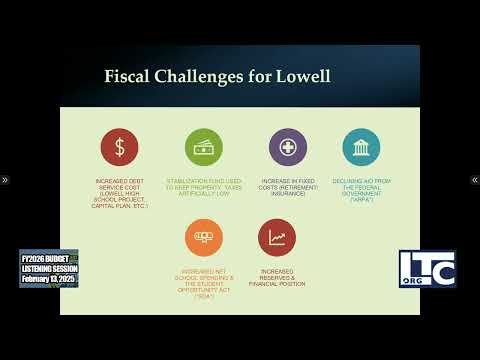
Why it matters: Lowell relies on a mix of property taxes, state aid and local receipts; officials said state funding formulas and federal grant programs materially affect the city's ability to deliver services. Finance staff warned that rising retirement and health-care obligations, charter-school assessments and debt service are shrinking discretionary budget space.
City finance staff described the main revenue and expenditure categories residents are likely to see. Deputy CFO Austin Ball said the general fund, which covers public safety, schools and other core services, is funded primarily by property taxes, state aid (including Chapter 70 education aid) and local receipts such as permits and fees. Connor Baldwin, the city’s chief financial officer, briefly summarized recent levy numbers: "The levy limit was $192,800,000. The tax levy was $178,800,000," leaving about $14,000,000 in excess levy capacity.
Officials noted that Lowell receives a larger share of its revenue from state aid than many smaller Massachusetts towns because of Chapter 70 and other state accounts. Baldwin and other speakers emphasized that the governor’s budget is only the first step; the House and Senate often change local-aid numbers, which can leave municipal budgets uncertain until the state process concludes. "The governor releases her budget…that gives us a preliminary look," said a city official explaining the state timeline.
ARPA, pilots and deadlines: Speakers said the city received about $76 million in American Rescue Plan Act (ARPA) funds and that the administration has obligated that amount. Officials described two federal deadlines: an obligation deadline of Dec. 31, 2024 (met) and an expenditure deadline of Dec. 31, 2026, by which payments must be made. "All of the checks have to be cut by 12/31/2026 for those obligations that were made," a finance official told the audience. Staff said ARPA has funded pilot programs such as a bookmobile and substance-abuse clinicians; those positions can be supported through ARPA timelines but will require alternate funding or discontinuation after federal deadlines.
Capital priorities and infrastructure: Officials listed parks, school facilities, roads and water/sewer work among top capital needs. The presentation said $8 million of ARPA will be used for a neighborhood park-improvement program; city staff said that over the next two years those projects will move from design to construction. On the high-school project, the presentation mentioned a remaining construction contingency of $10 million. A figure stated in the presentation for the total high-school project budget—"$38,381,900,000"—was not clarified in the meeting and appears anomalous given typical school project costs.
On water and sewer, staff reminded the audience that sewer and water are operated as enterprise funds paid by ratepayers rather than the tax levy. City officials said the council appropriated $175 million in FY25 toward combined-sewer-overflow (CSO) compliance under a federal consent decree; design and construction work in problem areas such as the Humphreys Brook area is underway. City staff also described a planned Douglas Road storage-tank project intended to hold stormwater during heavy rains and reduce backups.
Residents’ questions and service impacts: Attendees asked about staffing funded by ARPA, the senior-center bus driver, federal funding risks, and preservation of library and nonprofit grants. Councilor Mercier told the room, "The greatest ideas don't come from the city council. They come from people, the public," urging continued public input. Officials said some programs funded by one-time federal money will need evaluation for long-term funding; staff said they are exploring state and federal grant opportunities and the option of absorbing costs into the tax levy, but made no commitments.
What changed or what’s next: Finance staff urged departments to seek operating efficiencies; they said the city will continue community listening sessions and that more budget details will be available at the May council readings and the public hearing. The presentation included contact information for Austin Ball (aball@lowma.gov) and the city manager’s office phone number for residents with follow-up questions.
Ending — where to follow up: Officials encouraged residents to review the city’s ClearGov budget dashboard and the ARPA dashboard online for line-item details and to send ideas to finance staff ahead of the May readings.