Get Full Government Meeting Transcripts, Videos, & Alerts Forever!
Get email alerts on the Trail Access Easement topic
No spam. Unsubscribe anytime.
CPC review finds Stapleton stairway sits partly on private land; funding held pending legal clarity
Summary
A Horsley Witten survey presented to the Framingham Community Preservation Committee found portions of the Carol Getchell stairway and path fall on private lots and cemetery land. Committee members and conservation trustees urged the city solicitor work to secure recorded easements before design or construction funds are released.
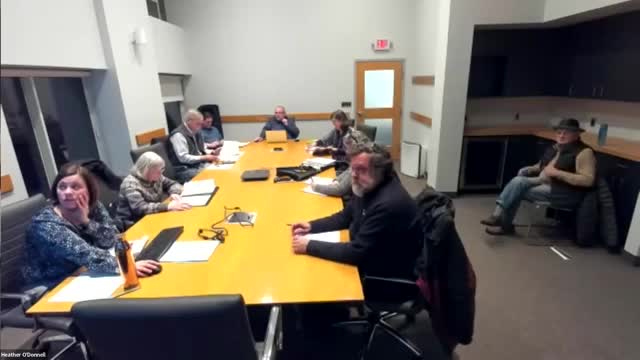
The Framingham City Community Preservation Committee on Jan. 13 heard that a professional survey of the Carol Getchell stairway shows parts of the walkway and timber stairs sit on two private abutting parcels and on land controlled by the Edwards Cemetery, complicating eligibility for Community Preservation Act funds.
Dan, a Horsley Witten representative, told the committee the firm had been hired to create a topographic and property-line survey. "We found that, where we believed there was an easement, there was not actually" a legally recorded easement, he said, adding that the walkway as located on the ground now "is on these 2 abutters' properties." He also noted the route crosses land near Edwards Congregational Church and the cemetery.
The finding matters because Community Preservation Committee (CPC) rules require that projects backed with CPC funds take place on land under appropriate municipal custody or documented easement. "You are the funding agency," a committee member said to the group, and under state and local practice project land must be under the "care, custody and control" of the appropriate municipal department or have a recorded easement before CPC money can be released for construction.
Conservation commissioners and the chair of the cemetery trustees stressed liability and safety concerns given the stairway's condition. A conservation representative said the commission is "very supportive of having the stairs" but was "surprised by Horsley Witten's findings that somehow the stairway was built on private property, seemingly without permission." The cemetery trustees offered to coordinate on a historic-style fence and on surveying burial plots close to the fence line to inform design.
Committee members and staff discussed options: move the current stairs onto land that would be covered by a properly recorded easement; ask the city solicitor to work with landowners (including the Edwards Congregational Church and the two private owners) to create or record easements; or limit CPC funding in the short term to design services for sections of the project that clearly fall on municipal-controlled land. Heather, the CPC coordinator, confirmed the funding request for the combined stairway and middle river-section design is $137,900 for site engineering, permitting and design services.
Committee members repeatedly emphasized they could not commit construction funds for work that would encroach on private property or land not under municipal control. As one member put it, if the project cannot show legal access within the committee's timeframe, "the funds just go back into the general fund of the CPC." Several members favored approving design funding for the middle section of the river path while making stair-design funds contingent on formal documentation of easement control.
Next steps included: staff engagement with the city solicitor to determine what legal filings or transfers (for example, an internal transfer of jurisdiction between departments or a recorded easement at the registry of deeds) are required; follow-up with Rebecca, the conservation administrator, and with the cemetery trustees; and keeping the design-phase request in committee hands subject to resolution of the right-of-way questions. Dan and CPC staff agreed to continue coordinating with the conservation administrator and the project manager, Brian Kucher, and to return with clarifying legal guidance and a finalized design-scope before CPC votes on any construction funding.
Ending: The committee did not vote to release construction funds during the Jan. 13 meeting. It directed staff to pursue legal confirmation of land control and easement recording and to return with clarified eligibility and a plan that would allow the CPC to fund design work without obligating money for construction on privately owned land.