Get Full Government Meeting Transcripts, Videos, & Alerts Forever!
Get email alerts on the Enforcement Monetary Settlement topic
No spam. Unsubscribe anytime.
FPPC approves $87,000 settlement in large campaign money‑laundering case
Summary
The Fair Political Practices Commission approved a stipulated administrative settlement totaling $87,000 in a multi‑count enforcement matter described by staff as one of the most complex money‑laundering investigations the agency has handled.
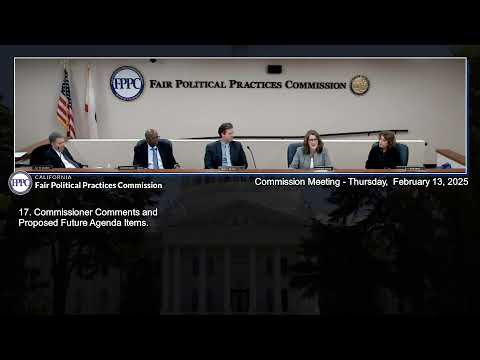
The Fair Political Practices Commission voted unanimously Feb. 13 to approve a stipulated settlement totaling $87,000 in an enforcement matter the agency described as complex and significant. Commissioners voted 5–0 to accept the agreement after staff described theft‑style and money‑laundering allegations and explained enforcement’s strategy in negotiating the settlement.
The case arose from alleged improper use of intermediary accounts and unreported advertising expenditures. Enforcement staff told the commission the investigation spanned multiple years and involved detailed forensic review of funds and advertising records. Chief Enforcement James Lindsey described the settlement as the largest administrative stipulation in recent FPPC history and said the figure reflected a negotiated, certain recovery compared with the uncertainty of full administrative or judicial proceedings.
Commissioners asked detailed questions about the stipulation’s language and the scope of charges not pursued. Commissioner Delia Baker asked whether statements in the stipulation were the respondents’ claims or findings of the FPPC; staff clarified that certain passages are recitations of the respondents’ account and not the commission’s factual findings. Commissioners also asked how the stipulated amount compared to maximum potential fines and whether the matter should be referred to local prosecutors. Lindsey said enforcement had pursued major counts (including money‑laundering counts and enhanced advertisement penalties) but that charging every conceivable count can be duplicative because of overlapping conduct. He said the negotiated settlement equated to roughly 85% of the agency’s assessed maximum for the charged counts and that enforcement had not, at that point, referred the matter to a district attorney for criminal prosecution.
Commissioners discussed the public‑interest tradeoffs in settling versus litigating. Some members noted the benefit of swift, certain recovery and the publicity effect of an administrative stipulation; others and public commenters urged referral for criminal review and asked whether the agency had fully explored the maximum penalty range. Staff said prosecuting to judgment would be resource‑intensive and uncertain, and that settlements yield immediate recoveries to the state.
The motion to approve the stipulation was made and seconded; the roll call vote was Baker: aye; Brandt: aye; Ortiz: yes; Wilson: aye; Chair Silver: aye. Motion passed.
The commission did not adopt any additional sanctions beyond the negotiated settlement during the meeting. Staff said probable‑cause and administrative hearing steps had occurred prior to settlement negotiations and described the pathway to an administrative hearing if the stipulation had not been approved. The commission also urged staff to consider whether criminal referral was appropriate and to document decision points for future public reference.