Get Full Government Meeting Transcripts, Videos, & Alerts Forever!
Get email alerts on the Police Oversight topic
No spam. Unsubscribe anytime.
Police oversight panel praises use-of-force reviews, readies March annual meeting; enters executive session
Summary
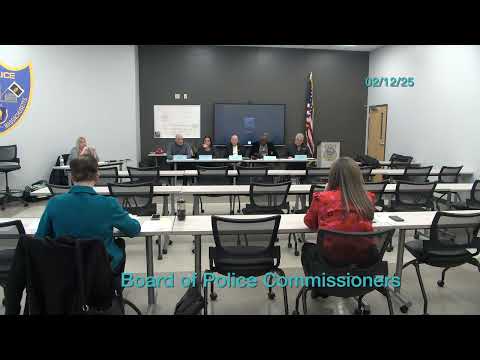
At a Feb. 12 meeting, the Springfield City Board of Police Commissioners received a report from its Use of Force Committee about monthly reviews of incidents and body-worn camera footage, discussed plans for the board’s March 12 annual public meeting, approved the minutes of Jan. 29, 2025 and voted to enter an executive session under state open‑meeting law to consider Special Order 25-001.
At a Feb. 12 meeting, the Springfield City Board of Police Commissioners received a report from its Use of Force Committee about monthly reviews of incidents and body‑worn camera footage, discussed plans for the board’s March 12 annual public meeting, approved the minutes of Jan. 29, 2025 and voted to enter an executive session under state open‑meeting law to consider Special Order 25-001.
A commissioner reported that "the use of force committee is using every means available to communicate clearly with the board," noting board access to videos and reports and a packet review form that allows commissioners to submit questions and comments for committee review. The commissioner said the committee includes members from training and squad operations and praised the committee’s thoroughness and willingness to evaluate whether officers’ actions were appropriate.
Why it matters: the committee’s monthly reviews and public annual meeting are part of the board’s oversight responsibilities and its reporting obligations under a settlement agreement with the U.S. Department of Justice, the article’s sources said. The panel’s handling of camera footage and case data informs public transparency and any future recommendations about training or discipline.
Details of the Use of Force Committee discussion The board heard that the committee meets monthly and reviews body‑worn camera footage alongside written reports from officers and training‑division materials. Deputy Superintendent Steve Kent (mentioned during the report) and training staff participate in the reviews, and the committee uses a “use of force committee packet review summary” to collect questions from board members.
Members discussed an upcoming technology change: the department expects to move to Axios body‑worn cameras in the spring (a speaker referred to implementation in April or May). A commissioner recommended that board members receive familiarity training on the revised body‑worn camera policy before the new system goes live so members can review combined video and report packages effectively.
Captain Murphy, asked whether complaints have changed since the camera program began, said, "I would say, the trend downward is more attributable to our body worn camera program." The captain also commented that excessive‑force complaints were "not existent" in recent reporting periods, according to the board exchange.
Annual meeting planning and logistics Board members discussed the March 12 annual public meeting format and materials. The meeting will be held at the Raymond E. Jordan Center and is open to the public; speakers suggested preparing a one‑page summary of improvements, a brief explanation of the complaint process, training summaries, and highlights of what the board has done to increase access to footage and reports.
Board members agreed on some logistical points: asking attendees to sign in (optional), enforcing time limits for public speakers (the commission’s regular 2‑minute limit was noted), and arranging for two officers to be present that night for security. There was discussion of whether refreshments would be provided (no consensus; the board indicated none had been planned) and whether to acknowledge visiting dignitaries when appropriate.
Board training and scheduling Lieutenant Barberi of the training division asked to reschedule the March training session because she is unavailable on the previously planned date. Two alternative dates were discussed: March 11 and March 25. Members favored March 25 at the 50 East Street facility and discussed a 4:30 p.m. start time for training; final confirmation was left to staff.
Votes at a glance - Approval of minutes for Jan. 29, 2025: Roll call votes recorded in the transcript include Commissioner Fernandez — yes; Commissioner Davenport — yes; Commissioner Brady — yes; Commissioner Walden — yes; Commissioner Jagdinis — yes. Outcome: approved. (Mover/second not specified in transcript.)
- Motion to enter executive session pursuant to Mass. Gen. Laws ch. 30A §21(a)(1) to discuss whether to hold a future hearing involving discipline, dismissal or complaints related to Special Order 25-001: the motion carried on roll call. Recorded votes in the transcript include Commissioner Fanning — yes; Commissioner Jackson — yes; Commissioner Burty — yes; Commissioner Oldham — yes; Commissioner Chennizi — yes. The board noted it would not reconvene in open session after executive session unless the employee requests an open session. Outcome: approved; no further public action taken at the meeting.
Discussion vs. formal action Most of the meeting’s substantive items were discussion and planning: updates from the Use of Force Committee, the upcoming annual meeting format, training scheduling and operational details about body‑worn camera handling. Formal recorded actions were limited to approval of minutes and the motion to enter executive session; where roll call votes were recorded in the transcript, they are listed above.
What’s next The board will hold its annual public meeting on March 12 at the Raymond E. Jordan Center; training rescheduling will be finalized by staff around the suggested March 25 date at 50 East Street. The board entered executive session at the end of the public meeting to consider personnel discipline matters under state law and, according to the motion recorded on the public transcript, will not return to open session unless the affected employee requests it.