Get Full Government Meeting Transcripts, Videos, & Alerts Forever!
Get email alerts on the District Improvement Financing topic
No spam. Unsubscribe anytime.
Springfield staff reintroduce District Improvement Financing as option for financing downtown infrastructure
Summary
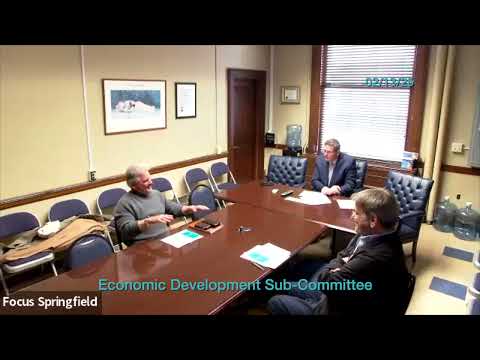
Economic development staff briefed the Springfield City Economic Development Subcommittee on District Improvement Financing, a Massachusetts program that would capture new tax growth inside a defined district to finance infrastructure.
Economic development staff briefed the Springfield City Economic Development Subcommittee on District Improvement Financing, a Massachusetts financing tool officials said could be used to capture tax revenue from new development within a defined district and direct it toward infrastructure investments.
Brian Connors of the economic development department told the subcommittee, “This is a program that’s existed in Massachusetts for quite some time. We just haven’t used it in Springfield in quite some time.” Staff said the DIF differs from the city’s Tax Increment Financing (TIF) approach because DIF captures the increment from new growth across multiple properties inside a district and can be used to finance public infrastructure or to support private development through a district-level financing structure.
Staff described key program parameters discussed during the meeting: districts may cover up to 25% of a community’s geography and financing terms can extend up to 30 years. Officials said the program only captures new tax revenue generated by a development project or new real estate value — it does not capture ordinary annual tax increases. The subcommittee was told that each DIF deployment requires legislative approval and that the assessor’s office and finance department would be closely involved in any district proposal.
As an example of prior use, staff cited the roadway built to serve the Smith & Wesson Industrial Park, financed using a DIF structure tied to new revenue from Performance Food Group. Staff also mentioned that a DIF could be structured to support projects in South Main, including the McCaffrey’s development, by capturing new growth inside a district and bonding infrastructure so the debt is repaid from captured revenues rather than through the city’s general-obligation borrowing.
Committee members asked about public opposition and the potential for displacement; staff said public engagement is part of the DIF process and acknowledged concerns such as gentrification would need to be addressed through outreach and project design. Staff estimated it could take several months to assemble the background work needed for a district and that the city might be able to use a DIF for projects within the next year if work proceeds.
No formal action or vote occurred at the meeting. Staff said they would return to the committee with draft materials once they have a concrete proposal and asked to circulate the meeting slideshow to councilors for review.