Get Full Government Meeting Transcripts, Videos, & Alerts Forever!
Get email alerts on the School Nutrition Milk topic
No spam. Unsubscribe anytime.
Committee backs bill to let schools offer whole milk under National School Lunch Program
Summary
The committee approved HR 649, the Whole Milk for Healthy Kids Act, to allow schools participating in the National School Lunch Program to serve whole milk; proponents cited recent studies and student acceptance, while public‑health groups and Democrats warned it contradicts Dietary Guidelines and could increase saturated fat intake.
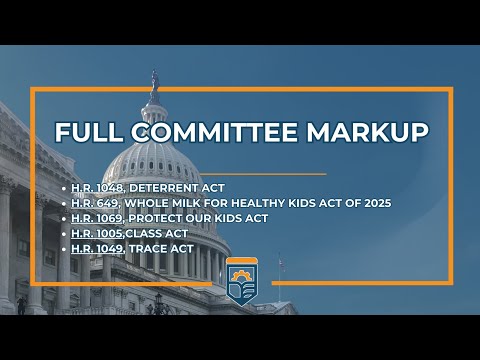
The House Committee on Education and Labor voted to report HR 649, the Whole Milk for Healthy Kids Act, which would change the Richard B. Russell National School Lunch Act to permit schools participating in the National School Lunch Program to offer whole milk.
Representative Thompson, sponsor of the amendment in the nature of a substitute, told the committee the bill "allows schools the flexibility to serve milk options that fit their students' needs" and argued that some recent studies show full‑fat dairy is not associated with increased obesity or cardiometabolic risk. He noted milk consumption in schools fell after the 2012 rules limiting milk-fat options and said making whole milk available could increase students' intake of key nutrients.
Opponents, including Representative Suzanne Bonamici and Representative Bobby Scott, urged reliance on the Dietary Guidelines for Americans and guidance from medical bodies. "Low‑fat and fat‑free milk, which are currently served during school meals, offer these nutrients without the added saturated fat," Bonamici said, citing recommendations from the American Heart Association, the American Academy of Pediatrics and the Academy of Nutrition and Dietetics that children age 2 or older consume low‑fat or fat‑free milk.
Supporters said the measure does not force schools or students to choose whole milk and includes options such as lactose‑free milk and allows parents and schools to decide. Representative Thompson also offered studies and letters of support from dairy and farming organizations into the record.
The committee adopted the amendment in the nature of a substitute by voice vote and later voted to report the bill to the House; the reported tally was 24 yeas and 10 nays. Opponents signaled concern about the bill's alignment with federal nutrition standards and warned the legislation could undermine science‑based processes that set school meal requirements.
Votes at a glance HR 649, Whole Milk for Healthy Kids Act — Committee reported to the House as amended. Final tally on reporting: 24 yeas, 10 nays.
Next steps: If passed by the House and enacted, the Department of Agriculture and the Department of Education would need to reconcile program rules with the changes to allowable milk options in school meal programs.