Get Full Government Meeting Transcripts, Videos, & Alerts Forever!
Get email alerts on the Central Wheeler Tank topic
No spam. Unsubscribe anytime.
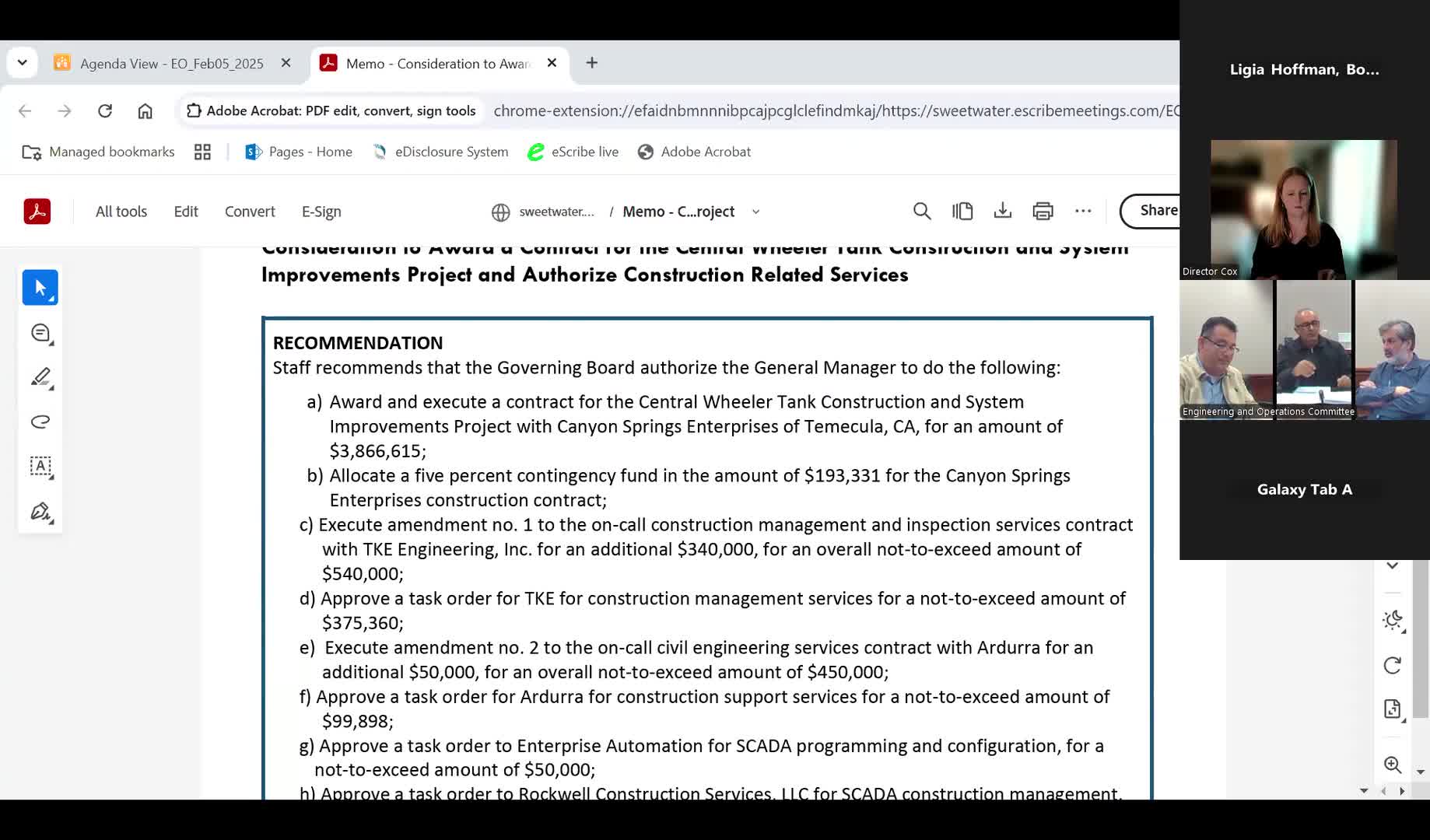
Committee recommends board award contract for Central Wheeler tank and system improvements
Summary
The committee recommended the board award a construction contract and related services for the Central Wheeler tank project, including pipelines and pressure-management work intended to raise service pressure for 87 parcels; bids came in below estimate and the project stays within the adopted budget.
The Sweetwater Authority Engineering and Operations Committee on Feb. 5 recommended that the full board award the contract for the Central Wheeler tank construction and associated system improvements and authorize related construction services.
Staff presented a multi-phase project that has appeared in the authority’s planning documents for more than two decades. The 2020 Water Distribution System Master Plan and earlier planning efforts identified a deficiency in the Wheeler pressure zone. The project scope includes construction of a new roughly 800,000-gallon tank on Sweetwater Reservoir property, connection pipelines, residual-control (mixing) systems to address water quality at the tail end of the distribution system, and conversion of about 87 parcels from the gravity zone to the Wheeler pressure zone.
The design engineer’s construction cost estimate was $3,967,000. Bids were opened in January; staff said four bids were received and the apparent low bidder, King Springs Enterprises (listed in staff materials as the lowest bidder), submitted a price approximately $100,000 below the engineer’s estimate. Staff reported the lowest bid met bid requirements; one other bid was deemed unresponsive due to missing documentation. The project delivery schedule in the recommended contract requires completion within 486 calendar days after notice to proceed.
The committee also considered construction management, inspection and technical support, SCADA configuration, and work under previously awarded on-call contracts for construction oversight and environmental compliance. Staff recommended contract amendments to increase the limits on several on-call agreements to allow those firms to perform anticipated construction support tasks.
Staff summarized fiscal implications: the total allocated budget for the project is $6,400,000, with expenses to date and encumbrances leaving an available balance of about $5,600,000; after accounting for the construction contract, contingency and related services staff projected a surplus on the order of $500,000. Committee members asked about customer communications and timing; staff said the authority will notify nearby customers (English/Spanish door hangers and signage) and that pressure-reducing valves (PRVs) required at customer laterals will be installed and paid for by the authority.
A public commenter, Tonda Johnson of Bonita, urged inclusion of PRV installation in the project scope and said several neighbors would contact the authority about low pressure; staff confirmed the authority expects to cover PRV costs and to use on‑call contractors or a public bid depending on final delivery approach. The committee voted to forward the recommendation to the board; Directors Castaneda, Cox and Martinez voted in favor.