Get Full Government Meeting Transcripts, Videos, & Alerts Forever!
Get email alerts on the Climate Emissions Inventory topic
No spam. Unsubscribe anytime.
Penn State team reports near-complete 2023 greenhouse‑gas inventory for Harrisburg; utility data delay slows release
Summary
Penn State researchers updating Harrisburg’s greenhouse‑gas inventory told City Council the 2023 inventory is nearly finished but cannot be released until electricity data from PPL is disaggregated and reconciled with earlier inventories.
Penn State researchers updating Harrisburg’s greenhouse‑gas inventory told City Council on an unspecified evening in January that the 2023 inventory is nearly complete but delayed while they resolve utility data problems with PPL.
"We don't want to give you an inflated number," said Brandy, a co‑leader of Penn State's Local Climate Action Program (LCAP). She told council that the utility supplied electricity consumption by ZIP code rather than by municipal boundary, and that those ZIP codes cross the city line, which “drastically” overestimates Harrisburg’s electricity responsibility unless downscaling is done.
The inventory effort is part of Penn State’s participation in the Pennsylvania Department of Environmental Protection (DEP) Local Climate Action Program. Peter Buck, co‑director of the Penn State program, and Brandy said the program pairs university students with municipalities and gives participating cities access to ICLEI software for greenhouse‑gas accounting and forecasting. DEP covers the ICLEI membership and ICLEI provides technical assistance to students using the software.
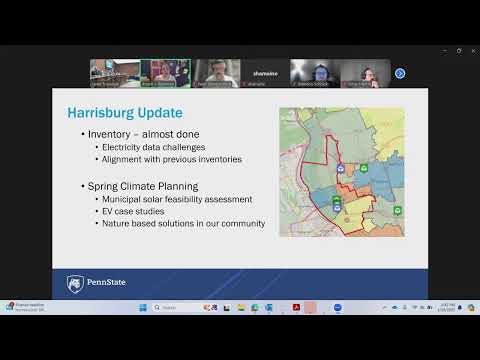
The team said students completed most data collection and analysis in fall 2024 but hit a snag when PPL delivered electricity data aggregated across adjacent ZIP codes. Brandy said the project team is working with PPL to get disaggregated data by ZIP code so the team can estimate what share of each ZIP code’s consumption falls inside Harrisburg’s boundaries; she called that approach “an imperfect and incomplete estimate, but it is much better than what we have now.”
Penn State also flagged the need to align the new inventory’s electricity methodology with two prior inventories — one conducted with Johns Hopkins and an earlier inventory by Chris Nave — so year‑to‑year comparisons reflect consistent methods. The team said they will document methodological differences and, if needed, adjust prior year data in ClearPath (the ICLEI tool) so Council can track emissions trends accurately.
On next steps, the LCAP team said they will deliver a final climate‑planning report in April and asked for city input on priorities for the spring semester, naming three possible focus areas: rooftop solar feasibility for municipal buildings, municipal fleet electric‑vehicle (EV) case studies, and opportunities for nature‑based solutions such as tree planting and community gardens.
Madeleine, one of the Penn State team members, said the project will include a community climate opinion survey to capture residents’ priorities and basic demographics. Brandy and Peter told council they welcome in‑person and paper survey options and offered to work with local partners — for example Heart of the Hill and Tri‑County Community Action — to reach residents who may not respond online. "Face to face ends up really mattering," Peter said.
Council members probed for environmental‑justice coverage and local air pollution data. Brandy said the inventory focuses on greenhouse gases (carbon dioxide, methane, nitrous oxide and some refrigerants) and does not catalog particulate matter or other toxic air pollutants. She added that students use the EPA’s EJSCREEN to examine cumulative health risks at the census‑tract level and that DEP’s PenEnviroScreen could serve a similar purpose if federal tools change.
Council members and staff offered to help connect the team with local stakeholders and to assist with survey distribution. The Penn State team asked to return in April to present the final inventory and climate‑planning recommendations.
The presentation included student participants Hope Glaze, Brandon Schreck and Ethan Merrill. Penn State and DEP staff said the final inventory and report will include QA/QC documentation and a clear methodological appendix so the city can compare annual results with confidence.
The city and Penn State team agreed to continue working on the PPL data issue; the inventory will not be released publicly until the team receives disaggregated electricity consumption and completes the QA/QC review.