Get Full Government Meeting Transcripts, Videos, & Alerts Forever!
Get email alerts on the Billboard Signage topic
No spam. Unsubscribe anytime.
Zoning board approves Lamar plan to convert Paxton Street billboard to LED with conditions
Summary
The Harrisburg Zoning Hearing Board granted Lamar Advertising permission to relocate and convert a Paxton Street billboard to a digital LED face, subject to PennDOT approval, a six-transitions-per-minute limit, and confirmation the structure is outside the 100-year floodplain.
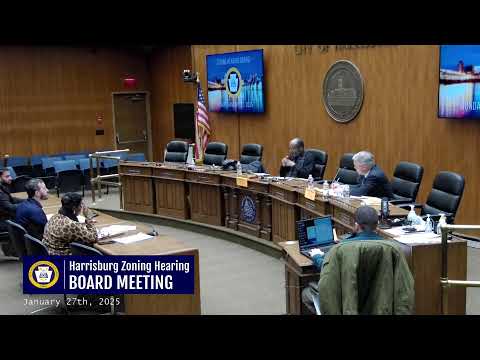
HARRISBURG — The Harrisburg Zoning Hearing Board on Jan. 20 approved application 2595 allowing Lamar Advertising to relocate and convert one face of an existing double‑faced billboard at 833 Paxton Street to an LED, electronically changing display, subject to conditions recommended by the City Planning Commission.
The board’s decision responds to a PennDOT highway‑widening project that will remove multiple static billboard faces along Interstate 83; the planning bureau said the requested relief aims to consolidate signage faces lost to the roadwork.
Jeffrey Knight, director of planning for the City of Harrisburg, described the proposal to replace an existing double‑sided static billboard and to reconfigure the structure into two separate sign bases with about a 25‑foot gap. Knight said the zoning code treats gaps up to five feet as a single two‑sided billboard, so the proposed separation requires relief. He told the board the applicant also seeks relief from prohibitions on internally illuminated and electronically changing messages.
Andy Reebuck, general manager of Lamar Advertising, said the PennDOT project will reduce the company’s faces along the corridor and that consolidation into digital faces is a way to maintain business viability. “The PennDOT project is a kick in the rear end,” Reebuck said, describing the loss of existing faces and the company’s need to modernize its inventory.
The Planning Commission recommended approval with three conditions: that the applicant obtain any required approvals from the Pennsylvania Department of Transportation after the zoning decision, that message transitions be limited to six transitions per minute (matching a prior board approval), and that the relocation footprint be outside the Federal Emergency Management Agency AE 100‑year floodplain where feasible. Knight said the current sign footprint is in the 100‑year floodplain and that the proposed location appears to be close to the floodplain boundary; the commission recommended the applicant negotiate a slightly more southern location if necessary to ensure the sign base is outside the AE floodplain.
Board Chair Claude Phipps, acting as the sole hearing member for the case, said he would approve the application with the planning commission’s conditions and that a written decision would follow.
The planning bureau’s case report noted the relief is intended in part to offset the loss of “18 structures with 30 signage faces” along the Interstate 83 corridor due to the highway‑widening project. Knight and the Planning Commission characterized the site as industrial and auto‑oriented and said the relocation would not be detrimental to the neighborhood’s general character.
The board’s written decision will document the conditions and any additional requirements; the applicant must secure PennDOT approval and is expected to receive a written ruling from the Zoning Hearing Board in the coming weeks.