Get Full Government Meeting Transcripts, Videos, & Alerts Forever!
Get email alerts on the Permitting Reform topic
No spam. Unsubscribe anytime.
Lawmakers, business and labor back bill to speed Minnesota environmental permits
Summary
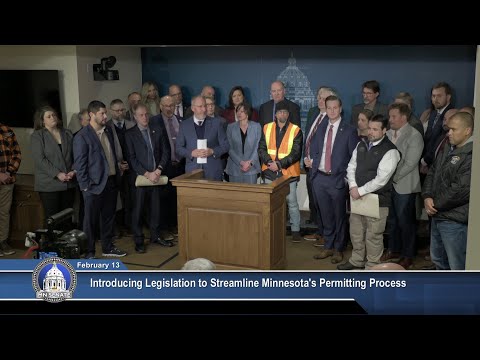
Legislators, the Minnesota Chamber and the state building trades described House File 8 as a bipartisan effort to create a permitting ombudsman, shorten review times and increase predictability for projects without lowering environmental or labor standards.
State lawmakers, business leaders and building trades representatives urged swift action on House File 8, a bipartisan bill they say would create a permitting ombudsman and shorten review times for environmental and industrial permits without lowering labor or environmental standards.
Supporters said Minnesota’s permitting process has become a competitive disadvantage and cited a Chamber-funded analysis that found Minnesota’s average air-permit review times at 656 days — well above the agency’s 150-day goal — and that from 2018 to 2023 Minnesota-based companies completed 355 projects outside the state, resulting in an estimated $17.5 billion in capital expenditures and 31,000 lost jobs.
“The most important thing that we're doing with this bill is trying to create a more efficient process for our agencies to work with applicants through the process,” said Sen. Grant Hochschild, who described the measure as a top priority for his district and part of a bipartisan group of authors. “So we're creating an ombudsman who can work with small and mid sized businesses to work through the process.”
Rep. Josh Heintzeman, chair of the House Environment Committee, said the bill — House File 8 — would be heard in his committee later in the day. “This bill, House File 8, will be heard in my committee today later at 1,” Heintzeman said, noting he planned to track the bill through the committee process.
Sen. Justin Eichorn, another Senate sponsor, framed the bill as part of a broader effort to improve Minnesota’s competitiveness amid a projected $5 billion state budget deficit. Eichorn pointed to past instances when manufacturers relocated projects out of state and urged legislative leaders to ensure the bill receives full vetting and hearings so it can move to the floor and, ultimately, the governor.
Doug Lewin, president and CEO of the Minnesota Chamber of Commerce, summarized the Chamber Foundation’s five-year analysis comparing Minnesota with peer states and stressed the reported differences in review times. “Minnesota's air permitting review times are 1.5 to 6 times slower than our peer states,” Lewin said. “The average time for a PCA to review and issue an air permit for new construction or capital investments averages 656 days, well over the 150 day goal set by the agency.” He added that the governor’s proposal includes additional full-time employees to help agencies process permits.
Tom Bicklitsch, executive director of the Minnesota State Building and Construction Trades Council, said labor supports the bill while insisting it does not weaken protections. “The last thing we want to do is advocate for weakening of these important standards,” Bicklitsch said. He added that labor, business and other stakeholders back changes intended to make permitting “more efficient, predictable, and transparent.”
Speakers emphasized that the bill does not change environmental or labor standards and described a mix of legislative changes and agency actions that supporters say could shorten delays — including clearer permit completeness processes, separate handling of industrial and municipal permits, and both statutory changes and internal agency improvements. Supporters also said some recommendations could be implemented administratively while others would require legislative action.
No formal votes or final actions on the bill were taken at the briefing. Heintzeman said the bill would face multiple committee stops before possible floor consideration and, if passed, the governor’s signature.
The discussion combined policy arguments, data points from the Chamber’s report and assurances from labor and business that standards would be preserved while improving process clarity and staffing to meet agency goals.