Get Full Government Meeting Transcripts, Videos, & Alerts Forever!
Get email alerts on the Mobile Sports Wagering topic
No spam. Unsubscribe anytime.
Senate committee deadlocks on bill to legalize mobile sports wagering in Minnesota
Summary
A Minnesota Senate committee heard hours of testimony for and against Senate File 757, which would legalize mobile sports wagering with tribal exclusivity and dedicated revenue streams, but a 6–6 committee vote failed to advance the bill to the next committee.
Senate File 757, a bill to legalize mobile sports wagering in Minnesota, drew hours of testimony Thursday, Feb. 13, 2025, before the Senate Committee on State and Local Government and failed to advance after a 6–6 committee tie.
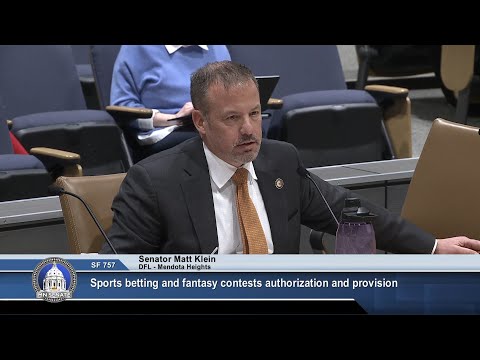
Senator Klein, the bill’s author, told the committee the bill would legalize mobile sports wagering while preserving tribal exclusivity over licenses and dedicating portions of tax revenue to racetracks, tribal aid and problem gambling treatment. “This bill, for the first time, enjoys the support of the previous combatants in this area. The 11 sovereign tribal nations, Canterbury Park, the allied charities, and the Minnesota professional sports teams,” Klein said during his introduction.
The proposal would permit statewide mobile wagering under a framework that the author said included consumer protections such as prohibitions on pop-up advertising and advertising at schools, a ban on college proposition bets, mandatory default daily wagering limits (which users could later change), and a requirement for the commissioner to develop methods to identify individuals at highest risk for problem gambling. Klein said the bill sets a taxation rate described in testimony as a 22% rate and directs revenue allocations including 15% to racetrack purses, 15% to a tribal equalization account, and an annual allocation identified in testimony of $6,800,000 to the Department of Human Services for problem-gambling awareness and treatment.
Supporters told the committee the bill is the product of negotiations among competing interests. Andy Plato, executive director of the Minnesota Indian Gaming Association, said MYGA and participating tribes back the bill because it recognizes tribal sovereignty and makes tribes exclusive license holders. “This trust is well placed as tribal gaming in Minnesota for over 30 years has been the most heavily regulated in the state,” Plato said.
Randy Sampson, chairman and CEO of Canterbury Park, and representatives of racing and horsemen’s groups said dedicated racing revenue would shore up purses and help keep the horse industry competitive. Rachel Jenner, executive director of Allied Charities of Minnesota, and Dr. Christy Janigo of the American Legion described the bill’s tax relief and proposed revenue transfers as necessary support for charitable, veterans and youth programs; Jenner said charitable groups have seen roughly a 20% revenue decline tied to prior changes in electronic pull-tab rules.
Opponents warned of public-health harms tied to making wagering available on phones. Bishop Michael Eisen, speaking for the Minnesota Catholic Conference, called mobile sports wagering “incredibly harmful” and cited research and hotline data from other states showing increases in problem gambling, domestic violence and financial distress after legalization. Father Peter Edsel and Jack Meeks of Citizens Against Gambling Expansion recounted personal and organizational experience with gambling-related financial harm and urged committee members to reject legalization.
Committee members probed numerous provisions. Senators asked about the bill’s integrity monitoring language, the role and selection of an independent integrity-monitoring provider, protections against account takeovers and match-fixing, default limits and how cross-platform self-exclusion would operate. Senator McQuaid asked whether a user who changes a self-imposed limit could immediately switch platforms to continue wagering; a committee exchange and bill language cited a 72-hour delay on limit changes and a commissioner notification mechanism intended to prevent circumvention when limits are exceeded.
Several senators expressed concern about targeted incentives and VIP “concierge” programs. Klein said the A13 author’s amendment adopted at the start of the hearing added a prohibition on individualized incentives unless the customer opts into them, and he acknowledged the language is a placeholder requiring strengthening.
The committee took a roll-call motion to move SF 757 to the Judiciary Committee. Staff recorded six ayes and six noes; with no majority in favor, the motion did not carry and the bill stalled in committee. The transcript records the committee tally as 6 ayes and 6 noes; the committee clerk announced “not a sufficient number of votes to pass the committee, the bill stalls out here.”
Supporters said regulated mobile wagering would recapture activity from offshore operators that currently allow underage play and provide no treatment funding; opponents said legalization risks expanding addiction by making betting continuously available on phones and by permitting in-game proposition wagering. Several lawmakers asked for a fiscal note before further consideration; Senator Klein said no fiscal estimate for the current bill was yet available.
The committee’s debate reflected competing priorities in Minnesota: tribal sovereignty and revenue-sharing; charitable and racing-sector financial pressures; consumer-protection and public-health concerns; and questions about whether regulation displaces illicit offshore wagering. The hearing record shows broad stakeholder engagement—including tribal leaders, racing industry representatives, veterans’ organizations, charities, faith leaders, problem-gambling advocates and industry representatives—and several senators asked for further drafting and stronger guardrails before any bill advances.
Votes at a glance: The committee voted on a motion to refer Senate File 757 to Judiciary; the motion failed on a 6–6 tie and the bill did not advance from the Committee on State and Local Government on Feb. 13, 2025.
Outlook: Senator Klein said he intends to pursue further committee stops (judiciary, health and human services, commerce, taxes and finance) if the bill is revived, and several senators said they would support moving an amended bill forward to other committees for further vetting but wanted stronger language on targeted incentives, integrity monitoring, data protections and fiscal impacts.