Get Full Government Meeting Transcripts, Videos, & Alerts Forever!
Get email alerts on the Cannabis Market Launch topic
No spam. Unsubscribe anytime.
Office of Cannabis Management outlines licensing timeline, testing variance and grants approach ahead of market launch
Summary
Interim director Eric Taubel told the committee the Office of Cannabis Management will open license applications, pursue a variance to shorten lab onboarding, run a CAN Renew grant program with close controls, and move toward market launch in spring–summer 2025 while continuing rulemaking and compact negotiations with tribes.
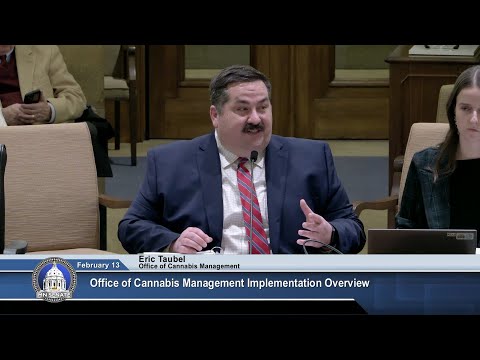
Eric Taubel, interim director of the Office of Cannabis Management (OCM), briefed the Senate committee on OCM’s budget proposals, implementation milestones and plans for market launch and enforcement.
Taubel described four narrow budget proposals: a modest operating adjustment for agency operations; a budget‑neutral request tied to administration of the CAN Renew community reinvestment grant; a testing‑facility licensing variance to allow non‑ISO‑17025‑certified labs to operate under supervision while they obtain full ISO accreditation; and a small rule change to social equity criteria to count certain adjudications or juvenile records in social equity determinations.
On lab testing, Taubel said ISO 17025 certification can take 12–24 months from start to finish, creating a potential two‑year barrier for new testing labs. The office proposes a variance that would permit testing facilities to apply while under contract with an ISO‑certified partner, provided the applicant demonstrates progress toward certification and follows national testing standards. “If we don't have enough testing capacity, we'll start to see product backlogs,” Taubel said, warning backlogs could delay product availability or push product toward illicit channels.
Taubel described OCM’s operational milestones: the office has grown from about nine staff last year to over 90 full‑time employees today; it acquired permanent office space and developed outreach materials including a local‑government guidebook; it opened a public comment period for initial rules (public comment closed the prior day); it posted a request for proposals for the CAN Renew grant; and it plans to open license applications on Tuesday, Feb. 18 with application windows closing in March and capped‑license lotteries expected in May or June. OCM has moved applicants from a prior preapproval lottery into the full licensing round and offered refunds to applicants who withdrew.
Taubel said the office adopts an “education to compliance” enforcement approach in the hemp‑derived cannabinoid program and reported compliance rose from roughly 35% in early 2024 to about 87% in December 2024 following outreach and inspections. For medical cannabis, OCM reported more than 51,000 registrants and a chronic‑pain research report showing about one‑third of patients reported decreased pain in the first year of medical cannabis use.
On compacting with tribes, Taubel said nation‑to‑nation negotiations fall to the governor’s office and any signed compacts will be published to a public website as required by statute, but OCM will assist with implementation for agencies charged by any compact.
Committee questions covered staffing levels, the length and cost of consultant contracts, revenue collections to date, litigation tied to the preapproval lottery and the reasons OCM shifted from preapproval to a full licensing round. Taubel and his staff said records on tax revenue and consultant contract dates will be provided to the committee. He said the office decided to pivot from the preapproval lottery to general licensing after litigation and because preapproval conveyed timing advantages but not licenses; OCM concluded the broader licensing round was a clearer, fairer path to licensure for all applicants.
Why it matters: OCM’s schedule and rule decisions determine when licensed cannabis businesses can begin operations, which affects applicants, local governments, tribal governments, testing labs and public health oversight. The testing variance and licensing schedule are intended to reduce bottlenecks that could delay legal products reaching the market.