Get Full Government Meeting Transcripts, Videos, & Alerts Forever!
Get email alerts on the Data Practices Ag topic
No spam. Unsubscribe anytime.
House committee advances bill to limit attorney general data secrecy, citing Supreme Court decision
Summary
The Minnesota House Judiciary Committee advanced House File 20, a bill that would amend section 13.65 of the Minnesota Government Data Practices Act to clarify that “data on individuals” covers natural persons, not records about organizations or policy matters.
The Minnesota House Judiciary Committee advanced House File 20, a bill that would amend section 13.65 of the Minnesota Government Data Practices Act to clarify that “data on individuals” means data about natural persons rather than records about organizations or non‑individual policy matters.
Supporters told the committee the change corrects what they called an incorrect interpretation by the Minnesota Supreme Court in Energy Policy Advocates v. Ellison and would restore decades of practice that treated data on institutions and policy differently from data about people. Opponents, including the Office of the Attorney General, warned the change could expose complainants and small businesses to disclosure and urged a more nuanced fix.
Representative Niska, the bill’s author, told the committee the proposal is “a very, very small change” that “just adds 2 words to section 13.65,” and that the change would accomplish three goals: reverse the court’s interpretation, restore balance between transparency and individual privacy, and increase public visibility into who influences the attorney general’s office. He argued the Energy Policy Advocates decision “distorted the meaning of the Data Practices Act” and allowed non‑individual policy material to be shielded from public view.
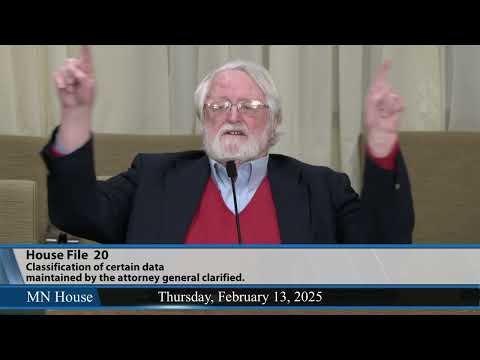
Don Gimberling, who said he helped write the Minnesota Data Practices Act and represented Minnesotans for Open Government, gave historical context. Gimberling described how the classification system in the 1970s and 1980s intentionally treated data on individuals (natural persons) differently from data not on individuals and said the Supreme Court’s recent majority interpretation departed from that system. “Part of the process was to encourage people to go to the Department of Administration,” he said, recounting how the statute and emergency classification process developed.
James Dickey, the attorney who represented Energy Policy Advocates in the Supreme Court case, described the litigation’s facts and consequences. He said Energy Policy Advocates sued after being denied documents related to the attorney general’s placement of New York University fellows as special assistant attorneys general and that the court’s decision “changed the traditional interpretation of the DPA,” leaving important policy and investigative records inaccessible when they do not identify a natural‑person subject.
Rich Neumeister, an open‑government advocate, gave examples of records that historically were available and that he said now may be withheld under the court’s interpretation — including inactive investigative memoranda and communications related to policy and task forces. “This data which used to be public for 40 years is now secret,” he said, quoting portions of Justice Thiessen’s dissent.
Oliver Larson, an assistant attorney general who litigated Energy Policy Advocates v. Ellison for the Office of the Attorney General, told the committee the AG’s office handles a broad array of data practice requests and that some protections exist to encourage constituents and small businesses to come forward. Larson warned that parsing whether records are about an individual or an entity can be difficult in practice and that the bill, by flipping the statutory test in subdivision 1, could remove protections for complaining individuals or small business owners who submit information under an entity name.
Committee members pressed both sides on the policy and practical implications. Representative Feist asked whether an ordinary consumer complaint (for example, a complaint about AT&T) would remain private; sponsors and witnesses answered that data identifying a natural person would remain protected but said the bill aims to make records that do not implicate a natural person available. Members also debated whether the committee should request a fiscal note to study resource implications for the AG’s office; the sponsor said he had not requested one and did not plan to.
The committee considered a motion from Representative Liebling to re‑refer House File 20 to the House State Government Committee for further review (including fiscal review). That motion failed on a roll call, 6–7. The committee then voted to advance the bill to the general register; the motion to place House File 20 on the general register carried on a subsequent roll call, 7–6.
The bill’s supporters say the change would restore the Data Practices Act to its original balance — preserving privacy for natural persons while allowing the public to review policy and investigative records that do not implicate individual privacy. Opponents, including the attorney general’s office, urged more targeted statutory fixes to protect complainants, small businesses and family farms that may operate under non‑individual names.
House File 20 is now on the general register; supporters and opponents signaled they expect follow‑up debate about definitions (including what constitutes an “individual” for the statute) and potential resource impacts for the attorney general’s office.