Get Full Government Meeting Transcripts, Videos, & Alerts Forever!
Get email alerts on the Data Centers Backup Generators topic
No spam. Unsubscribe anytime.
Committee sends data-center backup-generator bill to environment committee after split vote
Summary
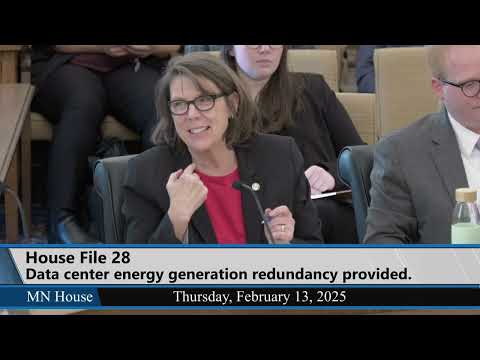
The House Committee on Energy, Finance and Policy on Feb. 14 referred House File 28 to the Environment and Natural Resources Finance and Policy Committee after an 8-7 roll call, moving forward a measure that would narrow state certificate-of-need review for standby generation at large data centers and allow some projects to use local AUAR processes instead of PUC site‑permit environmental review.
The House Committee on Energy, Finance and Policy on Feb. 14 referred House File 28 to the Environment and Natural Resources Finance and Policy Committee after an 8-7 roll call, moving forward a measure that would narrow state certificate-of-need review for standby generation at large data centers and allow some projects to use local alternative urban area-wide review (AUAR) processes instead of Public Utilities Commission (PUC) site-permit environmental review.
Representative Mecklen, the bill’s author, framed HF28 as an economic development measure intended to help communities that have lost large power-plant tax bases. “This is going to create a environment where we can be the host state of a tremendous amount of private capital investment,” Representative Mecklen said, arguing data centers could replace lost tax revenue and provide construction and permanent jobs in places such as Becker.
Supporters — including elected officials from Becker, Xcel Energy and several labor unions — told the committee that Becker and other communities face large revenue losses as coal-fired units retire and that AUAR work done locally should not be repeated. Jeremy Schmidt, superintendent of Becker Public Schools, told the committee his district could lose “about 40% or the equivalent of around $5,000,000 out of our $12,000,000 levy” when Sherco units go offline, and called HF28 “a critical opportunity to address those economic shortfalls.” Mayor Mark Kolbinger and Becker City Administrator Greg Larrue said AUARs done for Becker examined large-area, multi‑project scenarios and that redoing those reviews would be duplicative and costly.
Opponents, including environmental and community groups and local residents near proposed sites, said the scale and impacts of hyperscale data centers and their backup generators require the PUC’s technical expertise and a full environmental impact analysis. Kathy Johnson, president of the Coalition for Responsible Data Center Development, said HF28 would “essentially avoid forms of environmental review” and warned that local permitting bodies “enticed by the big dollar promises” could approve projects harmful to neighboring communities. Moe Fashami, who said he lives next to a proposed Farmington site, described proposals for large campuses and raised concerns about noise and frequent generator testing.
State Department of Commerce Assistant Commissioner Sydney Leib told the committee the department is “excited about this economic opportunity” but identified specific concerns: chiefly, that environmental review for large backup generators should be handled at the PUC, not solely by local governments, and that AUARs should not be allowed to replace the environmental review normally associated with site permits. “We don’t think that [allowing the AUAR to replace the PUC review] is appropriate,” Leib said, adding that the department supports exempting some projects from the certificate-of-need process so long as site-permit environmental review remains robust and occurs through the PUC.
Industry groups and some unions urged approval. Dan DiOrio, senior director of state policy for the Data Center Coalition, said data centers maintain backup generation to keep critical services running and that “these generators are highly regulated at the federal and state levels.” Joel Johnson of the IBEW State Council and Charles Sutton of the International Union of Operating Engineers Local 49 said data centers deliver construction jobs and property-tax revenue for host communities.
Environmental groups and rural advocates urged stronger state-level review. Ivana Starrick of Clean Water Action warned of water and cooling impacts — citing national data on growing water use at large facilities — and Sarah Meradian of CURE said filings to the PUC indicate some proposals would rely on hundreds of diesel-fired backup units. Meradian noted one filing before the PUC asserted a developer planned “approximately 250 generators operating on diesel fuel for a combined capacity of up to 600 megawatts,” and said that scale warrants a certificate-of-need and full environmental analysis.
Committee members pressed authors and witnesses on job figures, generator operation and how AUARs differ from project-specific environmental review. Representative Jones and others noted that long-term on-site employment at hyperscale data centers tends to be far smaller than construction employment, while construction periods can produce thousands of temporary jobs at large multi‑building projects; Representative Mecklen said some projects under development could involve multiple buildings and multi‑year construction that together generate substantial construction employment. Assistant Commissioner Leib and multiple testifiers emphasized the PUC’s expertise in assessing grid and reliability impacts, alternatives analysis and enforceable public review.
A roll call recorded members’ votes on the referral: Chair Swadzinski (aye); Vice Chair Murphy (aye); Representative Acum (no); Representative Kraft (no); Representative Anderson (aye); Representative Baker (aye); Representative Carroll (no); Representative Frazier (no); Representative Jones (no); Representative Mahamud (no); Representative Meckland (aye); Representative Sexton (aye); Representative Weiner (aye); Representative Hollins (no). The motion passed 8–7.
The committee also noted that the PUC expects to consider related certificate-of-need issues in late March; several committee members and the Department of Commerce urged ongoing coordination between the legislative and PUC processes. HF28, as referred, will be considered next by the Environment and Natural Resources Finance and Policy Committee.