Get Full Government Meeting Transcripts, Videos, & Alerts Forever!
Get email alerts on the Permitting Reform House File 8 topic
No spam. Unsubscribe anytime.
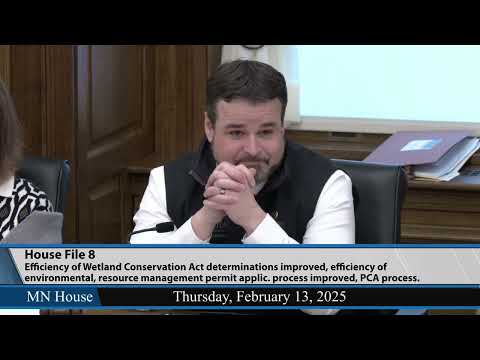
Committee sends House File 8 to labor panel after questions on permitting, tribal consultation and ombudsman
Summary
After extended questioning about permit timelines, tribal consultation and an ombudsman proposal, the committee voted 7-5 to re-refer House File 8 as amended to the Labor and Workforce Development Committee; earlier motion to lay the bill on the table failed 5-7.
The committee voted 7-5 on a roll call to re-refer House File 8 as amended to the Labor and Workforce Development Committee after extended questioning about permitting timelines, tribal consultation and a proposed ombudsman, Committee Chair Heintzeman said.
The bill would change aspects of state permitting and create an ombudsman function; supporters say changes will speed permitting and improve service for smaller projects, while several members and witnesses warned the legislation could miss key safeguards or skip required outreach. Representative Hansen raised concerns about consolidation in agriculture and the effect of large, dominant local employers on whether residents can freely participate in local permitting processes.
Representative Hansen said the state used to have “a lot of small farms” and argued consolidation has left communities with reduced local voice and concentrated environmental impacts. Chair Heintzeman replied that the bill’s language covers both “the county and the adjoining county,” not a single county, and emphasized the sponsor did not intend to lower environmental standards.
Members debated specific bill provisions and implementation details. Representative Purcell questioned an expedited, fee-based option and warned that a paid fast-track could advantage large corporations over small and mid-size operators: “If this is truly for small and middle sized operations, they maybe don't have the money that an Amazon ... can just pay that money and get to the top of the line,” Purcell said. Chair Heintzeman and the bill sponsor said the expedited fees would remain in the agency to support faster processing.
Several members pressed for clearer stakeholder outreach. Representative Jordan repeatedly asked whether Minnesota’s 11 sovereign tribal nations had been consulted; the sponsor said he had reached out to many stakeholders and welcomed continued conversations but did not provide a list of tribal consultations on the record. Representative Jordan said that omission was significant given treaty-protected rights under the 1854 treaty and asked how the bill would interact with those obligations.
Aaron Clemens, testifying for the Minnesota Center for Environmental Advocacy, disputed a characterization in the Minnesota Chamber report that permitting delays alone had caused companies to leave the state. Clemens cited three cases the Chamber raised — Epitome Energy, Huber Engineered Woods, and Talon Metals — and said each had its own facts: the Epitome example included moves to North Dakota with longer permitting waits there; Huber left after a court-ordered environmental impact statement following a $60 million subsidy and a statutory carve-out; and Talon (Talon Metals) revised and resubmitted environmental review materials, prolonging the process. Clemens also referenced roughly $114,000,000 in federal Inflation Reduction Act funds tied to a North Dakota plant and noted that project changes commonly lengthen environmental review.
Representative Fisher (lead) said he supported working the bill further in committee and voiced skepticism that the bill, as written, would prevent future permit violations, citing past cases (Northern Iron, Northern Metals, Water Gremlin) where permits were issued but later violations occurred. Fisher also asked for a fiscal note and specifics about staffing and costs; Chair Heintzeman and other members agreed the bill would next proceed to the Labor and Workforce Development Committee for additional work.
Members also debated technical design choices: whether notice and participation should be based on a county and adjoining county (as the bill reads) versus watershed boundaries, and whether technology could be used to provide real-time public notice of permits rather than periodic reports. The committee discussed which agency would pay for an ombudsman and were told the ombudsman role would be an expenditure of DEED’s budget if implemented.
Procedural votes ended the session’s debate. Representative Fisher moved to lay the bill on the table; that motion failed on a roll call, 5 yes to 7 no. Individual roll-call votes recorded in committee testimony show yes votes from Representatives Fisher, Falconer, Hansen, Jordan and Purcell and no votes from Chair Heintzeman, Vice Chair Burkhall, Gilman, Jacobs, Nelson, Schultz and Warwas (tally 5–7). Later, Fisher renewed his motion that House File 8 as amended be re-referred to the Labor and Workforce Development Committee; that motion carried on a roll call, 7 yes to 5 no, sending the bill to the next committee for additional consideration.
The committee left several items for further work in the next committee stop: documenting tribal consultation, producing a fiscal note specifying added staffing and costs, clarifying which permit types and project phases would be eligible for expedited processing, and whether an ombudsman should be housed at DEED. The bill’s sponsor invited members and stakeholders to continue negotiating amendments before the next hearing.
Votes at a glance: a motion to lay the bill on the table failed, 5–7 (yes: Fisher, Falconer, Hansen, Jordan, Purcell; no: Heintzeman, Burkhall, Gilman, Jacobs, Nelson, Schultz, Warwas). A motion to re-refer House File 8 as amended to the Labor and Workforce Development Committee passed, 7–5 (yes: Heintzeman, Burkhall, Gilman, Jacob, Nelson, Schultz, Warwas; no: Elite/Lead Fisher, Falconer, Hansen, Purcell).