Get Full Government Meeting Transcripts, Videos, & Alerts Forever!
Get email alerts on the Mde Budget And Federal Funding topic
No spam. Unsubscribe anytime.
Education Finance Committee holds deep dive on Minnesota Department of Education budget, federal funding and oversight
Summary
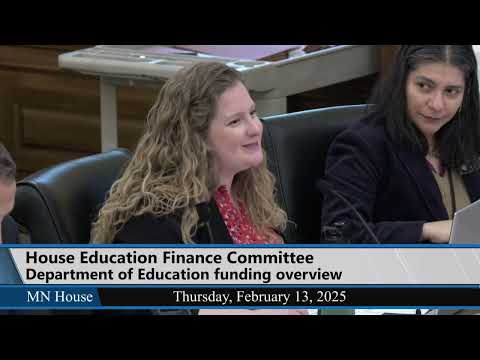
The House Education Finance Committee on Feb. 13 examined administrative funding carried by the Minnesota Department of Education, federal and special‑revenue dollars, and agency anti‑fraud steps while pressing MDE officials about staffing and the possible effects of federal funding changes on school districts.
ST. PAUL, Minn. — The House Education Finance Committee on Feb. 13 examined administrative funding carried by the Minnesota Department of Education (MDE), the department’s use of federal and special‑revenue dollars, and its steps to prevent fraud as lawmakers pressed agency officials about staffing and the potential impact of federal funding changes on school districts.
The committee heard a line‑by‑line explanation of three spreadsheets prepared for members that isolate administrative set‑asides in (1) general fund appropriations, (2) non‑general/non‑federal funds, and (3) federal funds. Ms. Beckel of House Fiscal described how the spreadsheets track statutory or session‑law carve‑outs and agency operating allocations and pointed members to a statutory fallback for administrative use: "Minnesota Statute 16B.098 subdivision 14 establishes that unless otherwise stated agencies may retain 5% of an appropriation for named grants and 10% for competitive grant programs," she said.
Why it matters: Committee members said they need clarity on how administrative dollars are used, how outside grants are acquired and administered, and how any disruption in federal funding would affect services in districts already adjusting after ESSER-era spending ended.
MDE officials summarized the department’s portfolio and operating mix. "We serve over 850,000 students across the state," Stephanie Graff, deputy commissioner at the Minnesota Department of Education, told the committee, and she said MDE oversees more than $11,000,000,000 in education aid and grants annually. Graff added that, statewide, federal funds make up roughly 10% of total education funding while MDE’s internal operating budget is roughly 60% federally funded and 40% state funded.
Agency finance director Sean Pfannhorst described common drivers of reported administrative costs in the federal spreadsheet, noting that accounting conventions affect how payroll and non‑payroll administrative spending are shown. He said large lines in the federal spreadsheet can reflect vendor contracts or COVID‑era reimbursements rather than recurring operating overhead.
Grant seeking and external awards: Committee members asked how MDE pursues competitive, non‑federal awards. Pfannhorst said MDE "has a team or essentially a two‑person team that seeks out external funding opportunities" and, when selected, MDE becomes the grantee and manages contracts and eligible expenditures under the grant terms. Members asked whether the team’s work is revenue‑positive; Pfannhorst said the team "do(es) cover their own cost" and offered to provide more detailed follow‑up on cost recovery.
Nutrition and other federal programs: Adosh Unni, MDE’s director of government relations, told the committee federal nutrition funding is substantial: "for the fiscal 24 award, the funds totaled about $431,000,000 for our federal nutrition program," he said, noting those dollars come from the U.S. Department of Agriculture. Committee members repeatedly raised concern about uncertainty created by recent federal actions and memos that briefly paused some grant flows, and they pressed MDE on contingency planning if federal streams such as Title I, IDEA, child nutrition or Head Start were reduced.
Oversight and fraud prevention: Several members pressed MDE about fraud prevention after past audits. Graff said the agency established an Office of Inspector General in 2023 and is beefing up legal support: "since the establishment of the OIG in 2023 ... we've received 140 complaints, of which 80 are closed and 60 are open investigations," she said. Graff and other officials described new or expanded legal and investigative capacity and said they are coordinating with the Office of Grants Management and other partners to strengthen pre‑award risk assessments and grant controls.
Staffing, roles and transparency: Members asked for detail on MDE staffing and job classifications. Graff referenced committee materials that show "475 employees" as of Dec. 13 and said the department will follow up with exact FTE and payroll figures on request. Lawmakers asked for job descriptions (for example, for classifications labeled "education consultant 3") and for clearer public contact points for priorities such as literacy and chronic absenteeism; Graff said MDE will provide more detailed role descriptions and program contacts.
Follow‑ups requested: Committee members asked MDE for (1) a breakdown of staff who moved to the newly formed Department of Children, Youth and Families after the 2023 reorganization, (2) details on the grant team’s cost recovery and review processes, (3) counts of staff focused on literacy and chronic absenteeism, and (4) additional context about special‑revenue and interagency arrangements.
Committee action and next steps: The committee approved minutes from its Feb. 11 meeting by motion of Chair Bakersch. The committee chair closed the session after summarizing members’ concerns and announced the committee will hold at least one bill hearing on Feb. 18, 2025, including House File 6.
— Reporting by the House Education Finance Committee meeting transcript; direct quotes and figures are attributed to the speakers named in committee remarks.