Get Full Government Meeting Transcripts, Videos, & Alerts Forever!
Get email alerts on the Permitting Efficiency topic
No spam. Unsubscribe anytime.
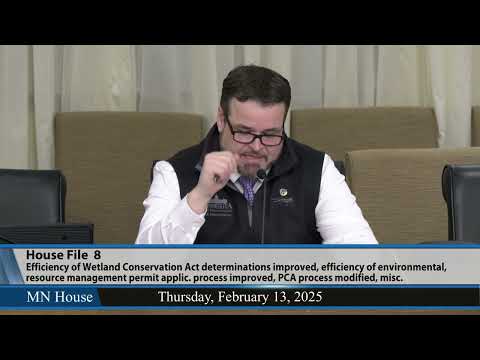
Minn. committee hears wide testimony on HF 8 permitting reforms; amendment adopted
Summary
Representative Rob Heintzeman moved House File 8 forward and an authors' amendment was adopted by voice vote as the committee heard more than a dozen stakeholders testify on changes to Minnesota's environmental permitting process.
Representative Rob Heintzeman, the bill author, moved House File 8 before the committee and offered an authors' amendment that the panel adopted by voice vote.
HF 8 would change several parts of Minnesota's environmental permitting and review process. Key provisions in the bill include limiting local wetland‑permit extension authority to one 60‑day extension unless the applicant agrees to more; requiring the Minnesota Pollution Control Agency to publish permit‑efficiency reporting more frequently; treating a missed 150‑day goal for a tier‑2 permit as a final action that could trigger judicial review; making the agency immediately notify applicants when an application is administratively incomplete (with the 30‑day completeness clock not reset unless more than 30% of required information is missing); permitting separate construction and operation permits; allowing agencies to retain expedited fees if they complete review ahead of schedule; narrowing who may petition to force an Environmental Assessment Worksheet (EAW) from 100 Minnesota residents statewide to 100 residents in the county or an adjoining county; and creating a business permitting ombuds at DEED, the Department of Employment and Economic Development.
Why it matters
The bill seeks to shorten and make more predictable the permitting process for businesses and public projects, something supporters say is needed to attract investment and allow projects to begin construction windows that can be sensitive to Minnesota weather. Opponents say the changes risk weakening public participation and could shift costs or workload to agencies and local governments without guaranteeing faster outcomes.
What was said
"These are technical amendments," Heintzeman said when moving the A2 amendment, describing fixes such as a typo and clarifications to scoping language.
Tom Johnson, government relations director for the Minnesota Pollution Control Agency, told the committee the MPCA supports the goal of better, timelier permitting but raised specific concerns with the bill's language. "Minnesotans expect the MPCA to rigorously protect our air, water, land, and climate," Johnson said, adding the agency has already implemented internal improvements including a permit tracker and an applicant hotline. He warned that some provisions — for example making failure to meet a goal a "final action" that triggers judicial review — could add legal complexity and not speed outcomes.
Business and trade groups — including the Minnesota Chamber of Commerce, Minnesota State Building and Construction Trades Council, Minnesota Biofuels Association, Minnesota Agri Growth Council, Greater Mankato Growth and several agricultural associations — testified in favor. They told committee members that delays and uncertainty have led some projects to locate outside Minnesota and that more predictable timelines will help farmers and manufacturers adopt new equipment and technologies.
Environmental and public‑interest witnesses were divided. The Minnesota Center for Environmental Advocacy said better data and an ombudsman could be helpful, but warned that the bill "misses the point" if it reduces agencies' ability to say no to projects that do not meet environmental standards. MCEA and other speakers cited the PolyMet permit litigation and urged caution about changes that could limit oversight or public participation.
Local government and watershed voices said permitting demands and inconsistent agency processes have imposed time and cost burdens on regional restoration and infrastructure projects. The Red River Watershed Management Board testified that 10 projects in its region required 89 permits, and that state permits accounted for a large share of time and cost.
Votes at a glance
- A2 authors' amendment — moved by Representative Rob Heintzeman; outcome: adopted by voice vote (committee recorded "Aye" and the amendment was declared adopted). No roll‑call tally was recorded in the transcript.
Committee process and next steps
Representative Heintzeman moved to recommend House File 8 be re‑referred to the Labor and Workforce Development Committee. The transcript records the motion; a formal roll‑call on that referral was not recorded in the portion of the hearing provided. Committee members and multiple testifiers said they expect continued negotiation among stakeholders; committee members asked whether a consolidated fiscal note is complete and whether significant rulemaking and staff resources would be needed to implement some changes, particularly the split of construction and operation permits.
Who spoke (selection)
Representative Rob Heintzeman — bill author and committee member; moved HF 8 and the authors' amendment. Tom Johnson — Government Relations Director, Minnesota Pollution Control Agency (representing MPCA and Environmental Quality Board). Tom Dicklich — Executive Director, Minnesota State Building & Construction Trades Council. Andrew Morley — Environmental Policy Director, Minnesota Chamber of Commerce. Darren Broughton — Executive Director, Minnesota Agri Growth Council. Lauren Servick — Director of Public Policy Strategy and Sustainability, Minnesota Pork Producers Association. Darren McBeth — Minnesota Milk Producers Association (representative testifying). Aaron Lehi — Chief Strategy Officer, Minnesota Center for Environmental Advocacy. Robert (Rob) Sipp — Executive Director, Red River Watershed Management Board. Brian Werner — Executive Director, Minnesota Biofuels Association. Veda Kanitz — DFL Environmental Caucus Legislative Committee. Bridal Martinson — Environment Policy Analyst, Association of Minnesota Counties. Tim Kelly — Watershed district administrator (name of district redacted in transcript).
What to watch for
Committee members said a consolidated fiscal note remains in progress; the MPCA and other agencies said portions of the bill could require substantial rulemaking and staffing. Lawmakers also signaled they will continue stakeholder discussions on petition thresholds for environmental review, the practical effects of separating construction and operating permits and data/reporting requirements for agency permitting performance. The committee recessed to reconvene later in the day for further questions and deliberations.