Get Full Government Meeting Transcripts, Videos, & Alerts Forever!
Get email alerts on the Emergency Powers Hf26 topic
No spam. Unsubscribe anytime.
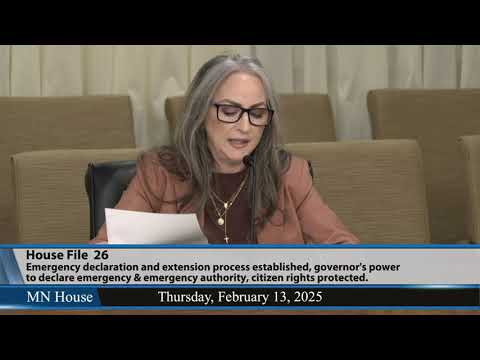
Committee hears emotional testimony on HF 26 to curb governor emergency powers; bill sent to Veterans Division
Summary
Testifiers described being barred from loved ones during COVID as Rep. Roach’s House File 26 — which would limit unilateral emergency authority — drew questions on scope, National Guard deployment, cyberattacks, fiscal effects and remote voting. Chair Nash referred the bill to the Veterans and Military Affairs Division by chairmemo.
Saint Paul — The House State Government Finance and Policy Committee heard emotional testimony and hours of debate Feb. 13 on House File 26, Rep. Roach’s proposal to limit the governor—s unilateral emergency powers, before Chair Nash referred the bill to the Veterans and Military Affairs Division by chair—s memo under House Rules 6.05.
The bill drew several speakers who said pandemic-era restrictions caused lasting harm. Mary Manders, a survivor who testified in support of HF 26, said she was hospitalized with COVID in January 2022 and spent 52 days in the hospital, "28 of which I was completely alone." She told the committee she was "tied down, heavily sedated with hard narcotics, denied food and hydration," and that her weight fell from 117 to 88 pounds. "None of this would have happened if my husband was allowed in the hospital," Manders said.
Jana Kangas, who identified herself as with COVID Justice Minnesota, said her father "was also killed by hospital protocol" and described limited communication with clinicians and withheld medications. Golden Valley resident Joe Shuth told the committee the experience was "absolute torture" for families who could not be at the bedside.
The testimony framed the bill for many lawmakers. Representative Roach said the measure is intended to "prevent unilateral control" by a single elected official and to "give the decision making back to the legislature." He said the bill would require the Legislature to be convened and to approve a declared emergency by a two-thirds vote of each house before the governor could exercise emergency powers.
Committee members pressed on operational implications. Representative Kraft raised concern that HF 26 could conflict with the disaster contingency account that allows rapid executive response without calling the Legislature back into session. Representative Howard repeatedly warned that the bill's language, as drafted, "has far reaching implications" and asked whether the governor would still be able to deploy the National Guard or use executive orders in situations such as a terror attack or a cyber incident.
Representative Bonner and others highlighted cyberattack scenarios, noting that minutes and hours matter in incidents that disable critical government systems. Representative Bonner said such attacks can shut down police operations, courts and bill payments and argued that the executive branch is structured to act quickly in those moments.
Representative Lee Cleburne asked detailed procedural questions about the bill—s mechanics, including who would convene a special session (the governor), whether remote voting was authorized (it is not specified in the bill), per diem and other fiscal consequences and whether a fiscal note had been requested (Representative Roach said no fiscal note had been requested). Representative Howard noted the bill also would eliminate criminal penalties in the emergency powers chapter, a point he said may have consequences beyond the bill—s intent.
Representative Freiberg said House File 26 differs from another bill the committee discussed earlier (House File 21) because HF 26 would repeal the governor—s emergency powers statute rather than amend it, and asked the author why he preferred the repeal.
Chair Nash said he would move HF 26 to the Veterans and Military Affairs Division by memo under House Rules 6.05 so the division chair could review it; Chair Nash said the bill may then return and could also be routed to other committees including Health, Judiciary and Attorney General/State agencies depending on content. The chair said the committee would try to expedite the bill—s path while allowing the other committee stops it needs.
Action taken: Chair Nash withdrew an earlier referral to Health and instead referred HF 26 to the Veterans and Military Affairs Division via chair—s memo under House Rules 6.05. The committee did not take a final vote on the bill.
What the bill would change and outstanding questions
- What HF 26 would do: As described by the author, it would require that if the Legislature is not in session the governor may call the Legislature and a declared emergency would only take effect after a two-thirds affirmative vote in each house. The bill also limits the duration of an emergency to five days unless extended by two-thirds votes and contains language the committee discussed that would remove criminal penalties in the chapter.
- Open questions raised in committee: whether the change would hinder time-sensitive disaster responses (including National Guard deployments), whether the governor can still call a special session and how remote convening or voting would be handled (the bill does not specify remote voting), whether a fiscal note is required for per diems and other costs (none had been requested), and how the bill would affect responses to cyberattacks or other emergencies that require immediate action.
Next steps
Chair Nash referred the bill to the Veterans and Military Affairs Division under House Rules 6.05. Committee members said the division chair asked to see the bill; committee staff will issue the chair—s memo and track the referral. Committee members and the author indicated the bill will likely be revised as it moves through division and subsequent committees. The committee did not approve the bill and no floor referral was made at this hearing.