Get Full Government Meeting Transcripts, Videos, & Alerts Forever!
Get email alerts on the Environmental Permitting topic
No spam. Unsubscribe anytime.
Chamber Foundation: Minnesota issues many routine permits quickly but industrial tier‑2 reviews are frequently delayed
Summary
Chamber Foundation researchers told the committee Minnesota issues routine permits rapidly but that individualized industrial reviews (tier 2) commonly exceed the MPCA’s 150‑day goal, creating delays for construction projects.
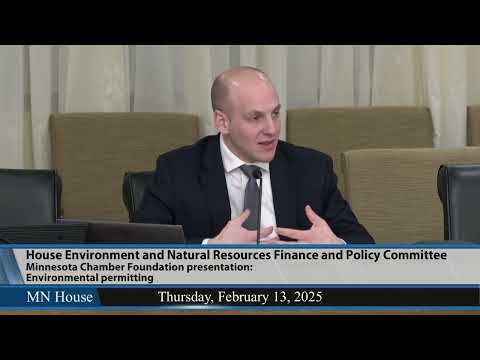
Chamber Foundation researchers told the Environment and Natural Resources Finance and Policy Committee that Minnesota issues routine environmental permits quickly but that industrial, individualized (tier 2) air and water permits often take far longer than the Minnesota Pollution Control Agency's 150‑day goal.
The report, delivered by Sean O'Neil, director of economic development and research for the Minnesota Chamber Foundation, says most tier 1 air permits issue in about 29 days, while median times for tier 2 air permits used for construction ranged into the hundreds of days (the report gives a median of roughly 351 days for priority tier 2 air permits and an average near 586 days across 2018–2023). For non‑priority tier 2 air permits the researchers reported a median of about 887 days and an average approaching 1,300 days.
Those differences matter because delays can postpone capital investments, the report says. Policy Navigation Group, a co‑researcher, estimated Minnesota could gain between $260 million and $910 million in additional annual output and between roughly 960 and 3,400 full‑time equivalent jobs annually if permitting timelines aligned more closely with faster peer states.
The report explains the MPCA divides permits into tier 1 (routine, no individualized action) and tier 2 (individual facility review, public comment allowed) and prioritizes applications needed for construction. O'Neil said the study compared Minnesota to peer states and found the state’s average time to issue certain federal air permits was “considerably higher,” reporting Minnesota averages in the mid‑600s of days across the sample period compared with roughly 110 days in faster states such as Iowa or Illinois.
On water permits, researchers found similar patterns for industrial tier 2 reviews but noted fewer applications: the MPCA received 15 priority industrial tier 2 water applications since 2018 and issued 3 within the 150‑day goal. The study also flagged 152 administratively continued water permits as of third quarter 2023 with an average extension of about 6.6 years.
The Chamber Foundation recommended three priority reforms: (1) reduce timeline for issuing tier 2 air and water permits to better meet the 150‑day goal; (2) address backlogs of renewals and minor modifications; and (3) increase transparency and coordination so applicants can better predict schedules. Example proposals include separating construction and operating permits and expanding an expedited permitting option that applicants can pay into.
O'Neil emphasized the study examined opportunities to improve efficiency without lowering environmental standards, saying, “The state's environmental regulations are designed to both protect the environment and human health while also enabling economic development.”
Committee members sought more granular explanation of root causes. Representative Lee Fisher and others asked whether long timelines were driven by agency capacity, court appeals, permit violations by applicants, or other factors; O'Neil replied the study analyzed program design and available data rather than each individual permit file and recommended further investigation into permit‑level causes. Representative Schultz said the report’s year‑by‑year breakdown (2018–2023) shows variation but not a clear COVID‑era discontinuity.
The full technical report and a summary are available on the Minnesota Chamber Foundation website; the committee followed the presentation with policy discussion and a bill hearing on related permitting legislation.