Get Full Government Meeting Transcripts, Videos, & Alerts Forever!
Get email alerts on the Zoning Tree Preservation topic
No spam. Unsubscribe anytime.
Woodstock council approves $5,000 settlement and replanting plan after unauthorized tree removal at Arnold Mill
Summary
The Woodstock mayor and council approved a motion requiring a $5,000 payment to the city and a replanting plan to resolve a zoning fine for 39 trees removed without a permit at a commercial site on Arnold Mill Road; the vote was 5-1 with Councilman Ake opposed.
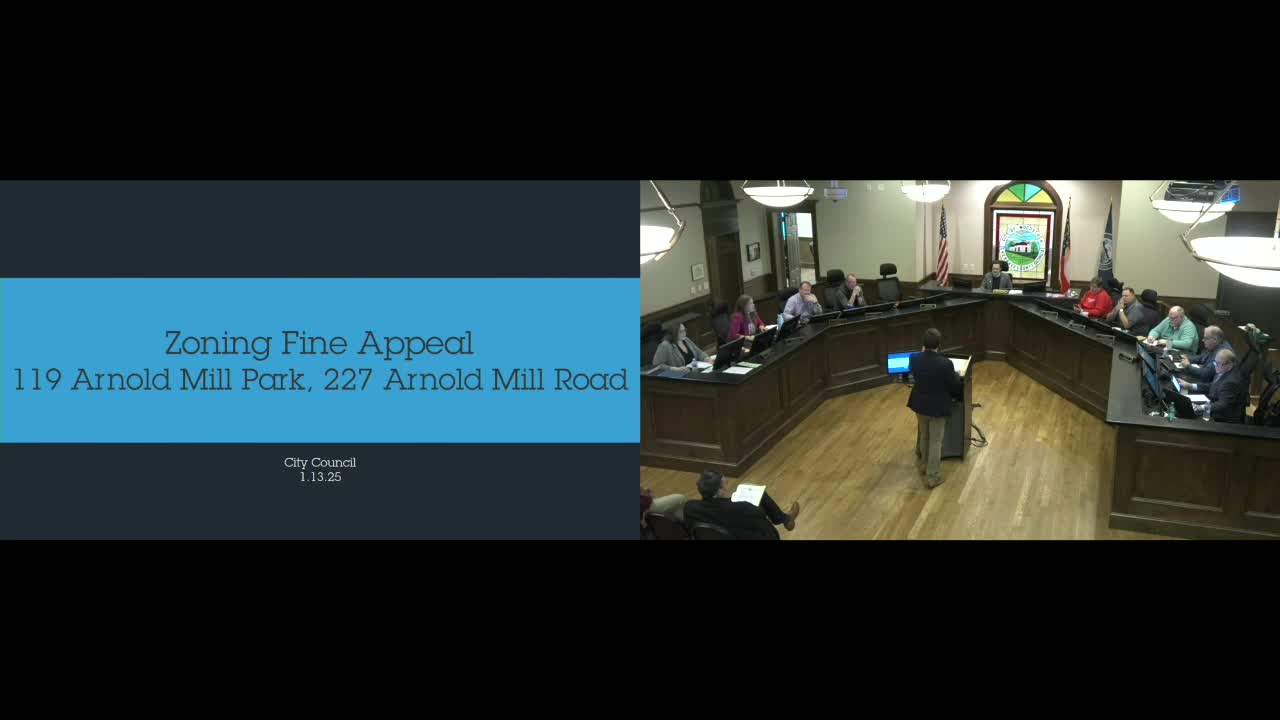
The Woodstock mayor and council on Jan. 13 approved a settlement requiring the property owner to pay $5,000 to the city and install a replanting plan by April 1 to resolve a zoning fine for trees removed without a permit at 119 Arnold Mill Park and 227 Arnold Mill Road. The motion passed 5-1, with Councilman Ake casting the lone negative vote.
City staff told the council that the contractor felled 39 trees totaling 454 tree inches and that the original fine, calculated at $150 per inch, was $68,100. An arborist report procured by staff in June 2024 found that about 15% of the removed trees were dead or dying; staff said that finding and the appellant’s proposed replanting plan reduced the recommended fine to $39,285. Staff presented the council with the updated calculations and urged a deadline for the replanting work. “Staff would also recommend that council stipulate that this plan be executed by 04/01/2025, and if work is not completed by this point, staff would recommend that the appellant pay the remainder of the fine,” Mr. Dunn told the council.
The appellant’s representative told the council the trees were removed from a steep slope behind a commercial building to prevent debris from filling the building’s gutters and causing ongoing maintenance problems. The appellant’s team proposed planting roughly 60 shrubs in a utility easement behind the properties to screen the building from adjacent residences; the proposed species are limited by power-line easement restrictions. The appellant also offered the $5,000 payment to the city’s tree preservation fund as compensation for staff time.
Councilman Potts moved the approved motion, which requires the $5,000 payment, completion of the submitted planting plan by April 1, 2025, and that the building owner either remove or put the building’s exterior lights on motion-activated or timed controls so they do not shine into neighbors’ yards. Councilman Wolff seconded the motion. The motion carried 5 to 1; Councilman Ake voted no.
City staff had earlier explained that, had the property owner sought a permit before removal, the site likely would have met the city’s tree-density requirements and the permit would have been routinely approved. Staff also noted the replanting credit calculation: the appellant proposes 62 plantings (approximately 2-inch size each) in the easement; staff agreed to accept those species for credit given easement constraints. City staff recommended a deadline for installation and that, if the work is not finished by April 1, the remaining fine be required.
The council’s action resolves the outstanding zoning fine by combining a reduced cash payment with a replanting requirement and a deadline; council members cited the need to balance neighborhood impacts with practical remediation that is feasible in a power-line easement. No additional action was scheduled in open session.