Get Full Government Meeting Transcripts, Videos, & Alerts Forever!
Get email alerts on the Federal Relief Essr topic
No spam. Unsubscribe anytime.
District presents final ESSER III use-of-funds report, credits investments with early instructional gains
Summary
CCSD presented its final ARP ESSER III use-of-funds report and reported instructional and well-being gains tied to investments in tier‑1 instructional materials, reading skills centers, mental-health supports and technology; trustees accepted the report 7-0 and asked for continuing sustainability planning.
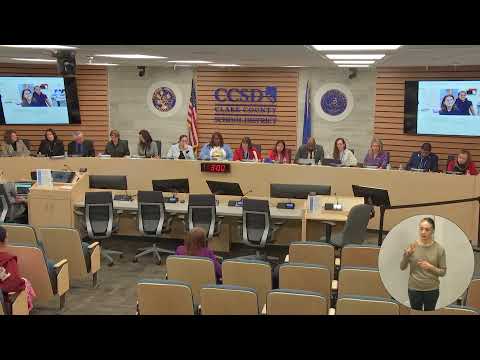
The Clark County School District presented its final report on American Rescue Plan Elementary and Secondary School Emergency Relief (ARP ESSER III) spending and said the district obligated the full award and has produced evidence of student learning and well-being improvements tied to the investments. Trustees accepted the report 7-0 on Feb. 13, 2025 (agenda item 4.03).
Kelly Kowal Paul, Chief Strategy Officer, summarized multi-year investments: tier‑1 instructional materials and aligned professional learning in English language arts, math and science; funding for reading skills centers and Transformation Network schools; expanded mental-health and school-based health services including a mobile clinic; visitor-management and signal-blocking pouches for cell phones; and partnerships with community organizations. The district reported the obligation deadline for ESSER III was Sept. 30, 2024, with the liquidation deadline in January 2025; the state has applied for a possible late-liquidation extension.
The presentation highlighted measurable improvements: increases in ELA and science proficiency for several cohorts, an uptick in 11th‑grade ACT rates to pre-pandemic levels, improvements in cohort science scores between grade 5 and grade 8, and districtwide gains in some subgroup outcomes. The district also said it had made targeted investments in teacher pipelines and retention, and noted examples of former program participants who remained in the district as educators and leaders.
Kowal Paul described program monitoring, third‑party validation by Hanover Research, and six approved revisions to the spending plan that allowed reallocation to higher-impact activities during implementation. Trustees asked about remaining unliquidated funds (less than 1% at the time of presentation) and whether any remaining dollars could be redirected to avert layoffs; staff said unspent funds had been largely obligated and cannot be reallocated beyond the obligation deadline.
Board members accepted the final use-of-funds report and directed staff to continue sustainability planning for central investments and to work with schools as budgets change. Trustees and staff emphasized the need to inform the state legislature about funding design so school gains are not penalized when funding formulas change.