Get Full Government Meeting Transcripts, Videos, & Alerts Forever!
Get email alerts on the Property Taxes topic
No spam. Unsubscribe anytime.
Chamblee holds public hearing on whether to opt out of GeorgiaHouse Bill 581floating homestead exemption
Summary
City staff explained how the statewide "floating" homestead exemption created by House Bill 581 would work, the deadlines and procedural steps to opt out, and potential revenue impacts; no formal decision was made at the hearing.
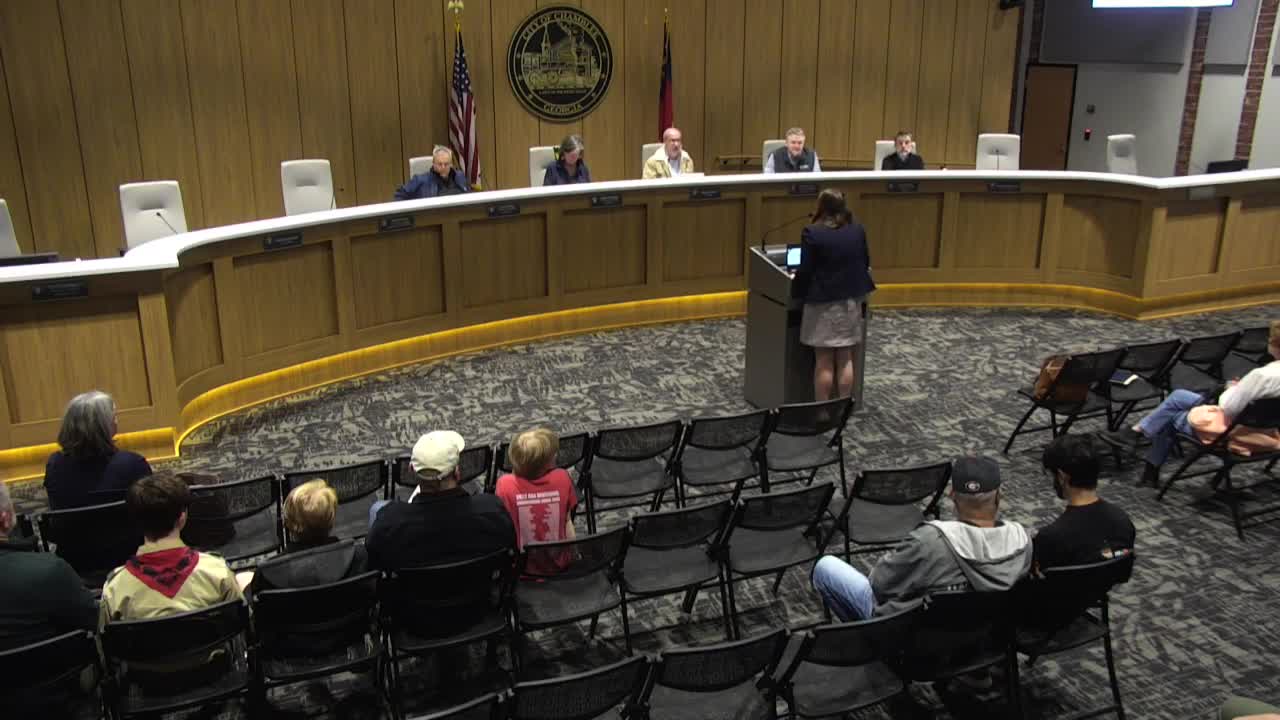
At a public hearing before the Chamblee City Council, city staff described House Bill 581the state law that created a statewide "floating" homestead exemptionand explained that the council must decide whether to opt out before a March 1 deadline.
City staff member Kristen said the council is holding the second of three required public hearings before it could adopt a resolution to opt out. "House Bill 581 . . . implemented a statewide floating homestead exemption for all local governments, including counties, cities, and school boards," Kristen said. She explained the exemption is a base-year or value-offset exemption that "is designed to offset or reduce increases in taxable value to the property."
The nut of the proposal is that the exemption "floats" with inflation: Kristen offered an example, saying that if a home's taxable value rose from $100,000 to $110,000 and inflation were 2 percent, the adjusted base-year value would be $102,000 and the exemption would effectively be $8,000, leaving the homeowner taxed on roughly the original base value. Kristen added the city does not yet know how the Georgia Department of Revenue will calculate the inflation adjustment and said the city believes the department will use the Consumer Price Index but has not received confirmation.
Kristen told the hearing that the exemption would apply only to homesteaded residential property; commercial property would continue to be valued at fair market rate. She said homes receiving a homestead exemption in taxable year 2025 would use the 2024 assessed value as the base year, and the base year resets when property is sold or when a substantial property change triggers a reassessment. She also noted that the statewide floating exemption would be in addition to, not in lieu of, existing local exemptions; Chamblee currently has a general local homestead exemption of $50,000 that would continue to apply.
Kristen warned the decision is effectively permanent in one sense: "The decision to opt in versus opt out is a permanent decision," she said, but also noted the city could later pursue local legislation or a ballot measure to create a local floating exemption or tax freeze. She also presented illustrative revenue scenarios (described to the council as "not hard numbers"), saying the example model showed a potential first-year revenue impact on the order of tens of thousands of dollars and rising to roughly half a million dollars by 2029 under certain inflation assumptions.
Council members and staff discussed related local tax mechanisms. Kristen explained that the bill also included a local-option sales tax provision but that DeKalb County currently does not grant cities access to a local-option sales tax revenue stream in the same way; Chamblee receives SPLOST (special-purpose local-option sales tax) funds that are earmarked for transportation and public-safety projects. "The floated element . . . was intended to offset potentially the loss of revenue from the floating homestead exemption," Kristen said, but added that if the county does not opt into the sales-tax option, that offset would not be available to the city.
Members of the public were invited to comment. One resident, Kim, said she did not understand why the city would not adopt the exemption, echoing other attendees' confusion. The mayor and other officials told residents the council cannot answer policy questions during the hearing but offered to speak with members of the public afterward.
No formal vote or resolution was taken at the hearing. City staff and the council indicated that this was the second of three required public hearings on the question; the council must complete the hearing process before making a final decision on whether to adopt a resolution to opt out.