Get Full Government Meeting Transcripts, Videos, & Alerts Forever!
Get email alerts on the Affordable Housing topic
No spam. Unsubscribe anytime.
Industrial Development Board ad hoc committee reviews Atlanta, Austin tools for affordable housing; approves prior minutes
Summary
At its Feb. 12 ad hoc meeting, the Industrial Development Board reviewed research on affordable-housing tools used in Atlanta and Austin—highlighting municipal bond authority, philanthropic revolving funds and childcare tax credits—and approved prior meeting minutes by voice vote.
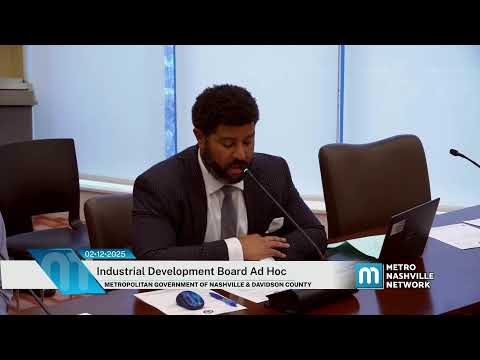
On Feb. 12, 2025, the ad hoc committee of the Industrial Development Board met and discussed research comparing affordable-housing policies used in Atlanta and Austin and whether similar tools could be applied in Nashville.
Board Member Haston said the Atlanta presentation showed “using their own city's bond authority to back deals and or issue their own, bonds to help subsidize both housing and infrastructure,” a tool he said the committee legally could deploy under state enabling legislation. He also told members that philanthropy in Atlanta had helped capitalize a revolving loan fund to subsidize projects, an effort he described as having “raised a couple hundred million dollars” in philanthropic capital.
The discussion focused on which existing legal authorities the city could use immediately and which changes would require state or Metro Council action. Members named potential tools including municipal bond support for mixed projects, property-tax abatements for developments with an affordable component, employer-facing childcare tax credits and philanthropic loan funds. Board Member Wright said Austin’s approach also offered lessons and that the committee should select “one or two items from maybe each city that they're doing that we currently are able to do and maybe we're not doing.”
Committee members noted that some pilots or abatements previously used by the board would still require Metro Council approval unless state law has changed. One member referenced possible state-level clarification to tax-increment financing enabling language, identifying “Title 7, Section 53” as the statute under discussion.
Members also asked staff to include day-care businesses among target industries for a forthcoming small-business grant program. The committee discussed the high cost of child care and its interaction with housing and transportation burdens; one member said housing costs can reach about “40% of a person's income” and, combined with other costs, leave households paying a large share of earnings to basic needs.
Votes at a glance: The committee approved the ad hoc meeting minutes for Oct. 9 and Dec. 11. Board Member Haston moved to approve the minutes; Board Member Wright seconded. A voice vote was taken and minutes were recorded as approved.
The committee did not adopt new programs or make funding commitments at the meeting; members directed staff to continue comparative research, to flag items that could be implemented under current authority, and to include daycare as a target industry in small-business grant planning. The board adjourned with plans to continue the discussion at a future meeting.