Get Full Government Meeting Transcripts, Videos, & Alerts Forever!
Get email alerts on the Prioritization And Process Improvements topic
No spam. Unsubscribe anytime.
State Water Board details tribal data policy, new prioritization framework and TMDL priority rankings for 2026 report
Summary
State Water Board staff said the 2026 Integrated Report introduces a statewide approach to tribal data, factors environmental justice and climate in restoration prioritization, and replaces completion dates with high/medium/low TMDL priority rankings.
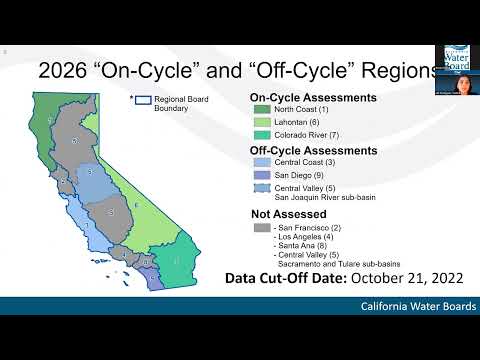
Laurie Weber, senior environmental scientist in the Integrated Report program, outlined process changes the State Water Board used in developing the draft 2026 Integrated Report. Weber said the program is adopting a statewide approach to data collected by or on behalf of tribes and clarified how bioassessment and pollutant data will be handled.
Weber said data collected on ‘‘federally recognized tribal lands by any entity will not be assessed for the integrated reports’’ because state and regional water quality standards do not apply on tribal lands and EPA does not approve state assessments for tribal waters. She added that data collected by tribes on lands bordering or off tribal lands will be assessed if they meet the program’s data screens and listing policy requirements.
Weber described the newly released prioritization framework for plans to restore impaired water bodies and said environmental justice and climate change are newly added factors in prioritization. The framework differentiates three restoration plan types: TMDLs (Total Maximum Daily Loads, EPA-approved), 4(d) demonstrations (EPA-reviewed equivalents where other regulatory mechanisms are expected to address impairment), and Advanced Restoration Plans (ARPs), short-term, non-EPA-approved plans that can lower TMDL priority.
To replace outdated individual TMDL completion dates, staff introduced three priority rankings for scheduling TMDL development: ‘‘High’’ (planned within two years), ‘‘Medium’’ (planned between two and ten years) and ‘‘Low’’ (planned for more than ten years or expected to be addressed through EPA-approved 4(d) or an ARP). Weber said the change was intended to improve transparency and avoid confusion created by thousands of static completion dates.
During Q&A, commenter Paul Padore asked whether the integrated report communicates the rationale for assigned restoration or TMDL priorities. Weber acknowledged that the staff report communicates the TMDL priority ranking but said a discrete, explicit field for ‘‘restoration priority’’ is not yet included and invited public comment on adding clearer rationale fields.