Get Full Government Meeting Transcripts, Videos, & Alerts Forever!
Get email alerts on the Economic Development topic
No spam. Unsubscribe anytime.
Committee hears bill to increase funding and change reporting for associate development organizations
Summary
Senate Bill 5677 would raise per‑ADO funding caps, expand rural allocations and streamline some reporting for large counties; state and local ADO leaders urged support, saying state investment leverages significant local matches and supports rural projects.
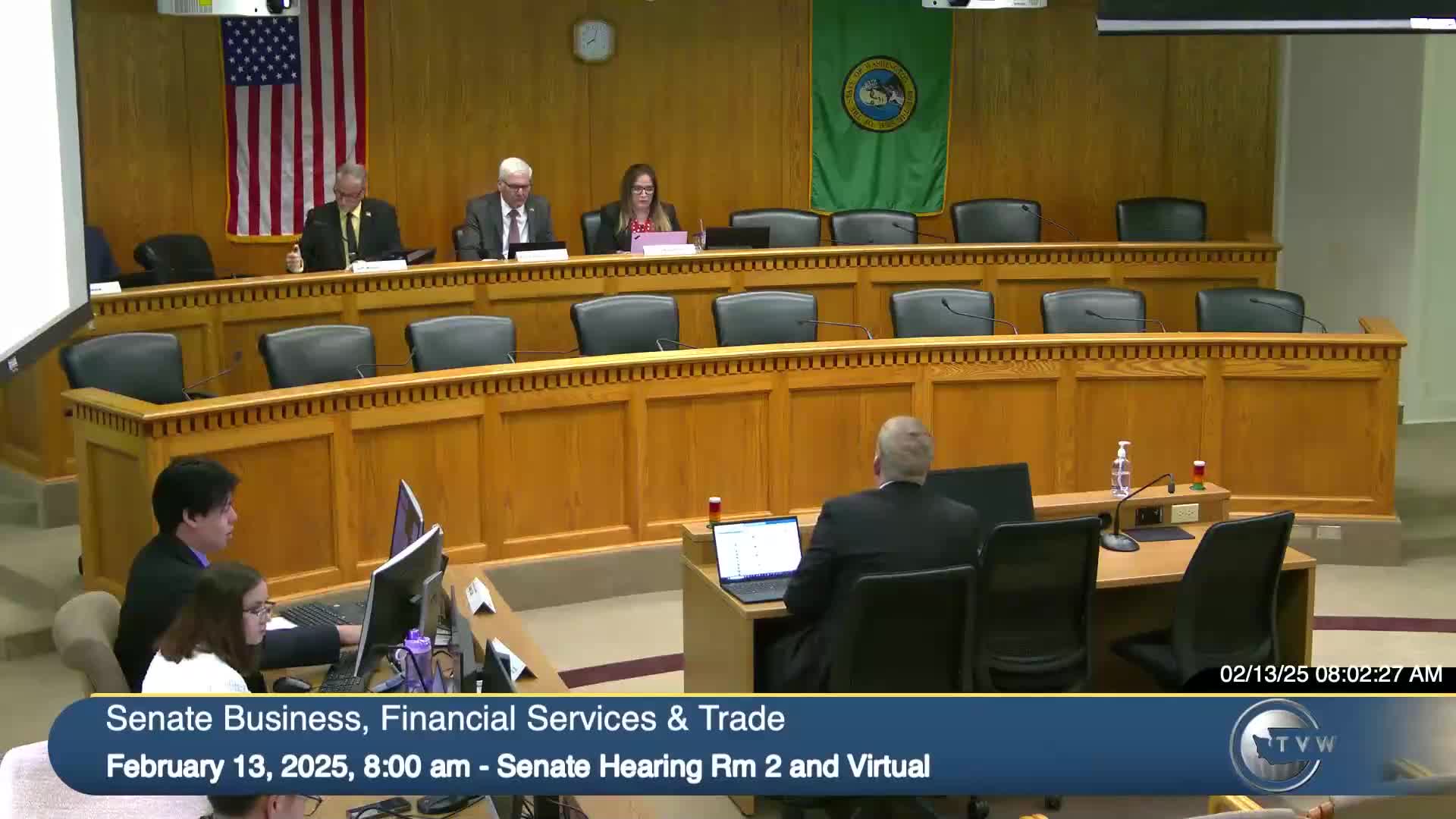
Senate Bill 5677, concerning associate development organizations (ADOs), received a public hearing Feb. 13 before the Senate Business, Financial Services and Trade Committee. The bill’s sponsor, Senator June Cortez, described ADOs as the state’s local economic‑development partners and urged the committee to support increased assistance targeted to both rural and urban counties.
Committee staff summarized the bill’s provisions. Under current statute, ADO awards are tied to per‑capita and county allocations that vary between urban and rural counties. Staff said SB 5677 narrows eligible contract purposes to ‘‘direct assistance’’ such as business planning and changes the award schedule: for urban counties the per‑county allocation cap would be raised (staff briefed the committee that the previous $300,000 cap for urban ADOs would be modified to a $500,000 cap under the proposed changes); for rural counties the bill sets a per‑county allocation range with minimums and maximums (staff described rural allocations of at least $85,000 and up to $150,000). The bill allows the required match to include cash, in‑kind contributions or a combination, but limits in‑kind matching to 25 percent. Reporting requirements specific to ADOs serving counties with populations over 1,500,000 (the staff briefing described this as applying to King County) would be removed.
Proponents from across the state urged passage. Suzanne Dale Estee, executive director of the Washington Economic Development Association, said the bill is intended to make statutory changes that are “cost neutral” while helping rural capacity and urban ADOs that were not aided by recent appropriations. "ADO funding from the state is leveraged by at least $6 for each $1 from the state," she said.
Regional ADO leaders gave concrete examples of local impact. Jennifer Baker, president and CEO of the Columbia River Economic Development Council, said the Clark County ADO achieved what she described as $34 million in business‑to‑business activity last year, secured 9 business retention or expansion wins, supported 445 jobs and attracted roughly $338 million in capital investment. Jenny Dickinson, who serves the Port of Columbia and the Columbia County ADO, described Columbia County as the state's second‑smallest by population (about 4,100 residents) and said the state ADO funds are essential to projects such as a countywide broadband build, an artisan food processing park and a new childcare center—initiatives Dickinson said would not have occurred without ADO resources.
Darren Raines of Greater Grays Harbor Inc. said ADO funding is a cornerstone of regional operational budgets and testified that each state dollar helps leverage public and private matches that are critical to local entrepreneurship, business retention, and job creation in rural counties.
Committee members asked questions about reporting, past legislation that added monitoring requirements for minority‑owned business engagement, and where final reports are filed. Staff said reports typically are delivered to the committee chair and circulated to members and staff; staff and the sponsor offered to follow up with specific legislative history on prior reporting mandates.
The committee did not vote on SB 5677 at the hearing. Public testimony concluded and the committee proceeded to other items on the agenda.