Get Full Government Meeting Transcripts, Videos, & Alerts Forever!
Get email alerts on the Children Online Safety topic
No spam. Unsubscribe anytime.
Senate committee hears bill to curb social‑media features for minors as supporters cite mental‑health harms, industry raises legal and practical concerns
Summary
Lawmakers heard hours of testimony on SB 5708, a proposal to require age assurance, limit data use and restrict ‘‘addictive feeds’’ for users under 18. Supporters cited mental‑health studies and personal tragedies; industry groups warned of First Amendment, privacy and interstate‑commerce problems and asked for changes.
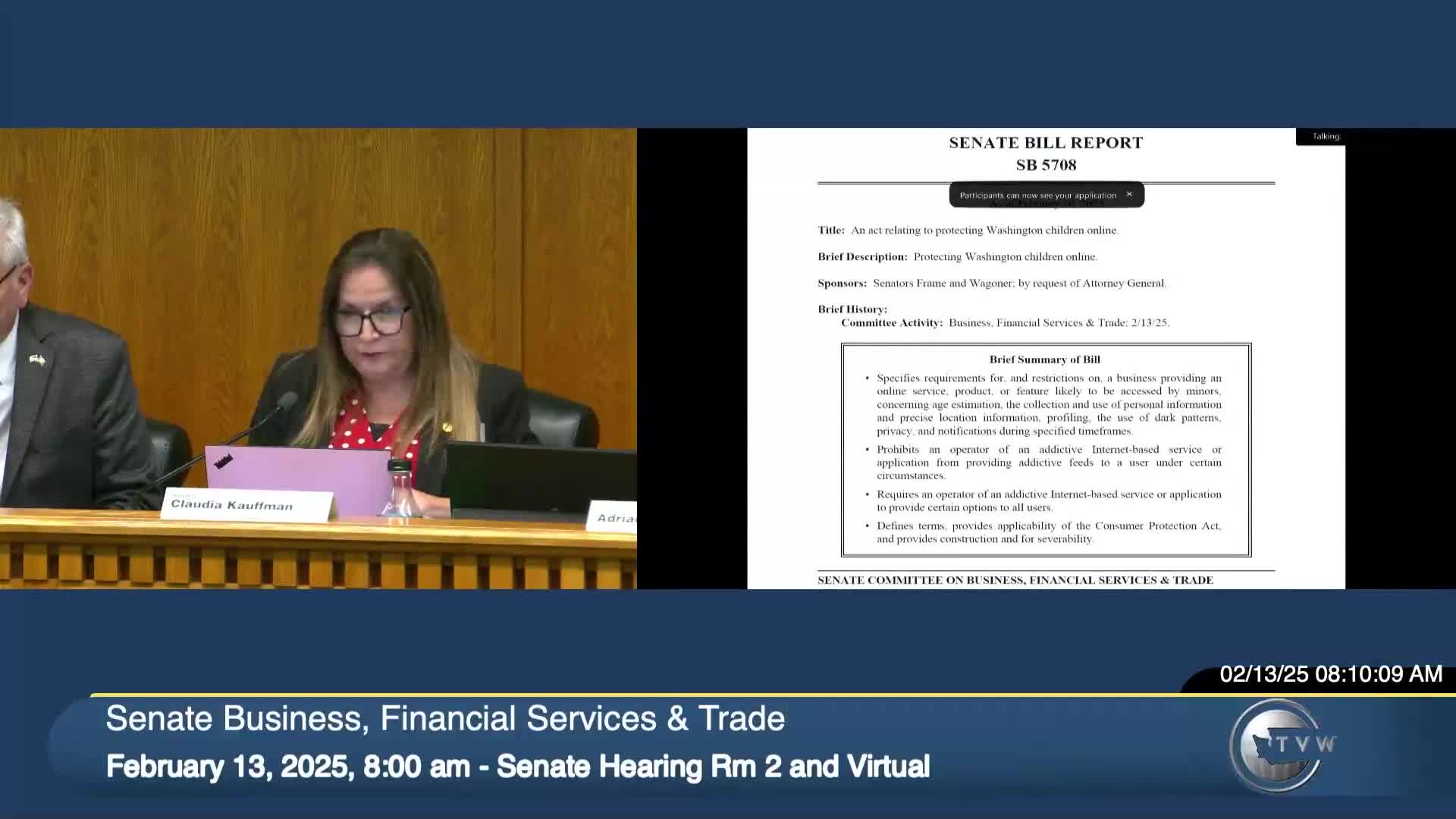
The Senate Business, Financial Services and Trade Committee held a public hearing Feb. 13 on Senate Bill 5708, a measure that would require online services likely to be accessed by minors to estimate user age with reasonable certainty, limit collection and profiling of minors’ data, restrict targeted notifications and prohibit ‘‘addictive feeds’’ to known minors until 2026 and more broadly beginning in 2026.
The bill’s sponsor, State Senator Noelle Frame, told the committee the measure is intended to protect children’s mental health and expand prevention alongside behavioral‑health services. "This bill will significantly improve and protect the mental health of Washington's kids," Frame said during her remarks to the committee.
Committee staff said the bill mirrors provisions in recently enacted California laws and in federal proposals such as the Children and Teens Online Protection Act and the Kids Online Safety Act, and that litigation over the California statutes in the federal courts — including in the Ninth Circuit — could affect how the Washington measure is applied. Adam Eitman of the Office of the Attorney General described the bill’s core requirements: reasonable age estimation or applying minors’ privacy safeguards to all users, limits on collection and use of precise location and profile data for minors, restrictions on “dark patterns,” default privacy settings and permitted notification windows, and options for users to limit exposure to addictive content. He noted enforcement would operate under Washington’s Consumer Protection Act.
Supporters who testified in favor said the bill responds to mounting evidence of harm. Taku Manashita from the Office of the Governor urged passage, citing the U.S. Surgeon General’s advisory on youth mental health and social media and warning that excessive use correlates with higher rates of anxiety and depression. Laura Marquez Garrett of the Social Media Victims Law Center described interviews and case reviews of children harmed by product features she characterizes as designed to create dependency: "The common factor is harmful dependency, due to product features intended to addict," Garrett said. Taj Jensen, a father whose son died after purchasing what he described as a drug through a social platform, testified that location features and algorithmic recommendations played a role in his son’s death and urged lawmakers to prioritize children’s safety over corporate profit: "It comes down to kids' lives or tech profit," he said.
Experts and advocates who support the bill also told the committee they expect platforms already use age‑estimation technologies and data profiles; those witnesses said the law would require companies to use that capability to protect minors. The Children’s Alliance and testimony from a public‑school teacher and parent highlighted student use during school hours and late at night and said limiting algorithmic targeting could have measurable public‑health benefits.
Industry representatives and business groups urged caution. Morgan Derwin of the Association of Washington Business and Rose Feliciano of TechNet said state‑level regulation risks running afoul of constitutional limits and the dormant commerce clause; Derwin pointed to litigation over California’s law and argued that state rules that effectively regulate out‑of‑state companies can raise legal exposure. TechNet’s testimony called parts of the draft “likely unconstitutional,” citing First Amendment and compelled‑speech concerns. Robert Singleton of the Chamber of Progress said the proposal would force operators either to verify ages via government ID or biometric data — raising privacy and security concerns — or to default to heavy-handed measures: "There are really only two definitive ways to verify a user's age with certainty: government ID or biometric data," he said.
Committee members asked multiple witnesses how companies would meet the age‑estimation requirement. Staff and AG office representatives acknowledged the bill leaves the specific methods to operators and noted rapidly evolving tools; several witnesses told the committee they would follow up with technical explanations. The committee also heard alternatives and practical concerns about compliance, enforcement costs and whether a state law would survive federal court challenges.
The bill drew a mixture of personal testimony, research citations and legal warnings. Student testimony from Lake Washington High School student Matthew Hong said the bill’s limits on profiling and dark patterns would better protect minors and urged safeguards that do not require identity documents. Supporters argued the bill balances protections for youth with parental rights and options for minors to be informed of parental tracking tools.
No vote on SB 5708 took place at the hearing. After a prolonged public‑testimony period that included dozens of witnesses for and against the measure, the committee closed the public hearing and later moved into executive session on several, separate bills.
The committee record shows extensive public comment and multiple requests for technical follow‑up from staff and the sponsoring offices; the chair did not take a formal vote on SB 5708 at that time.