Get Full Government Meeting Transcripts, Videos, & Alerts Forever!
Get email alerts on the Special Education Restraint Isolation topic
No spam. Unsubscribe anytime.
Committee Hears Bill to Limit Restraint and Isolation in Washington Schools; Sponsors Emphasize Training, Monitoring
Summary
Senate Bill 5,654 would ban specified types of restraint and isolation, phase out isolation for younger students unless narrowly authorized, require training and reporting, and expand OSPI monitoring and technical assistance. Supporters and opponents told the committee the measure needs funding and time to implement.
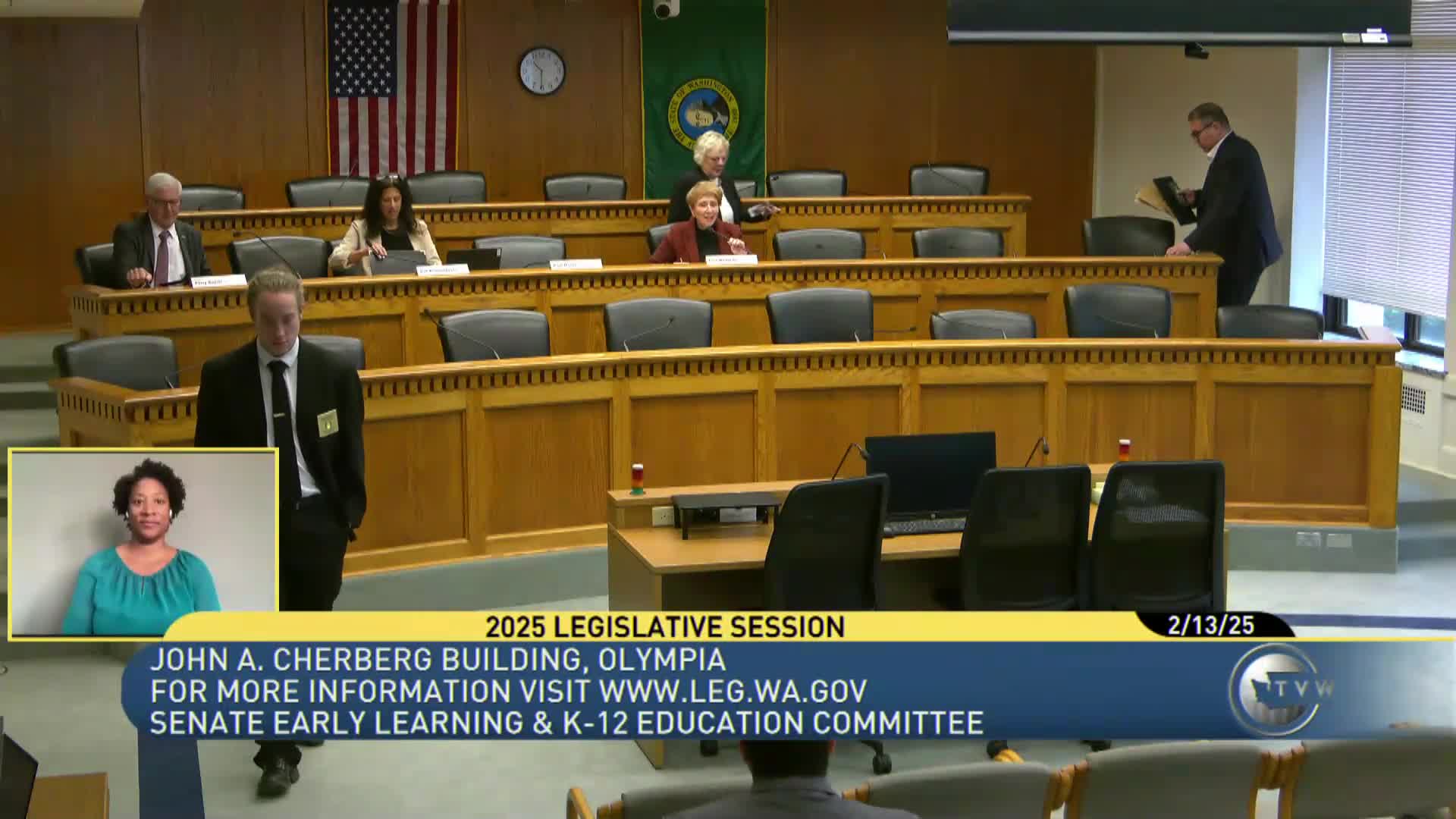
The Early Learning & K-12 Education Committee on an unspecified date heard Senate Bill 5,654, which would further restrict the use of restraint and isolation of students in public schools and related educational programs and expand state monitoring, training and reporting requirements.
Supporters said the bill strengthens protections for students while providing funding and technical support for staff; opponents and some school staff said the policy will require sustained funding, staffing and time to implement safely.
The bill would add roughly 16 new definitions, apply requirements to institutional educational providers and authorized entities that deliver special education services, and explicitly prohibit certain categories of restraint and isolation, including chemical and mechanical restraints and restraints that are life-threatening. Beginning Aug. 1, 2027, the bill would prohibit isolation for students in prekindergarten through fifth grade unless the parent or guardian requests and provides written consent and two licensed health professionals have recommended isolation and provided instructions. It would also prohibit designing or remodeling buildings to include a room or other enclosed area solely for the purposes of isolating a student and—starting Aug. 1, 2030—would prohibit constructing or equipping such a room for pre-K through fifth grade.
The bill requires districts and other providers to adopt policies and procedures that meet the bill’s requirements, to periodically update those policies with stakeholder input, and to monitor and analyze trends in incident reports. It directs the Office of the Superintendent of Public Instruction (OSPI) to review staff training plans and incident reports, provide technical assistance, place districts on improvement plans if they do not make sufficient progress, and adopt rules to implement the law. The bill also calls for expanded training requirements across educator preparation and certification systems, requires submission of staff training plans with annual updates, and directs OSPI to provide intensive crisis prevention and response training with regional coaching subject to appropriations. The measure extends existing demonstration project grants (previously funded in the 2023 and 2024 operating budgets) and requires a final report in 2026; a fiscal note was requested but not available at the hearing.
“Restraint and isolation poses an incredible risk,” said Senator Claire Wilson, sponsor of the bill, describing risks to both students and staff and urging that the bill be paired with substantial training and supports. Eileen Cotto, committee staff, summarized the bill’s charted comparison to current law and the proposed timeline and reporting requirements.
Advocates and professional providers described demonstration-site results and stressed the centrality of training and multi-tiered support. Misha Chernisky, testifying on behalf of the Office of the Superintendent of Public Instruction’s demonstration project, said pilot sites reported notable reductions: “36 percent of the pilot sites…have seen their restraint and isolation use drop by more than half” after roughly one year of work. Cindy Taylor of the Crisis Prevention Institute said districts using sustained training reported large declines in incidents and urged continued funding.
Disability Rights Washington attorney Andrea Catlick summarized recent state data and emphasized limits on the bill: “The room just can't be locked,” she said, noting the bill would not permit locking a student alone in a room and that the bill does not remove life‑saving restraint when necessary. Juliana Ali, who testified as a survivor of restraint and seclusion, urged stricter limits on parental consent and exemptions: “Abusive practices do not become less abusive merely because a parent or guardian has consented to them.”
Classroom staff and paraeducators described safety, staffing and implementation concerns. Joshua Shepherd, a paraeducator with Seattle Public Schools, described student trauma from past restraint: “The restraint and isolation practices legalized in this bill are outdated practices. They harm student well‑being and long term prospects.” Several paraeducators said districts currently face many unfilled positions and that retention and pay for paraeducators affect the feasibility of expanded training and staffing commitments in the bill.
School administrators and principals’ representatives urged caution about unfunded implementation costs. Roz Thompson of the Association of Washington School Principals said principals support the policy goals but emphasized the need for staffing and funding: “Our staff, our teachers, our paraeducators, our principals, are going to extraordinary lengths to preserve the dignity and the safety of students in their buildings. And we want assurance…that…temporarily confining and escorting students to rooms…is still allowed by this law, which it seems like it is.”
Supporters pointed to a multi‑pronged approach that pairs policy change with funded professional development, coaching and ongoing monitoring. Several speakers asked that the bill’s training, data reporting, and communication requirements be explicit, and that grant funding for demonstration projects continue so districts can scale alternative practices. The bill contains a null-and-void clause and several reporting deadlines the committee staff highlighted.
A range of stakeholders provided testimony during the hearing, including parents, students, disability advocates, state training providers, demonstration-site administrators, and school staff. The committee did not take a final vote on the bill during the public hearing portion.
The committee chair closed the hearing by inviting additional written testimony and materials from providers and stakeholders; OSPI and training providers said they would supply further detail on fiscal and implementation needs. The bill’s demonstration projects will continue to produce reports through 2026 and OSPI is tasked in the bill with annual monitoring and technical‑assistance reporting.