Get Full Government Meeting Transcripts, Videos, & Alerts Forever!
Get email alerts on the Consumer Debt Default Judgments topic
No spam. Unsubscribe anytime.
Committee hears uniform consumer-debt default-judgments bill; sponsors, advocates and industry agree more work is needed
Summary
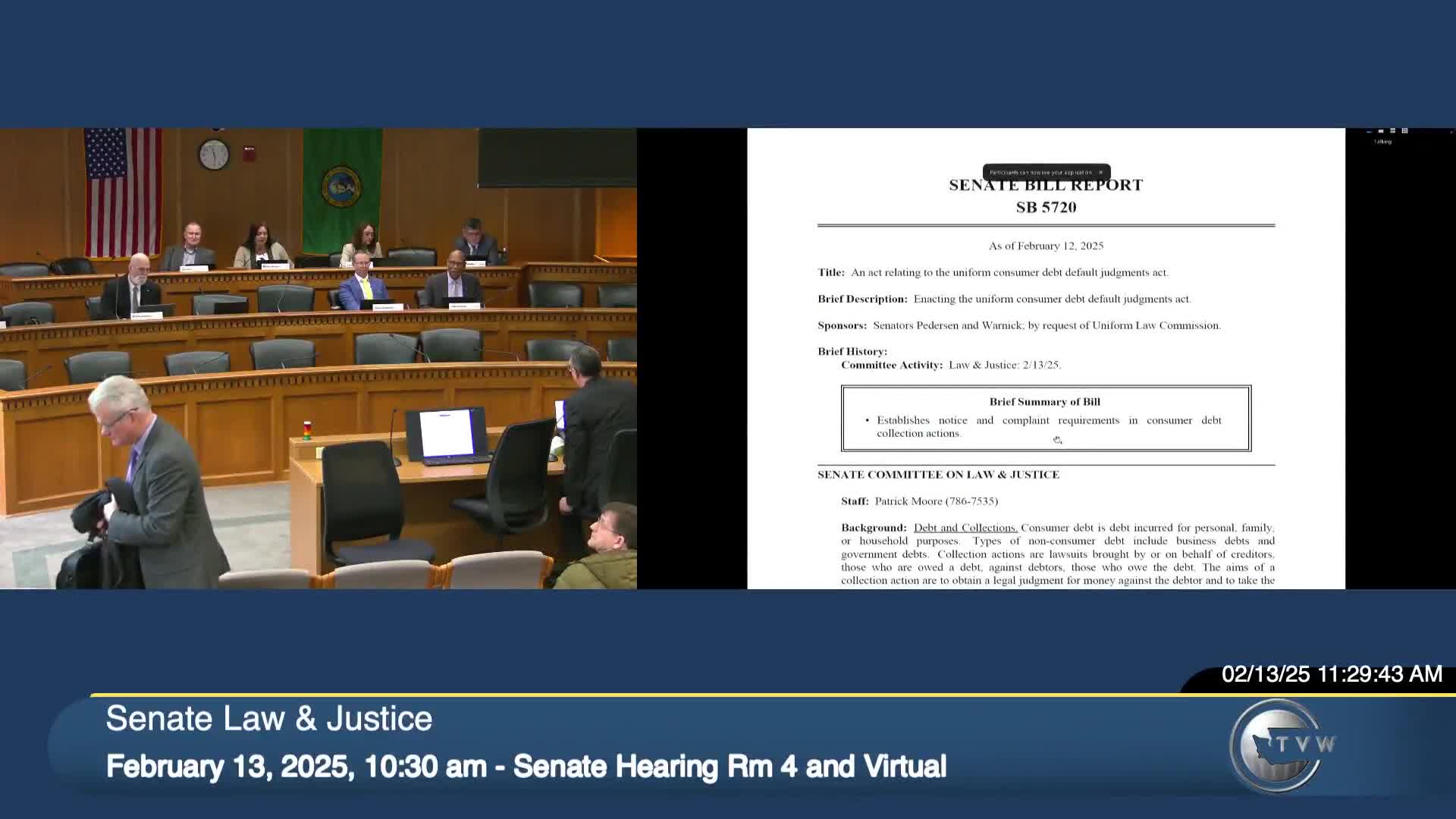
The Senate Law & Justice Committee held a public hearing on SB 5720, the Uniform Consumer Debt Default Judgments Act. Sponsor Sen. Peterson and stakeholders agreed the draft needs further stakeholder work to protect existing Washington consumer protections before it could move.
The Senate Law & Justice Committee on Feb. 13 opened a public hearing on Senate Bill 5720, the Uniform Consumer Debt Default Judgments Act, which would add notice and pleading requirements in consumer debt collection lawsuits. Sen. Peterson, the bill's sponsor, told the panel the measure is not ready to move this year and needs more stakeholder work.
The bill matters because default judgments in debt-collection suits are common and usually entered against unrepresented consumers, advocates and the Uniform Law Commission told the committee. Patrick Moore, staff counsel, said the bill would require complaints in consumer-debt cases to include itemizations of amounts sought and supporting documents and would, in some cases, require debt purchasers to state the chain of title for the account.
“Default judgments disproportionately affect our low-income clients,” said Julia Kellison, a consumer attorney with the Northwest Justice Project, in testimony. Kellison and other consumer advocates warned that as drafted SB 5720 could erode protections added to Washington’s Collection Agency Act in 2020, including pleading requirements for debt buyers and statutory remedies tied to violations of those rules.
Raymond Pepe, chair of the Uniform Law Commission drafting committee, said the model act responds to a national problem: large volumes of consumer-debt cases, very high default-judgment rates and low representation rates for defendants. “In many jurisdictions, 30 to 50% of the docket are debt collection cases,” Pepe said, and most consumers in those cases lack counsel. He said the Uniform Law Commission designed the act to give consumers clear information and to give courts standardized tools to screen deficient complaints.
Industry witnesses said they support a fair, uniform approach and praised the sponsor for stakeholder engagement. Donald Maurice, outside counsel for the Receivables Management Association International, said the act “adopts the core principles” from national court recommendations and urged more collaboration to adapt the model to Washington law. Kevin Underwood of the Washington Collectors Association called the bill “a fair treatment of some extremely difficult issues” and said creditors and collectors had made significant concessions in the draft before the committee.
Consumer advocates and legal services providers urged that any updated statute preserve the 2020 protections that require debt buyers to disclose whether they acquired a debt with any warranties, and preserve remedies that can reduce a debt and trigger consumer-protection claims when those rules are violated. Sam Leonard of the Northwest Consumer Law Center told the committee that debt buyers frequently purchase large data files without last statements and that inaccuracies often lead to default judgments.
Sen. Peterson said she hopes a revised substitute will be ready by the next session after interim stakeholder meetings involving courts, consumer advocates, debt buyers and collectors. The committee closed the public hearing with no vote taken; the sponsor announced plans for an off-session working group and further negotiation.
The committee record shows stakeholders from the Uniform Law Commission, legal services organizations and industry trade groups testified and asked for more time to reconcile the model act with Washington’s existing consumer protections. The matter will return if the sponsor files a revised substitute in a future session.