Get Full Government Meeting Transcripts, Videos, & Alerts Forever!
Get email alerts on the Higher Education & Workforce Development topic
No spam. Unsubscribe anytime.
Senate committee hears bill to create virtual campus for Washington community and technical colleges
Summary
A bill to create a statewide virtual campus and cross‑college online course portal for Washington’s community and technical colleges drew broad support in public testimony and endorsement from the State Board for Community and Technical Colleges, which said implementation will require additional staff and resources.
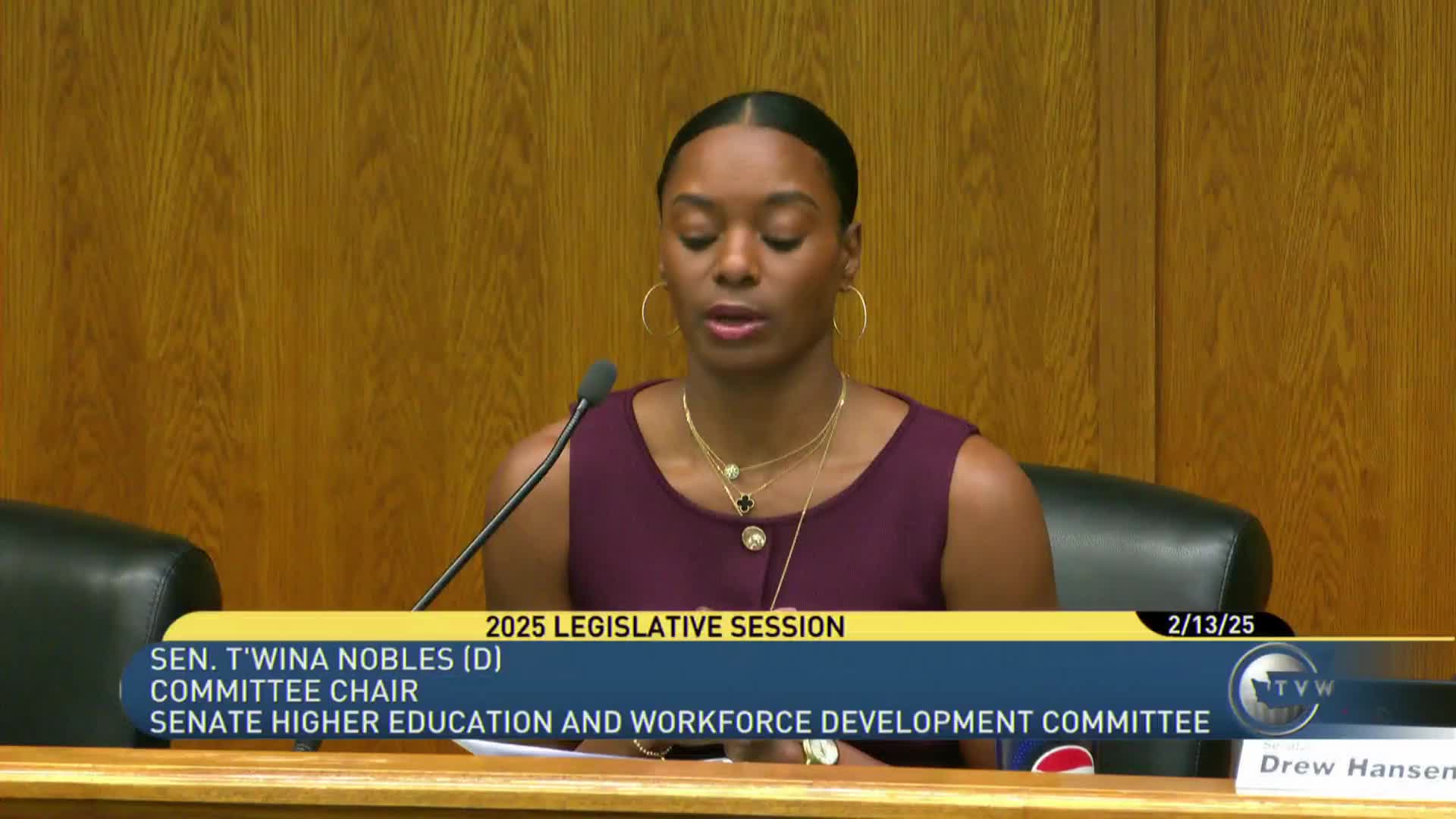
Chair Sen. Nobles opened a public hearing on Senate Bill 5663, which would create a work group and planning process to establish a virtual campus for Washington’s community and technical colleges and require a searchable statewide website of fully online course offerings.
Senator Vandana Slatter, the bill’s prime sponsor, said the proposal is aimed at expanding flexible, affordable access to credentials and accelerating workforce re‑entry. “We are in the middle of a workforce and affordability crisis,” Slatter said, adding that “flexible, online, high quality education must be part of the solution.”
Under the bill, a work group made up of the State Board for Community and Technical Colleges, the Washington Student Achievement Council and a faculty association would report back with legislation by Dec. 1, 2026, and the work group must consider a method to count students enrolled through the virtual campus for headcount and FTE reporting. The measure would also require the State Board for Community and Technical Colleges to establish a searchable website of fully online course offerings by the 2026–27 academic year and sets the goal of a virtual campus available by the 2028–29 academic year. The bill would lift current limits that prevent community and technical colleges from promoting programs outside their service districts when the programs are fully online.
Supporters at the hearing included students, college leaders and the executive director of the California Virtual Campus. Student testimony stressed access and transportation savings; a high‑school senior, Johnston Lai, said a virtual campus would let students “learn from the comfort of their own home without worrying about transportation.” Several higher education officials said Washington already allows simultaneous enrollment but lacks a centralized tool to find online courses systemwide. Joyce Hammer, deputy executive director for education at the State Board for Community and Technical Colleges, said the board “is very supportive of the concept” but emphasized the need for time and resources to build and maintain a statewide portal and to resolve technical issues for course sharing.
Representatives from colleges said technical and operational hurdles remain. Bob Morrifson, president of Centrari College, said course sharing today often requires “a lot of manual data entry” that would not scale and that available commercial tools did not meet existing needs. Dr. Marina Amini, executive director of the California Virtual Campus, described California’s experience with course‑sharing technology and offered to share lessons learned with Washington.
A fiscal note for the bill was requested but not available at the time of the hearing. No committee action was taken during the session; the hearing record will be used to inform committee deliberations and any potential substitute language.
The committee then closed the public hearing and proceeded to other business.