Get Full Government Meeting Transcripts, Videos, & Alerts Forever!
Get email alerts on the Virtual Campus For Ctcs topic
No spam. Unsubscribe anytime.
Senate committee hears bill to create virtual campus for community and technical colleges
Summary
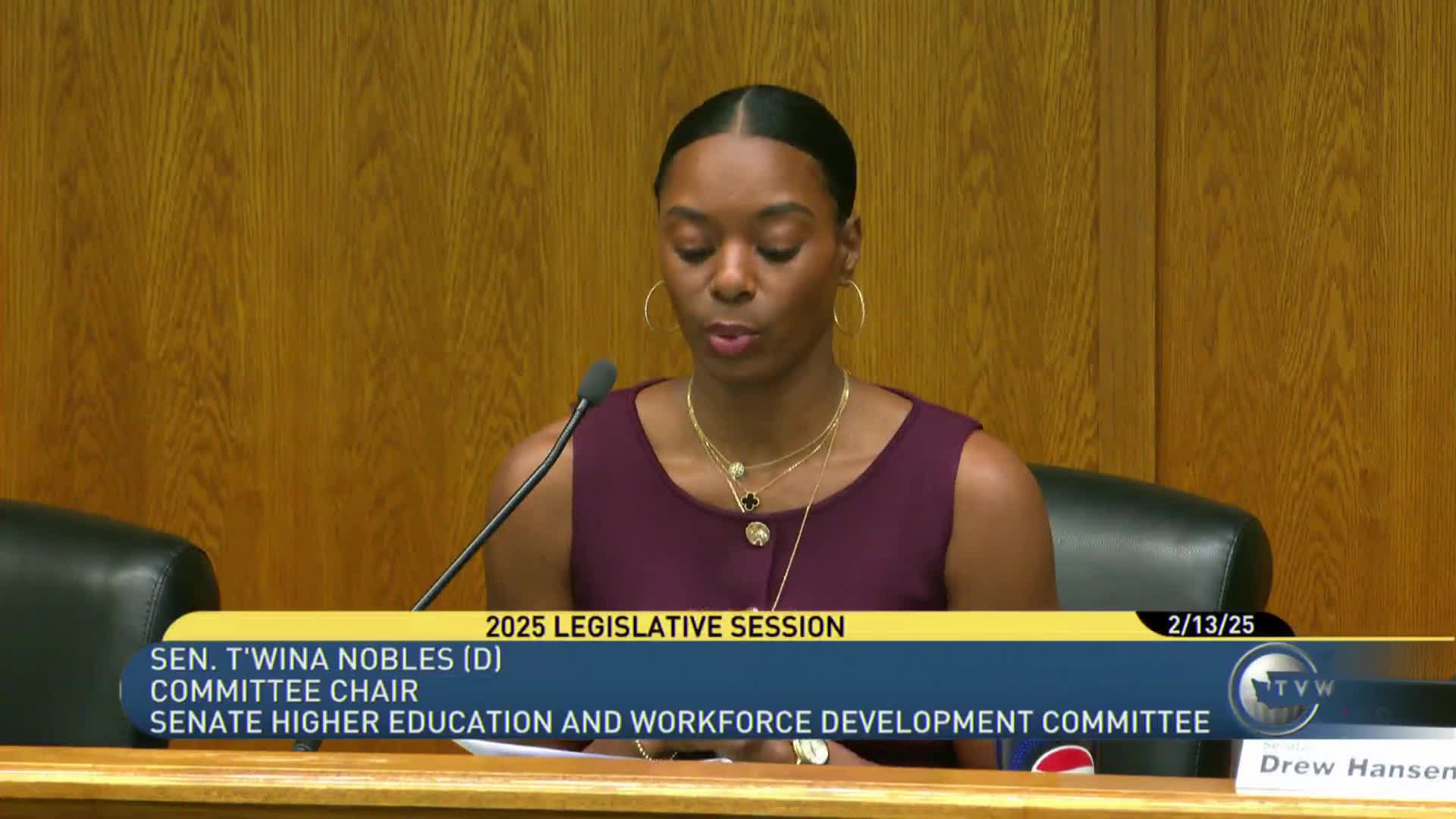
The Senate Higher Education and Workforce Development Committee opened a public hearing on Senate Bill 5663 on a proposal to establish “a virtual campus for all Washingtonians,” Kelly Gunn, committee staff, said in briefing the panel.
The Senate Higher Education and Workforce Development Committee opened a public hearing on Senate Bill 5663 on a proposal to establish “a virtual campus for all Washingtonians,” Kelly Gunn, committee staff, said in briefing the panel.
The bill, sponsored by Senator Vandana Slatter, would direct the State Board for Community and Technical Colleges and related partners to do three things: convene a work group to design a virtual campus and a method for counting headcount or full‑time equivalent students; create and maintain a statewide website listing fully online course offerings by the 2026–27 academic year; and allow community and technical colleges to promote fully online programs beyond their service districts. Gunn said, “Before you is Senate Bill 5663, an act relating to establishing a virtual campus for all Washingtonians.”
Why it matters: supporters said easier discovery and streamlined cross‑enrollment would expand access, particularly for working students, rural residents and those who cannot relocate. Senator Vandana Slatter told the committee the bill is intended to reduce barriers to upskilling and reskilling, saying Washington is “in the middle of a workforce and affordability crisis.” She urged the committee to support a centralized online hub where students could find courses and enroll across colleges without separate admissions at each campus.
Committee staff and witnesses described the bill’s timeline and resource needs. The work group must consider how to calculate headcount or FTE for students who use the virtual campus and report back to the Legislature by Dec. 1, 2026. Section 2 would require the State Board for Community and Technical Colleges to build and maintain a searchable website by the 2026–27 academic year; the fuller virtual campus is expected to be developed for the 2028–29 academic year. Gunn noted a fiscal note was requested but was not available for the hearing.
Students and educators who testified urged passage. Johnston Lai, a senior at Lake Washington High School, said the proposal would reduce transportation costs and make courses accessible “from the comfort of their own home.” Another student, Shuraj Padi, described using an out‑of‑state private online program because local options were not readily discoverable; he said a centralized portal could let students take in‑state dual‑credit or college‑in‑the‑high‑school courses without out‑of‑state costs.
Higher education professionals described both precedent and implementation hurdles. Joyce Hammer, deputy executive director for education at the State Board for Community and Technical Colleges, said the system already allows simultaneous enrollment across colleges but that the bill would better organize that option and make clearer a student’s ability to complete an entire online degree. Hammer said additional resources would be needed to develop and maintain the website, create marketing materials, and address technical work for course sharing. She noted Washington previously operated a course‑sharing program called Washington Online (created in 1998 and sunsetted in 2016) and retains experience from that program for some offerings.
Bob Morbacher, president of a community college, and others described practical barriers: manual processes for course sharing today, accreditation and student‑record protections, and the need to automate enrollment and transcript exchange to scale beyond small pilots. Morbacher said commercial tools assessed by colleges did not meet needs and internal solutions are being explored.
California’s experience drew particular attention. Dr. Marina Amini, executive director of the California Virtual Campus, described a system that lets students cross‑enroll in online classes across California community colleges without separate admission steps; she said enrollments have grown substantially and that California’s model required years of collaboration, technical work and change management.
Supporters emphasized workforce connections. Senator Slatter and several witnesses linked the bill to needs in health care, advanced manufacturing, clean energy and technology, arguing that easier online access could help fill skills gaps. Opponents were not recorded during this hearing on SB 5663.
The committee did not vote on SB 5663 at the hearing; members closed the public comment period and moved on to the next agenda item.