Get Full Government Meeting Transcripts, Videos, & Alerts Forever!
Get email alerts on the Traffic Safety topic
No spam. Unsubscribe anytime.
State Patrol and traffic safety commission present data on repeat traffic offenders, speeding and device use
Summary
State Patrol officers and the Washington Traffic Safety Commission told senators that repeat infractions, speeding and distracted driving continue to be major crash contributors; new telematics and survey data show high self‑reported speeding and higher device use on lower‑speed residential streets.
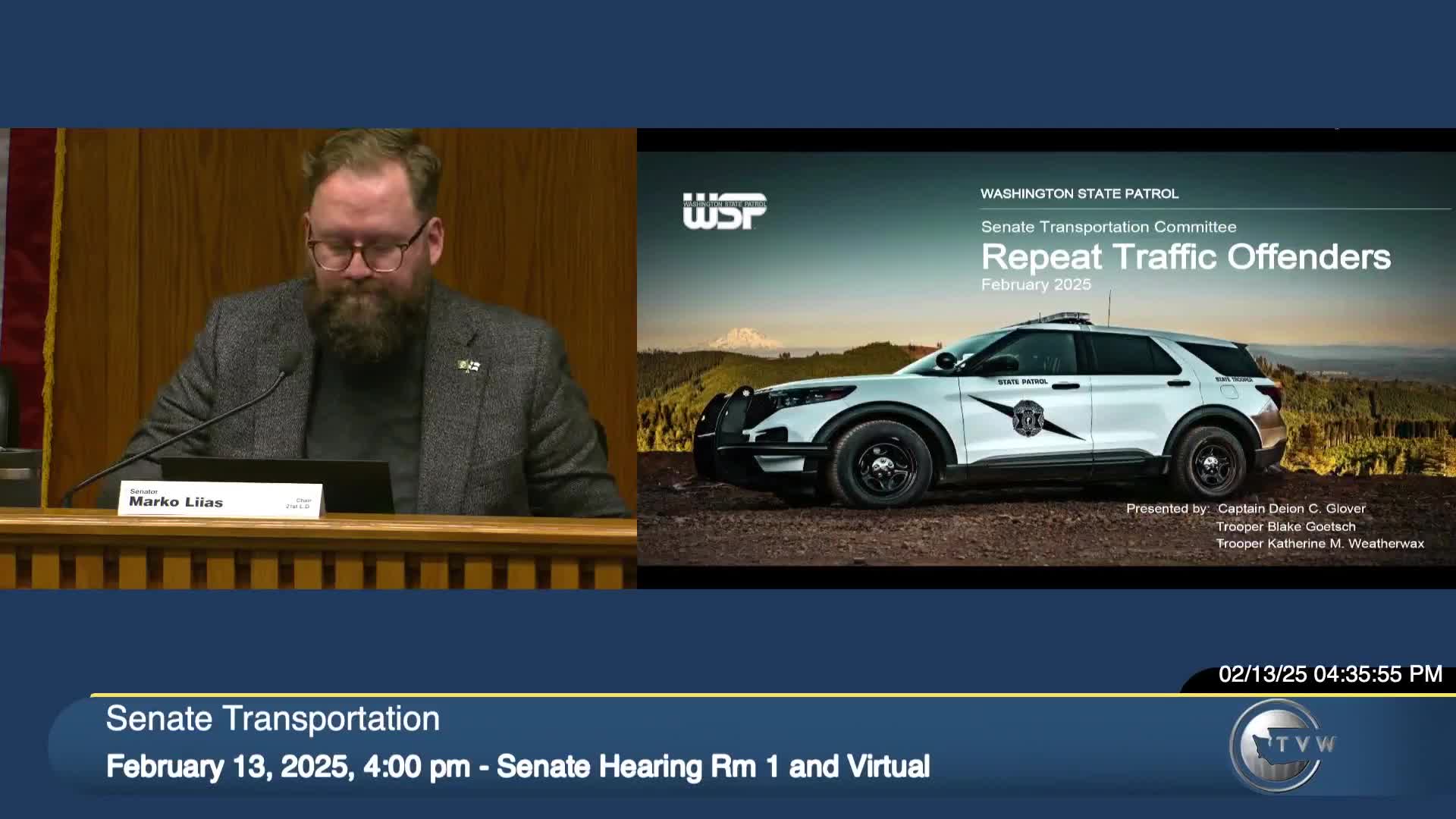
Captain Deon Glover of the Washington State Patrol and troopers Catherine Weatherwax and Blake Gooch briefed the Senate Transportation Committee on Feb. 13 about repeat traffic offenders and behavior change efforts, followed by a data presentation from Mark McKechnie of the Washington Traffic Safety Commission.
Captain Glover explained the agency’s focus on changing driver behavior with the “lowest use of enforcement” possible, combining education, verbal warnings and selective infractions for repeat offenders. He defined a repeat traffic offender for the department as an individual with more than one infraction on their driving record and said that some drivers receive repeated citations without changing their behavior.
Trooper Catherine Weatherwax, a collision technical specialist, described cases where drivers involved in serious injury collisions had prior speeding infractions on their records. Trooper Blake Gooch (Gooch/Goetzch in the transcript) discussed repeated distracted driving contacts he has encountered on the I‑5 corridor and said some drivers admitted a problem when engaged directly.
Mark McKechnie, External Relations Director at the Washington Traffic Safety Commission, presented statewide survey, fatality and telematics data. Key findings he highlighted:
- A statewide survey (2023–24) showed roughly 70% of respondents reported driving 10 or more mph over the posted limit at least once in the previous 30 days; device‑interaction measures were reported in the 30–40% range for different behaviors.
- Fatalities involving a speeding driver increased about 67% from 2014 through 2023.
- Telematics data (anonymous, opt‑in insurance app data) show that device use measured in minutes per hour is higher on lower posted speed roads (residential streets showed about 1.6 minutes per hour of device use) and that high‑speed episodes tend to be shorter in duration (e.g., 2.4 minutes per hour exceeding the limit on highways for certain cohorts).
McKechnie also showed that recorded citations for speeding fell substantially during and after the pandemic (a low point in 2022) even as speeding‑related fatalities rose, illustrating the complexity of enforcement, exposure and behavior changes.
Why it matters: WSP and the Traffic Safety Commission told senators they are seeking a broad array of interventions — education, targeted enforcement, technology and legislative tools — to address repeat offenders and behaviors most associated with fatalities, including speeding, impaired driving, seat‑belt nonuse and distracted driving.
Additional notes: Captain Glover and troopers encouraged legislators to take ride‑alongs to observe enforcement and investigations. Troopers and the commission noted an interplay between suspended licenses and uninsured drivers; some drivers with suspended licenses do not obtain insurance, which complicates enforcement and post‑collision remedies.