Get Full Government Meeting Transcripts, Videos, & Alerts Forever!
Get email alerts on the Harm Reduction topic
No spam. Unsubscribe anytime.
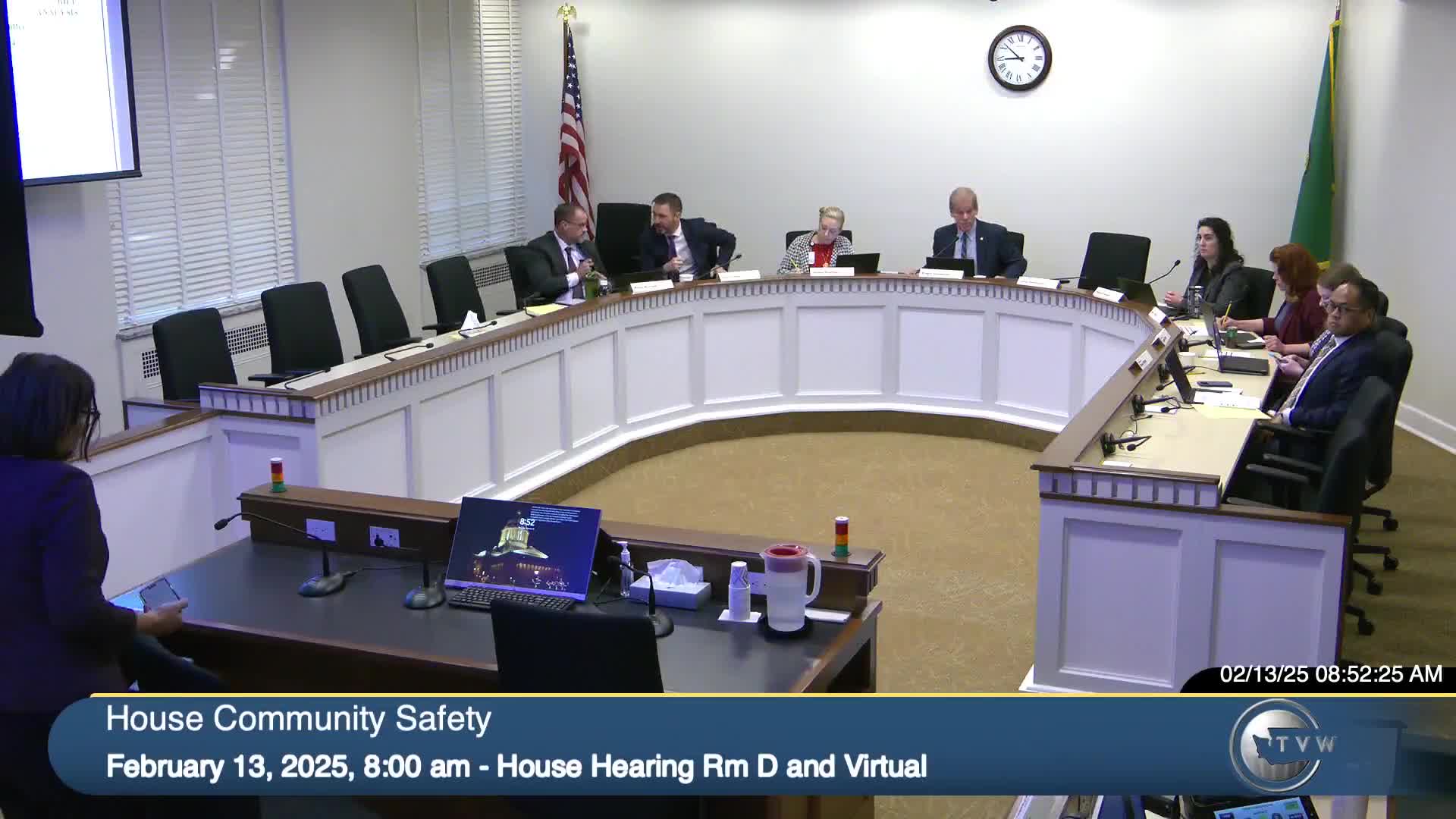
Committee hears bill to expand Good Samaritan protections and authorize drug checking and health-care distribution of harm-reduction supplies
Summary
House Bill 1574 would expand Good Samaritan protections for overdose response, protect clients who bring substances for drug checking, and broaden which health-care entities can distribute harm-reduction supplies; the committee heard wide-ranging testimony for and against the bill.
The House Community Safety Committee heard testimony on House Bill 1574, which would expand life-saving protections and legal clarity for harm-reduction services.
A staff briefing summarized current law: possession or use of controlled substances in public is a gross misdemeanor, with limited exceptions for those seeking medical assistance for an overdose; sales or distribution of paraphernalia are civil infractions; and state law preempts local regulation of drug paraphernalia except for a past carve-out for harm-reduction services. The bill as presented would do four things: expand Good Samaritan protections (shielding people acting in good faith who call for medical assistance from arrest, detention, charging, prosecution and some collateral penalties), add hospitals and health-care facilities to entities allowed to distribute harm-reduction supplies, exempt clients (not just staff) of drug-checking services from arrest or prosecution for bringing samples to be tested, and eliminate the local carve-out so that paraphernalia regulation is entirely governed by state law.
Sponsor Representative Macri said the bill makes modest adjustments to the 'Blake' framework adopted in prior sessions and aims to reduce overdose deaths by removing barriers to calling for help and by increasing access to harm-reduction services. Medical and public-health witnesses supported the measure. Caleb Banta-Green (University of Washington Addiction, Drug, and Alcohol Institute) described drug-checking programs and noted his team used on-site test strips, an FTIR spectrometer and confirmatory mass spectrometry in follow-up analysis. Public-health witnesses said drug checking and supplies reduce deaths and do not increase drug use.
A broad set of community organizations and service providers, including syringe-exchange operators and outreach teams, said the bill would protect lifesaving work and prevent local jurisdictions from blocking mobile services. Several students and local harm-reduction providers described personal community impacts and rising overdose counts.
Prosecutors and some law-enforcement speakers opposed or urged tightening of certain provisions, saying language as drafted could restrict officers’ ability to temporarily detain persons at emergency scenes, could be used to frustrate protection orders or be abused as coercive-control tactics, and might effectively decriminalize some behavior if broadly applied. The Washington Association of Prosecuting Attorneys and the Association of Sheriffs and Police Chiefs asked for narrower language to preserve officer safety and public-protection authority.
Ending: The committee took extensive testimony but did not take final action on HB1574 in this hearing; staff and members signaled follow-up and possible amendments.