Get Full Government Meeting Transcripts, Videos, & Alerts Forever!
Get email alerts on the I5 Bridge Revive topic
No spam. Unsubscribe anytime.
WSDOT narrows Revive I‑5 scope to limit closures, seeks contingency after unexpected cash‑flow needs
Summary
WSDOT said the Ship Canal Bridge deck requires major preservation; the agency will modify scope to postpone some long closures, free contingency funds and allow partners more time to prepare, after forecasting a $15 million shortfall in 2025 cash flow and noting uncertainty about deck repair quantities.
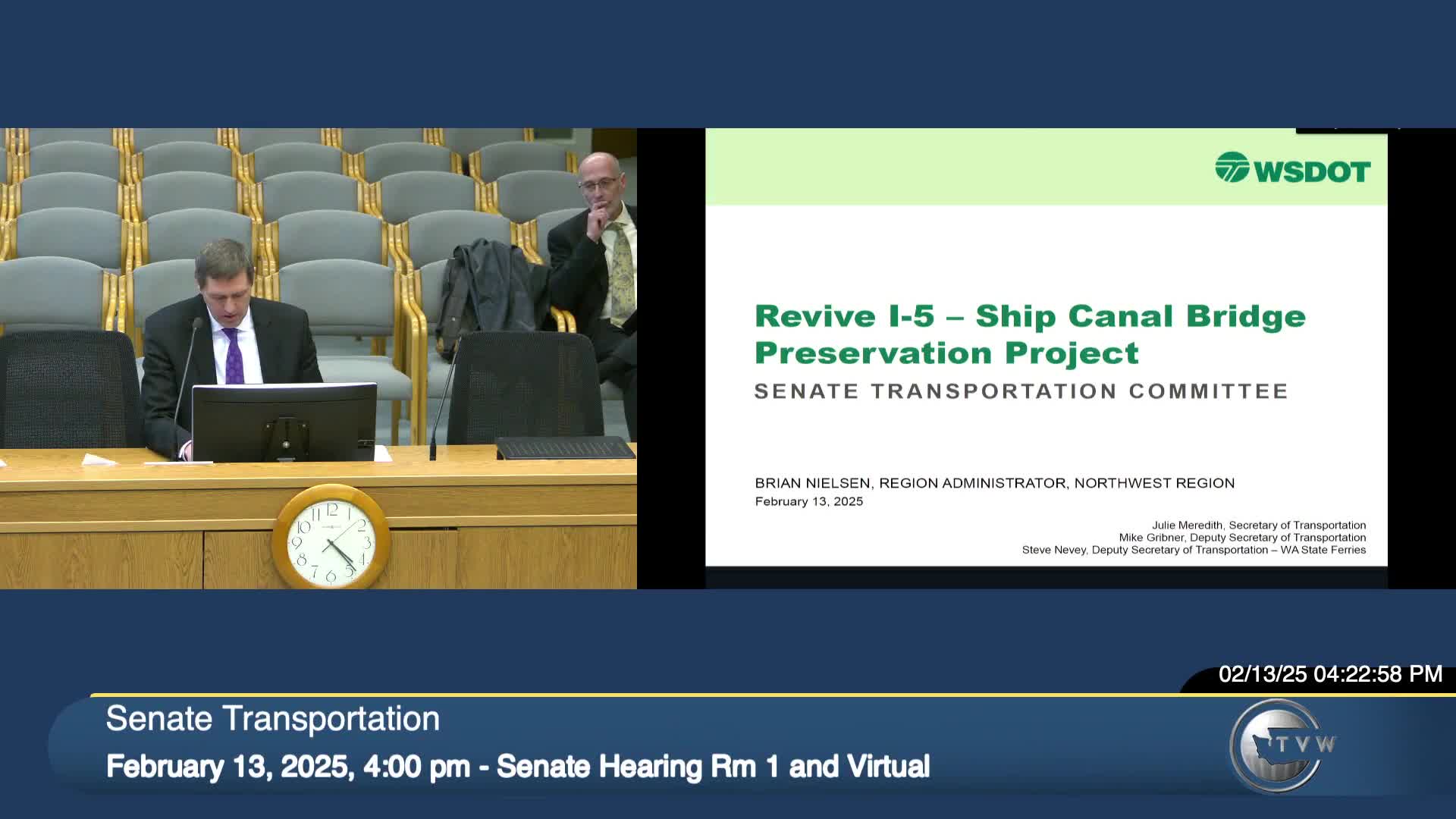
Brian Nielsen, regional administrator for the Washington State Department of Transportation’s Northwest Region, told the Senate Transportation Committee on Feb. 13 that the Ship Canal Bridge deck is showing serious deterioration and that WSDOT will adjust the Revive I‑5 project scope to reduce the near‑term impact on regional traffic and create additional contingency funding.
Nielsen said roughly 200,000 vehicles use the Ship Canal Bridge each day and the deck has not received major preservation in about 40 years. WSDOT, he said, has completed more than 200 emergency repairs on the deck since 2019. “As the deck continues to age those emergency unplanned repairs will become more frequent and more extensive,” Nielsen said.
The agency awarded a construction contract to Guy F. Atkinson and planned a construction phase budget of $248,000,000 from the preservation program. Nielsen told the committee that WSDOT previously budgeted $70,000,000 of spending in the current biennium through June 2025 but now forecasts $85,000,000 in cash needs for the same period, leaving a $15,000,000 gap that the project and the preservation program lack capacity to absorb.
To reduce risk, WSDOT said it will limit the near‑term scope to focus specifically on the Ship Canal Bridge work, postpone some long‑term lane closures that had been scheduled to begin in March, increase contingency funding to address unknown quantities of deck repair (the presentation stated the planned contingency was about $9,000,000) and continue negotiations with the contractor on schedule and scope. Nielsen said WSDOT will provide additional updates to the committee when agreements with the contractor are finalized.
Why it matters: WSDOT framed the change as a risk‑management step to avoid longer project timelines, reduce the chance that contingency will be exhausted once unknown deck repairs are exposed, and give regional partners time to secure their own mitigation resources. Nielsen also emphasized that the department will avoid high‑impact closures during the 2026 FIFA World Cup, a regional commitment the agency will honor.
Community outreach and mitigation: Nielsen said scaffolding work and other early construction activity began last fall; WSDOT is expanding community outreach, has offered noise mitigation options to neighbors and has added an environmental justice specialist to improve outreach to vulnerable groups. The agency also is collaborating with the Downtown Seattle Association and local business organizations on strategies to support the downtown core during construction.
Unresolved items: Nielsen said the extent of required deck repair will not be known until existing overlay is removed, creating uncertainty about final cost and schedule; he told senators the department will continue interagency coordination on traffic management and mitigation strategies and will return with more detail after contract negotiations conclude.