Get Full Government Meeting Transcripts, Videos, & Alerts Forever!
Get email alerts on the High Speed Rail topic
No spam. Unsubscribe anytime.
State transportation officials outline Cascadia high-speed rail work and joint I‑5 master plan
Summary
WSDOT and federal partners are advancing a service development plan for Cascadia high‑speed rail while coordinating it with an I‑5 master plan; state officials described grant awards, matching funds and a four‑year development window but said major design, environmental review and cost questions remain.
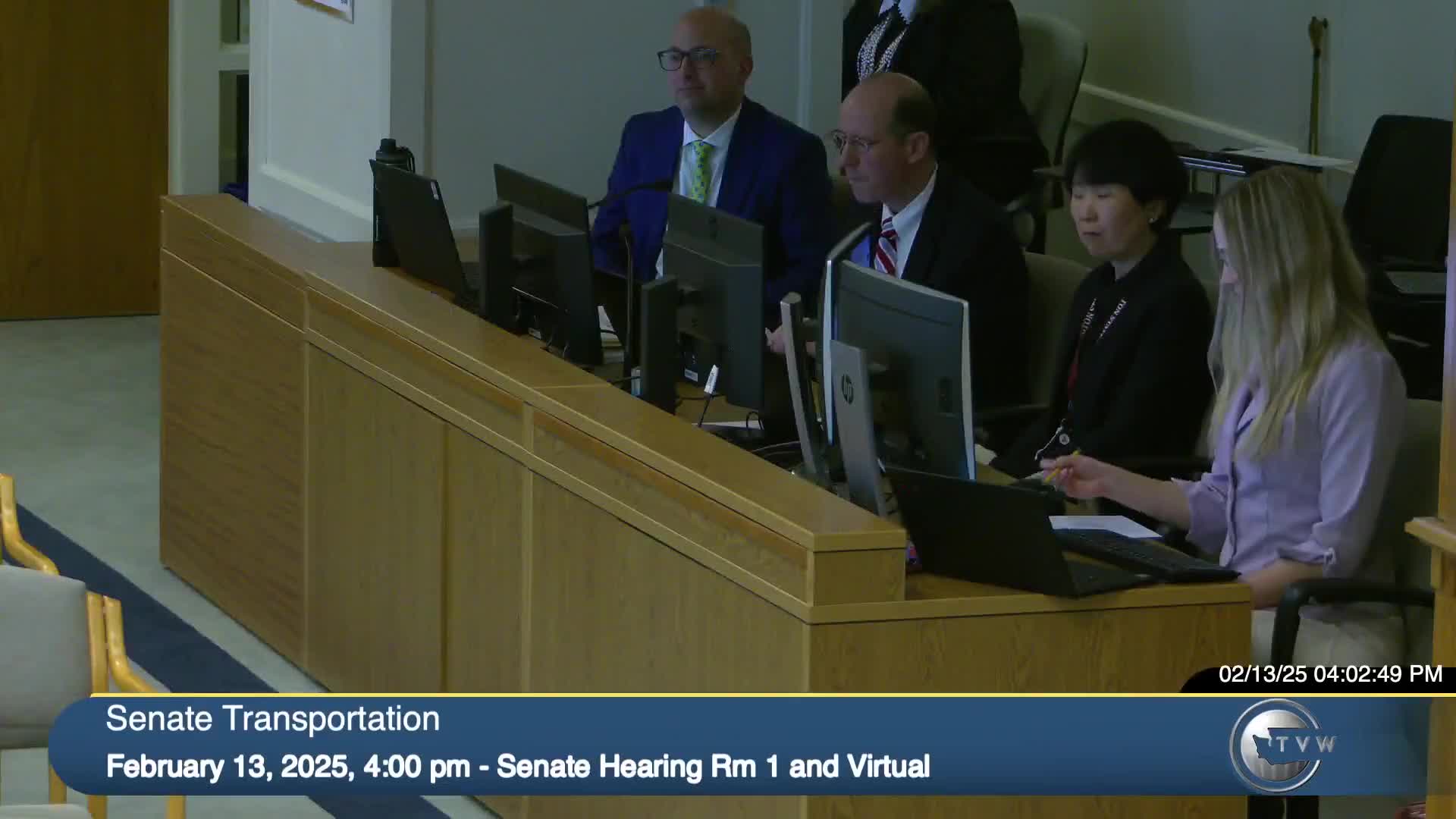
Ron Pate, acting assistant secretary for Urban Mobility Access and Mega Programs at the Washington State Department of Transportation, briefed the Senate Transportation Committee on Feb. 13 on the agency’s combined work on the Cascadia high‑speed rail program and the I‑5 master plan.
Pate said the agency consolidated the two efforts after legislative direction to “move those programs together” and told senators the combined approach is intended to surface tradeoffs among freight, intercity passenger rail, highway needs and other multimodal systems. “It’s one of those programs that we feel is really important to talk about together,” Pate said.
The update put several concrete items on the table: Washington was accepted into the Federal Railroad Administration’s Corridor Identification and Development (CID) program and in December was awarded federal CID funding Pate described as $49,700,000, with a state legislative match of $5,500,000; WSDOT will use the next four years through 2028 to develop a service development plan to answer governance, route, stop locations and financing questions; Pate said the agency anticipates a significant environmental process because the high‑speed alignment would be a new corridor rather than the current Amtrak Cascades right‑of‑way.
Why it matters: committee members pressed for clarity on costs, station locations and how the new high‑speed alignment would relate to existing Amtrak Cascades service. Pate emphasized that Amtrak Cascades is part of the planning conversation and said the programs are being coordinated so smaller communities remain connected. “We are not leaving Amtrak Cascades behind. It’s a well supported program,” he said.
Supporting details: Pate said the CID step‑2 work will require additional federal‑level environmental effort (NEPA project‑level work in step 3), and WSDOT estimates it would need roughly $30,000,000 as a 10% match to prepare for a possible $300,000,000 step‑2 request; the agency previously discussed a $250,000,000 federal‑state application. Pate also said private partners have shown interest, including a reported outreach from a Japanese high‑speed rail developer. He repeated that the governors of Oregon and Washington and the premier of British Columbia signed a 2021 memorandum of understanding to coordinate planning across the Cascadia mega‑region.
Committee questions focused on alignment (new corridor vs. using existing freight right‑of‑way), number and location of stops, and lessons learned from other U.S. high‑speed projects. Pate told senators the service development plan will address route and station questions and said the agency and FRA view the step‑by‑step process as necessary to avoid some mistakes made elsewhere: “If we do it upfront, we do the hard work upfront as making sure people understand what we're doing,” he said.
Remaining uncertainties: Pate repeatedly framed costs and specific station stops as outcomes of the service development plan. He said discussions with railroads such as BNSF will be required to determine where existing corridors can be used, and that the full extent of environmental review and associated costs remain to be defined.
What’s next: WSDOT will complete the service development plan and pursue the next CID milestones; Pate said the process will include community engagement and coordination with Amtrak Cascades, freight rail and regional partners.