Get Full Government Meeting Transcripts, Videos, & Alerts Forever!
Get email alerts on the Water Systems And Rates topic
No spam. Unsubscribe anytime.
Committee hears bill to tighten water system planning, limit utility rate returns
Summary
House Bill 1906 would change water system planning timelines, expand sampling options, and set new constraints for the Utilities and Transportation Commission when approving water-company rates and transactions.
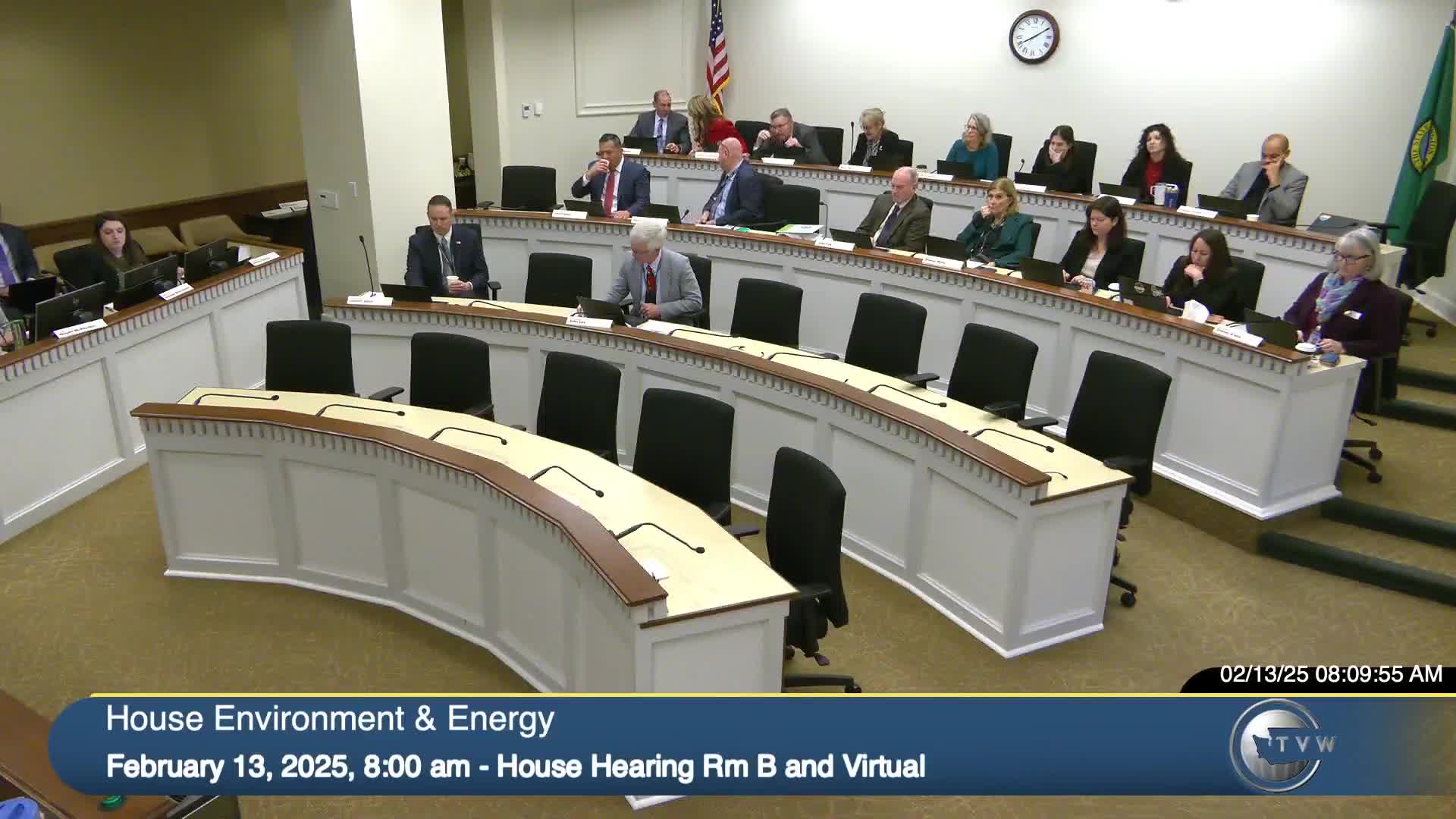
The House Environment & Energy Committee heard testimony on House Bill 1906 on Thursday. The bill would require public water systems to include all necessary capital improvement projects when submitting system plans to the Department of Health and to submit updated plans at least every three years rather than the current 10-year cadence for many systems. It would also change how the Utilities and Transportation Commission (UTC) assesses private water company rates.
Matt Sterling, staff to the committee, summarized the bill's mechanics: UTC would be required to adopt rules that set a rate-of-return ceiling of 7% and require detailed justification for returns above 5%; utilities would need to account for external funding sources when setting rates; and in consolidated systems the portion of capital costs attributable to a dissimilar system could not be absorbed into a single tariff if it exceeded the other system's costs by more than 5%.
Sponsor Representative Steve Thuringer (24th Legislative District) framed the bill as consumer-protection and reliability-focused, saying the state needs statutory guidance for regulators handling growing consolidation in water systems. "In many states... there is a separate agency that is the consumer advocacy agency that manages that and looks out for the consumer," Thuringer said, adding that the bill aims to strengthen UTC's role and set benchmarks for rate review.
Municipal and local utility groups raised concerns about the proposed three-year planning frequency. Kelsey Hulse of the Association of Washington Cities told the committee that Department of Health currently determines plan frequency based on system size and complexity; she warned that a blanket three-year requirement would be costly and that the added frequency would likely be borne by ratepayers. Representatives of public utility district associations and ports supported the bill's consumer-notice provisions and urged amendments to ensure local governments receive acquisition notice so customers might consider PUD takeovers of small private systems.
No action was taken; committee members suspended the hearing pending further drafting and stakeholder negotiation.