Get Full Government Meeting Transcripts, Videos, & Alerts Forever!
Get email alerts on the Housing Religious Property topic
No spam. Unsubscribe anytime.
Bill would lower affordability threshold for housing on religious land, expand tax-deferral eligibility
Summary
A House bill would let developments on land owned by religious organizations qualify for a local density bonus if 20% of units are affordable (down from 100%) and expand eligibility for a sales-and-use tax deferral. Supporters say faith communities hold underused land; counties warn of additional planning workload.
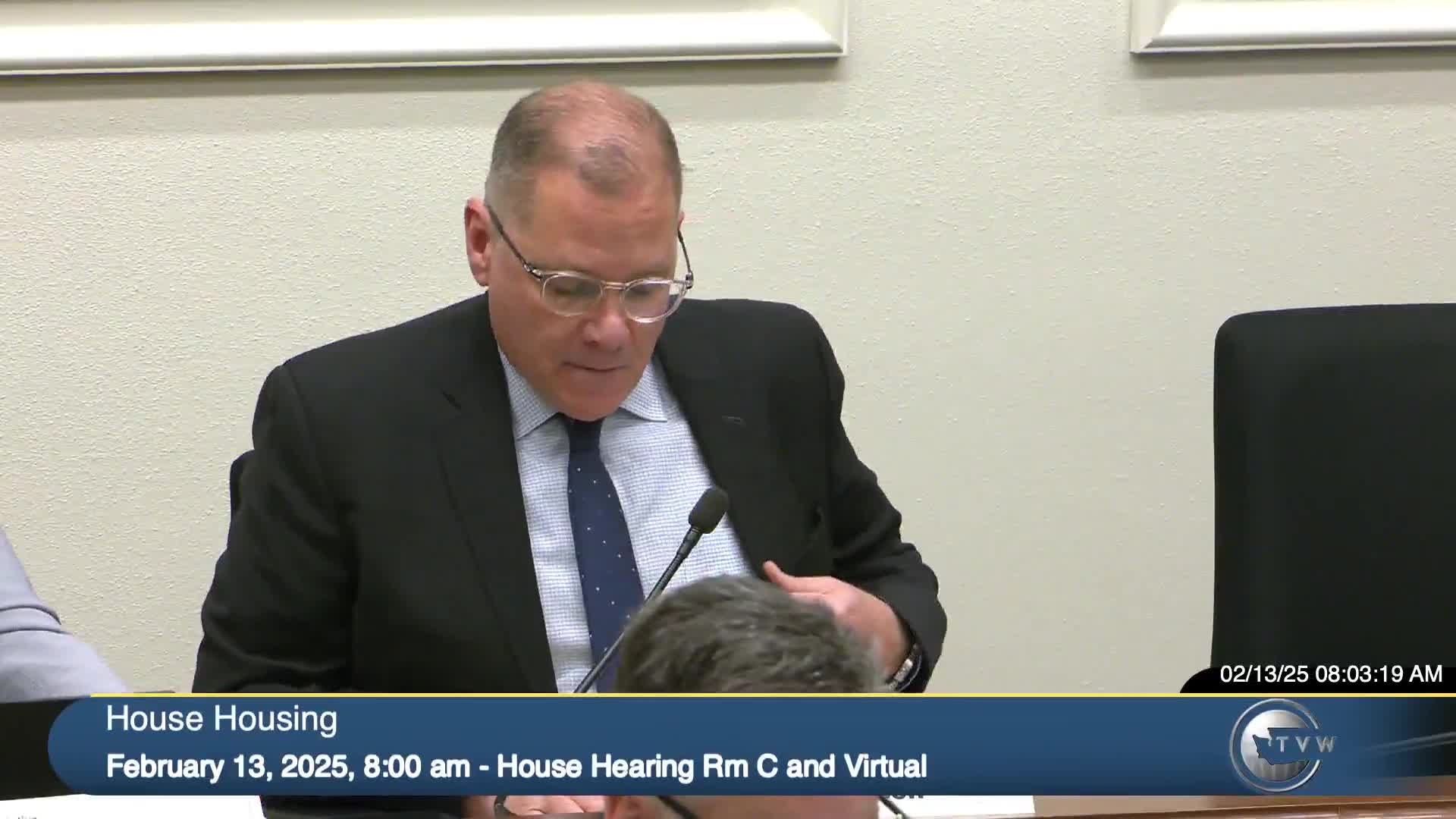
House Bill 18 59 would let residential projects on property owned or controlled by religious organizations qualify for a local density bonus if at least 20% of the units are set aside for low-income households for at least 50 years, Representative Usman Salahuddin told the House Housing Committee on Feb. 13.
The bill would also broaden eligibility for an existing sales-and-use tax deferral for conversions of underutilized commercial properties to affordable housing. Under current law staff described to the committee, a conversion project must maintain at least 10% affordable units for 10 years to avoid repaying deferred taxes; HB 18 59 would make lessees of religious-property eligible for that deferral.
Why it matters: The sponsor framed the bill as a supply measure that taps land held by faith institutions to help address Washington’s housing shortage. “We all know that we need more than 1,000,000 housing units in the next 20 years,” Rep. Usman Salahuddin said. The bill lowers the minimum set‑aside to 20% to make projects more financially feasible while allowing cities and counties to adopt higher local requirements.
Supporters said religious organizations often own large, underused parcels — parking lots and open space — and that lowering the threshold could unlock projects that do not currently pencil. Kristen Eng of the Faith Action Network said, “Faith communities across Washington state own underutilized land, especially large parking lots and open spaces,” and urged passage so congregations can “be part of the solution for Washington's housing crisis.” Brian Grow, board chair of Proclaim Liberty (a Spokane nonprofit affiliated with a Presbyterian congregation), pressed for an additional amendment applying similar sales-tax deferral language to the state’s “Parking to People” statute (RCW 82.92) because churches commonly own parking lots.
County officials supported the concept but raised implementation concerns. Curtis Steinhauer of the Washington State Association of Counties said county planning departments are already resource constrained and asked the Legislature to appropriate funding if the new duties are adopted.
The bill leaves multiple choices to local governments. Cities and counties that already allow greater density on religious properties could continue to do so, and the legislation explicitly lets jurisdictions adopt higher thresholds than the 20% minimum. It also requires jurisdictions to develop policies to implement a requested density bonus.
The committee held testimony from faith-based developers and organizations (including the Muslim Association of Puget Sound and other nonprofit developers) that said the change would help projects move forward; the committee did not vote on the bill during this session.
Questions and next steps: County staff asked for clarity on staffing impacts and potential funding to support review and implementation. One testifier requested a technical amendment to tie the sales-tax deferral expansion to RCW 82.92. The committee suspended and later resumed the public hearing to accommodate schedules; no amendment was adopted on the floor during the hearing.
Ending: The bill remains at the committee stage with supporters and local governments continuing to negotiate implementation details and potential technical amendments.