Get Full Government Meeting Transcripts, Videos, & Alerts Forever!
Get email alerts on the Local Government Finance topic
No spam. Unsubscribe anytime.
Counties seek authority to recover treasurer administrative costs; special districts and service providers oppose bill
Summary
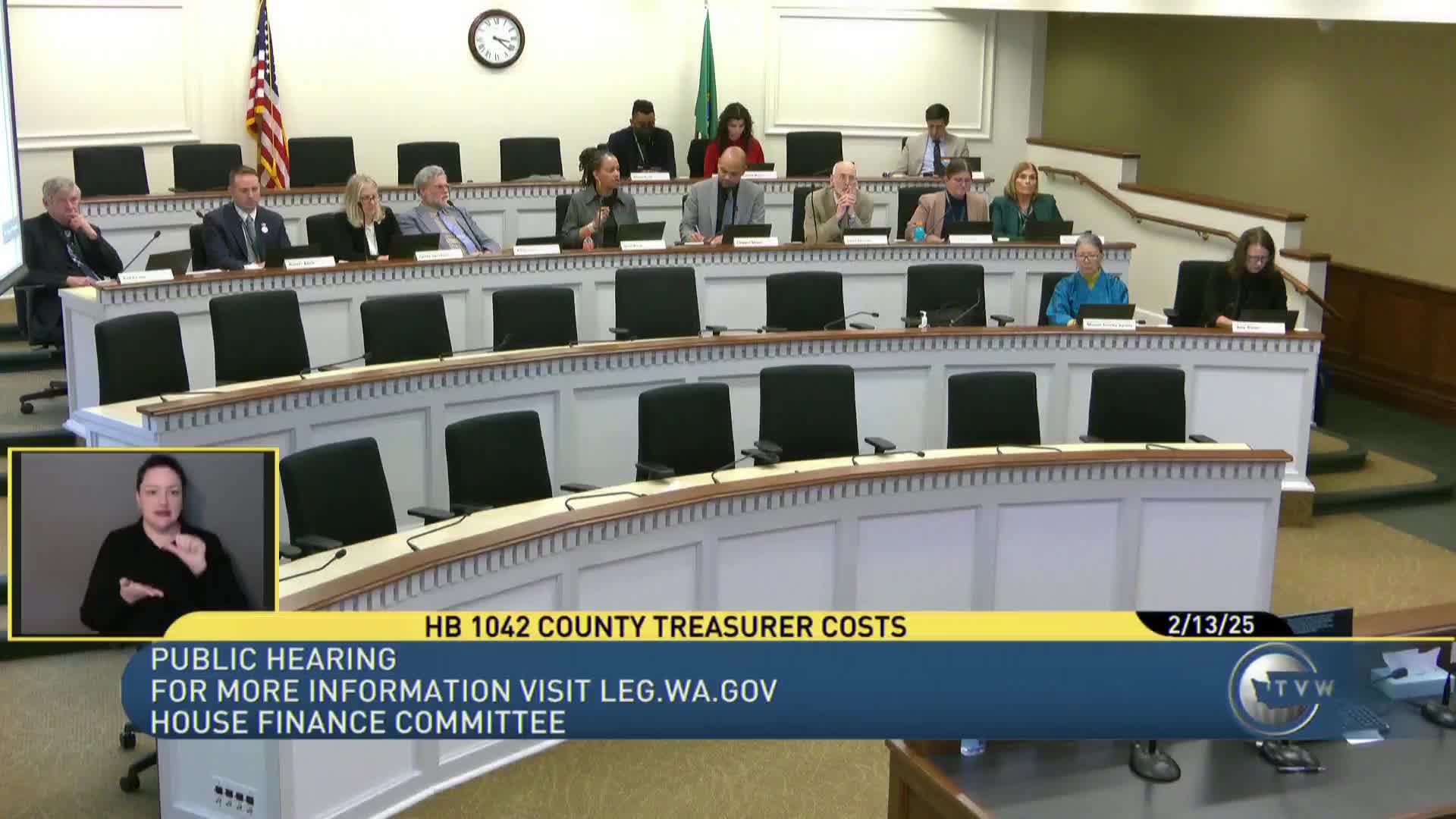
House Finance heard February 13 testimony on House Bill 10-42, a proposal to let county treasurers charge local taxing districts a cost‑recovery fee to recoup administrative costs of billing, collecting and distributing property taxes.
House Finance received extensive testimony Feb. 13 on House Bill 10-42, which would allow county treasurers to charge local taxing districts a cost‑recovery fee for the administrative costs of billing, collecting and distributing property taxes.
Committee staff (Tracy Taylor) described the proposal’s parameters: the fee is based on allowable actual costs from the prior 12 months; the first $50,000 of a taxing district’s aggregate collections is excluded; counties with population over 250,000 may charge up to 1% of a district’s tax roll and smaller counties up to 2%; the county must furnish the fee to affected taxing districts by Sept. 1 of the current year; and recovered costs would be credited to a county treasurer’s cost‑recovery account. Staff also explained districts could use the existing refund-levy mechanism to recover fees they pay to the county.
Representative Wiley (bill sponsor) framed the bill as addressing an administrative funding shortfall for county treasurers, saying treasurers are “the face of government” for many taxpayers and that existing funding models are stretched. Treasurer witnesses and county associations strongly supported the bill. Thurston County Treasurer Jeff Gadman, speaking for the Washington State Association of County Treasurers, said roughly 60% of treasurer workload serves districts other than the county and that current county general-fund support is not sustainable. Jennifer Wallace of the Washington Association of County Officials and Clark County Treasurer Alicia Topper also testified in favor, providing county-level cost figures and spreadsheets.
Opposition was widespread among special-purpose districts that rely on property-tax levies. School-district representatives (Schools Alliance) urged that if districts are required to use county treasurer services they should pay the actual cost, not an additional surcharge. Fire chiefs and commissioners from multiple counties said many fire districts already levy near the maximum allowed rate and would be unable to absorb the additional fee; they argued counties should use other means, such as levy increases, to address shortfalls. Hospital districts and public libraries said the measure would reduce funds dedicated by voters to direct services: “To take any of that away from the direct care of patients, which the voters specifically approved for that 1 purpose, will have a significant impact,” said Matthew Ellsworth of the Association of Washington Public Hospital Districts. Ports raised concerns about lack of prior notification and differentiated fiduciary roles across counties and ports.
Staff presented an illustrative statewide fiscal figure: the local-government fiscal note estimated an aggregate potential revenue impact for treasurers of about $80.2 million in FY 2026 and roughly $154.3 million in FY 2027 if counties charged the statutory maxima; staff emphasized these figures are illustrative and depend on county choices. The hearing record showed sharp disagreement over fairness and distributional effects; many witnesses urged further negotiation rather than passage as introduced.