Get Full Government Meeting Transcripts, Videos, & Alerts Forever!
Get email alerts on the Budget topic
No spam. Unsubscribe anytime.
Superintendent proposes 6.86% spending increase for Newington schools, cites contracts and state mandates
Summary
Superintendent Dr. Brummett presented a 6.86% proposed operating budget at the Feb. 10 Board of Education meeting, saying contract obligations and state mandates account for much of the increase and noting offsets from one‑time funds and grants.
Dr. Brummett, superintendent of the Newington School District, presented the district—s proposed 2025-26 operating budget at the Feb. 10 Board of Education meeting, asking the board to consider a 6.86% increase driven largely by settled contracts and state mandates.
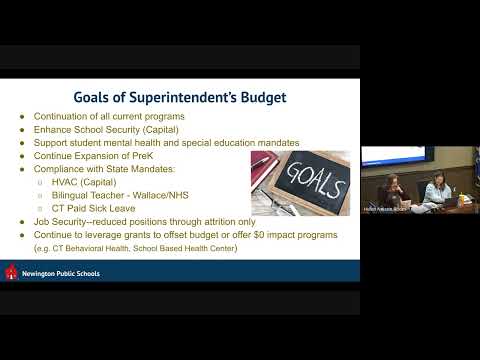
Dr. Brummett said, "My goals for the budget are to continue our current programs," and emphasized that much of the proposed increase reflects contractual obligations, special-education costs and new or clarified state requirements rather than new programs.
The administration detailed the principal cost drivers: approximately $2.3 million attributable to settled collective-bargaining agreements; rising special-education costs that the superintendent described as approaching 2% of the budget; health insurance increases of about 1.2%; and other operating increases (utilities, repairs and curricular supplies) of roughly 1.29%. The superintendent cited separate new or clarified state obligations including indoor-air-quality reporting and bilingual-staffing rules as additional, largely unfunded, pressures.
To temper the tax impact, the proposed budget relies on several one-time or non-recurring offsets. Dr. Brummett said the district expects to leverage nearly $2.7 million from the non-lapsing fund that will not be used this year, and that a memorandum of understanding with the town permits a $400,000 transfer from Open Choice special-education reimbursements into the operating budget. The presentation also assumed a 3% Open Choice reimbursement rate that the administration calculates would yield about $1.2 million in revenue; officials noted that moving to 4% would raise roughly $300,000 more but that seat fill rates make that funding uncertain.
The superintendent also identified several contingent or potential offsets under negotiation or review: a pending Nor'easter Academy grant (about $140,000), a proposed state-level change to excess-cost funding that could add an estimated $640,000, and the results of an ongoing special-education PERA audit that may allow internal reallocation of special-education expenditures.
Board members asked for clarifications about the non-lapsing fund math and the timing of grant awards; Dr. Brummett and finance staff responded that several figures are estimates and that some offsets depend on state actions or on enrollments that will not be firm until later in the fiscal year. The presentation warned that relying on non‑recurring funds reduces long-term flexibility and creates a future funding "cliff" if offsets are not replaced by recurring revenue.
The administration said the budget includes modest staffing requests targeted to maintain or improve services: additions discussed among others included a pre-K teacher, a district-wide bilingual teacher, a kindergarten teacher at Green, a school psychologist and expansion of several programs; many of those positions are shown with partial offsets from grants, tuition, or reallocated savings. The proposal preserves existing programs and singles out security, student mental health and compliance with HVAC and bilingual staffing rules as priorities.
The board scheduled further questions and a follow-up review later in the week; no final appropriation or vote on the full budget occurred at the Feb. 10 meeting.
Ending: Administrators asked the board to review the budget booklet, flagged timing risks tied to state actions and grant awards, and said staff would return with additional details and clarifications at the board—s next budget session.