Get Full Government Meeting Transcripts, Videos, & Alerts Forever!
Get email alerts on the Transportation Road Usage Charge topic
No spam. Unsubscribe anytime.
House Transportation Committee holds public hearing on HB 1921, a phased road-usage charge to replace shrinking gas-tax revenues
Summary
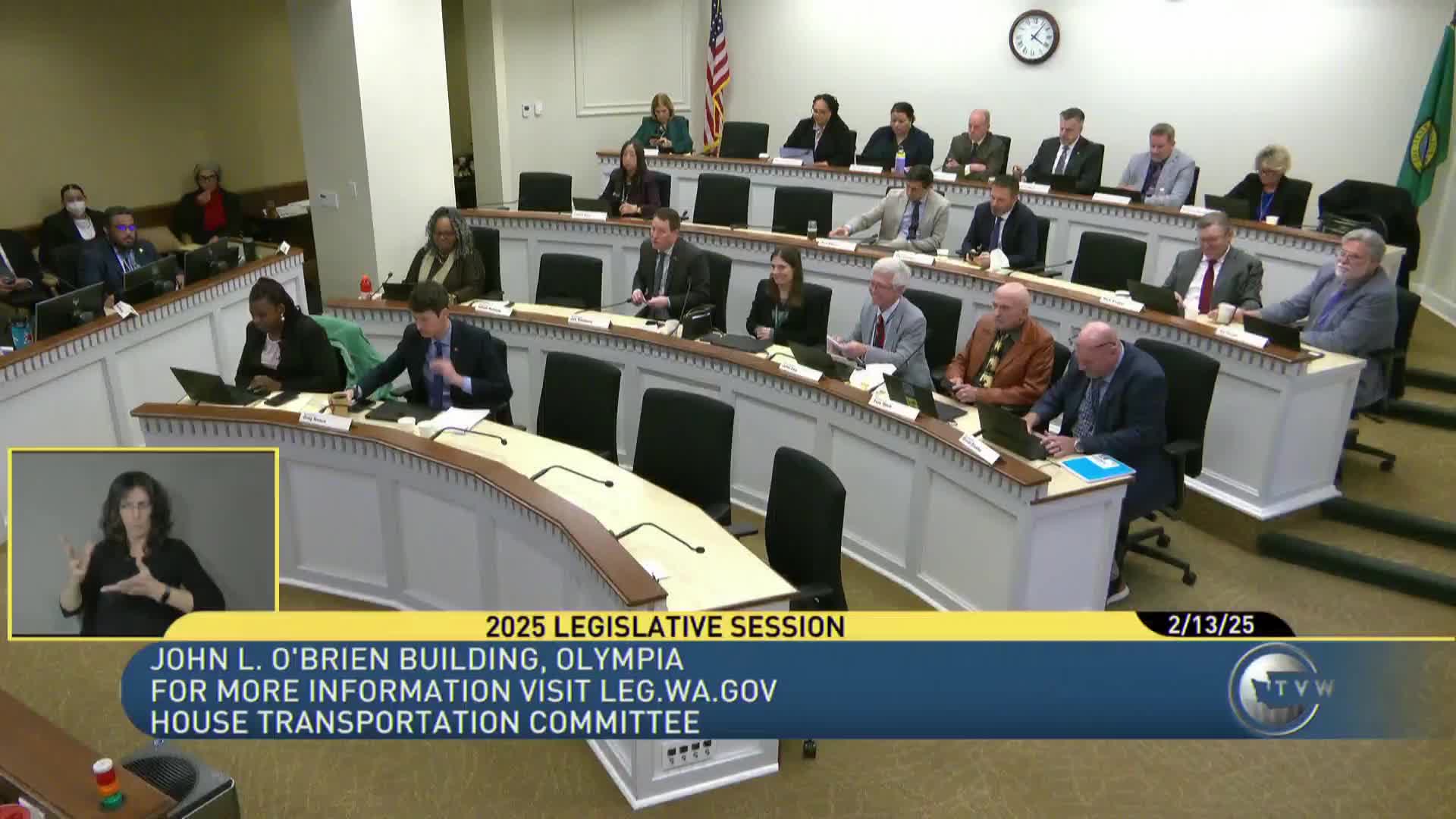
OLYMPIA, Wash. — The House Transportation Committee on Feb. 13 held a public hearing on House Bill 1921, a proposal to establish a road usage charge (RUC) that would levy a per-mile fee for use of public roadways and phase in mandatory enrollment over time, beginning with electric and hybrid vehicles.
OLYMPIA, Wash. — The House Transportation Committee on Feb. 13 held a public hearing on House Bill 1921, a proposal to establish a road usage charge (RUC) that would levy a per-mile fee for use of public roadways and phase in mandatory enrollment over time, beginning with electric and hybrid vehicles.
The bill would set a baseline road usage fee at 2.6 cents per mile and create a separate 10% road usage assessment, to be used for multimodal purposes such as rail, bicycle, pedestrian and public transit. Department of Licensing staff would administer the program; participants would report mileage by odometer or other approved methods and receive a credit for motor fuel taxes already paid. The bill includes multiple deadlines and direction for interagency reports, tribal consultation and legislative oversight.
Why it matters: Washington’s gas-tax revenue has fallen as vehicles become more fuel-efficient and electric, and committee presenters and many municipal groups told lawmakers that counties and cities face growing preservation and maintenance backlogs. The bill’s supporters say a per-mile fee protects the “user pays” principle and stabilizes revenue for highway preservation; opponents say the proposal is regressive, risks privacy encroachment, and could disproportionately burden rural and low-income drivers.
Presentation and bill summary
Jennifer Harris, committee staff, summarized the bill and the Transportation Commission’s multi-year work on RUC: “House Bill 19 21 concerns establishing a road usage program.” Committee and agency presenters described the bill’s main features: a voluntary enrollment window aimed at EVs and hybrids beginning in July 2027, a later window for certain higher-efficiency internal-combustion vehicles, and a mandatory phase that would begin with electric and hybrid vehicles in July 2029 and include additional ICE vehicle categories in subsequent years. The bill limits program eligibility to vehicles that can exceed 35 miles per hour and have a gross vehicle weight rating of 10,000 pounds or less.
Reema Griffith of the Washington State Transportation Commission briefed the committee on national experience with RUC pilots and programs, noting Washington’s role in long-running testing. “We’ve been at it for about 12 years researching and testing and trying to explore all of the potential implications,” Griffith said, and added that “protecting privacy through laws and mileage collection options is pretty standard.” She pointed to enacted programs in Oregon, Utah, Virginia and Hawaii and described odometer-based reporting as a lower-cost, privacy-protecting option that other states have adopted.
Key program mechanics and fiscal points
- Road usage fee: 2.6 cents per mile (bill text). The rate is designed to automatically adjust if the state fuel-tax rate changes by statute; participants receive a credit for the motor fuel tax attributable to their vehicle’s fuel consumption. - Road usage assessment: 10% of the road usage fees owed after credits and exemptions; revenues are directed to multimodal purposes (rail, bike/pedestrian, public transit) under the bill. - Reporting: Participants must submit periodic odometer mileage; DOL may offer automated reporting options but must protect personally identifying information and may only collect location data with informed consent. - Standard deduction: the bill applies a standard 200-mile deduction per 12-month period when calculating fees for enrolled vehicles. - Start-up and operations: Committee staff reported preliminary Department of Licensing estimates of roughly $6.5 million in start-up and initial ongoing costs; the formal fiscal note was not yet available at the hearing. - Constitutional protections and distributions: The bill creates a “road usage charge highway account” within the motor vehicle fund and says revenues must be used for preservation and maintenance; the bill also establishes a separate account for the 10% assessment. Committee staff reviewed language intended to comply with the state constitution’s limits on highway funds (the transcript references the state’s Eighteenth Amendment).
What the Transportation Commission and staff told the committee
Commission and staff witnesses urged a phased, voluntary start focused on EVs and high-mileage vehicles and emphasized the Commission’s finding that odometer reporting is an effective, lower-cost option that reduces privacy risks compared with GPS-based tracking. As Griffith summarized, “Many concerns about RUC are based on outdated notions that road charging requires the use of GPS to report annual miles. The commission’s testing and research has proven this is not needed, and other states are living proof that simple odometer reports work.” Committee staff clarified that, as drafted, the road usage charge would not simply replace all gas-tax revenues immediately and that fuel-tax credits would offset amounts owed by vehicle owners.
Public testimony: points for and against
More than 100 individuals registered to speak. Supporters included local governments, transportation agencies and industry groups that emphasized preservation needs and long-term revenue stability. Jane Wall of the County Road Administration Board testified: “The gas tax is a fleeting revenue source, and critical preservation and maintenance programs… are at risk of losing their overwhelming majority of revenues.” Local-government associations (cities and counties), the Puget Sound Regional Council, ports, construction and trade associations, and transit groups voiced general support, urging protection of distributions to local jurisdictions and stronger guarantees that funds will be dedicated to preservation.
Opponents and concerned citizens raised privacy, equity and administrative-cost objections. From the public record: Jeff Pack of Washington Citizens Against Unfair Taxes said, “This bill is predatory. It’s discriminatory.” Multiple speakers described the proposal as regressive for rural drivers and people on fixed or low incomes, and several urged sending a funding change to the ballot. Testimony from app-based drivers and their advocates asked the committee to study impacts on gig-economy workers, who typically drive high annual miles and operate on thin margins.
Unresolved questions and committee directions
Committee staff and presenters identified several items that will require further specification or study: the detailed fiscal forecasts and the formal fiscal note from DOL; exact rulemaking for reporting methods and privacy protections; how fuel-tax credits will be calculated in individual cases; and the bill’s phased schedule for mandatory enrollment for different vehicle classes (the bill text sets specific start years for some categories). The bill also directs agencies to coordinate tribal consultation and tasks the Joint Transportation Committee with studies on tribal applicability, road wear by heavy vehicles, and potential local revenue mechanisms to complement a statewide RUC. DOL is required to conduct outreach and to request odometer readings at vehicle registration and renewal beginning July 2026 (providing the option remains voluntary for non-enrolled vehicles).
The committee did not vote on HB 1921 during the hearing. Lawmakers heard testimony and invited additional written input and technical follow-up from agencies; presenters and dozens of citizens asked for more time to refine fiscal estimates, privacy safeguards and equity protections.
Next steps
Committee staff said the formal fiscal note and additional agency comments remain pending. The hearing closed after an extended public record. The committee indicated members would continue stakeholder work and legislative drafting prior to any floor action.
Ending
The chair adjourned the Feb. 13 hearing after public testimony concluded. No final committee action was taken at the session.