Get Full Government Meeting Transcripts, Videos, & Alerts Forever!
Get email alerts on the Environmental Permitting topic
No spam. Unsubscribe anytime.
Committee hears public testimony on bill expanding Ecology oversight of landfill permits
Summary
Substitute House Bill 11 54 would require Department of Ecology review and approval of landfill permits, expand suspension and penalty authority, and allow appeals to the Pollution Control Hearings Board; stakeholders raised concerns about overlapping authority and requested clarified language or alternative approaches.
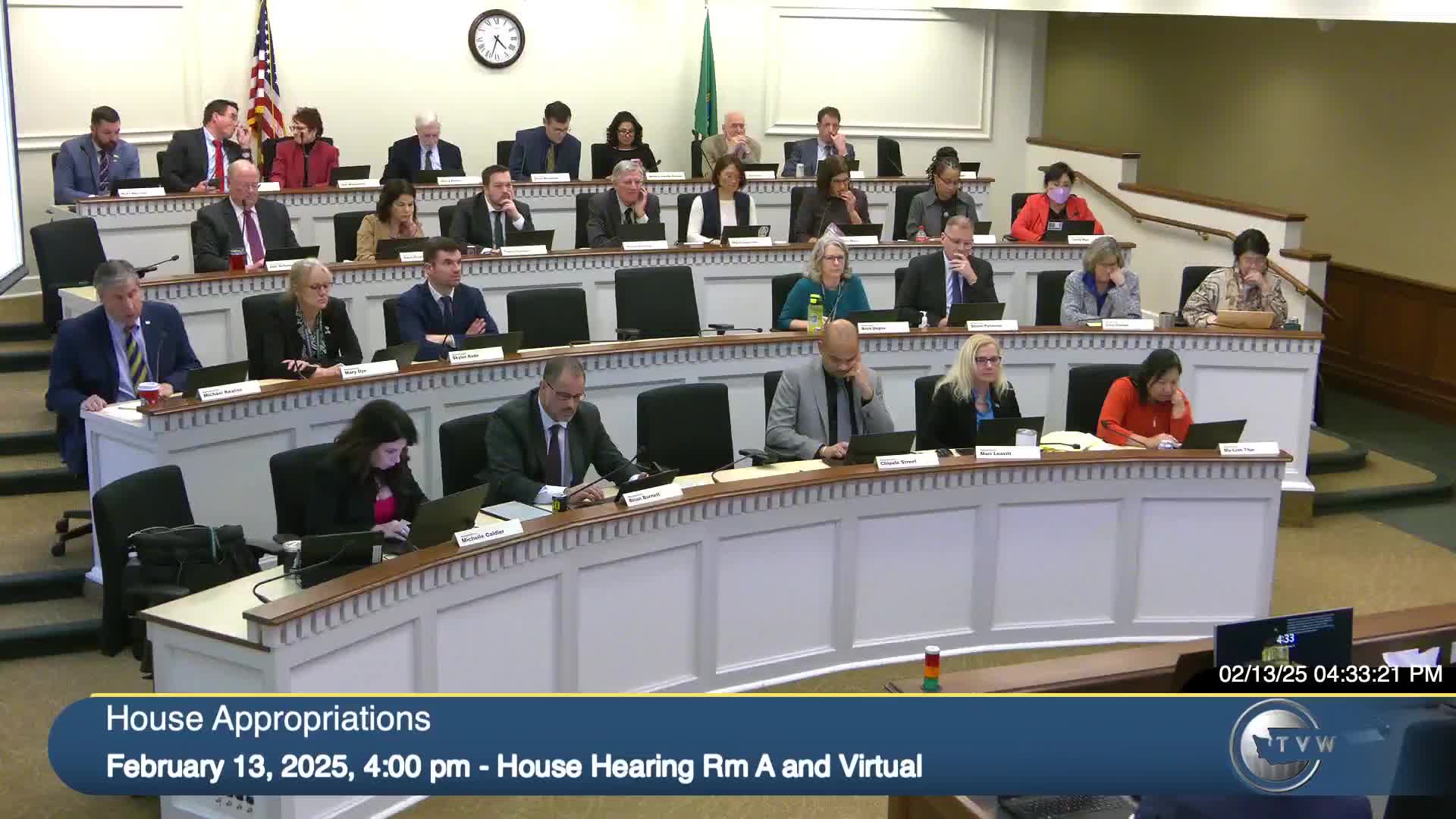
The House Appropriations Committee heard testimony on substitute House Bill 11 54, a proposal that would change permitting and enforcement authority for solid waste handling facilities by increasing the Department of Ecology’s role in landfill permitting and enforcement.
Under the substitute bill, local jurisdictional health departments (JHDs) would continue to issue permits for solid waste handling facilities, but Ecology must review and approve every landfill permit prior to issuance or renewal by the JHD. Ecology could require a JHD to amend a proposed landfill permit. Both the JHD and Ecology could suspend permits and impose civil penalties for noncompliance; penalties imposed by a JHD would be appealable to the local health officer and paid to the local treasury, while penalties imposed by Ecology would be deposited in the Model Toxics Control Operating Account and appealable to the Pollution Control Hearings Board (PCHB). The bill directs that, after Aug. 1, 2027, all landfill permits must be approved by Ecology.
Committee staff briefed members on the bill and on Ecology’s fiscal note: Ecology estimated approximately $500,000 in one-time costs from the Model Toxics Control Operating Account for staffing and 18 months of rulemaking related to the changes. Ecology did not estimate recurring costs from permit review because staff already closely reviews those permits; penalties and enforcement costs were not included because Ecology expects enforcement actions to be infrequent.
Public testimony reflected a mix of support and concern. Supporters, including the Washington State Association of Local Public Health Officials, Friends of Rocky Top and neighborhood advocates from communities near problematic landfills, said the bill would provide stronger enforcement tools and incentives to return facilities to compliance. Neighbors of the Kaitland landfill described alleged ongoing violations, environmental complaints, underground fires and unpermitted operations, and said state backup authority could have prevented or mitigated long-running problems.
Opponents and those urging caution included the Washington Association of County Solid Waste Managers, operators of recycling and transfer facilities, and some private landfill operators. Concerns centered on overlapping enforcement authority, jurisdictional clarity, and potential chilling effects on investment and operations. Industry witnesses and county solid waste managers requested clearer language defining when Ecology can supersede local decisions, or alternative approaches such as an independently funded regulatory commission.
Several stakeholders, including local public health officials and county managers, asked for tightened coordination language and for reinstating data-gathering provisions stakeholders had previously supported. Recycling industry representatives urged deletion of certain sections they said create two enforcement agencies with unclear roles, arguing that would harm recycling operations. Supporters said the substitute bill’s changes and recently adopted amendments begin to address some coordination issues but recommended further statutory language.
Committee members asked staff and Ecology about the fiscal note, appeals processes to PCHB, and the implementation timeline. Staff said Ecology could require changes to local permits and that a local or Ecology appeal would go to the PCHB. The committee did not take action; the hearing concluded after testimony.
If enacted as drafted, the bill would shift substantive permitting authority for landfills to Ecology over time and create dual enforcement pathways with separate appeal routes and different penalty deposit accounts.