Get Full Government Meeting Transcripts, Videos, & Alerts Forever!
Get email alerts on the Land Use Development topic
No spam. Unsubscribe anytime.
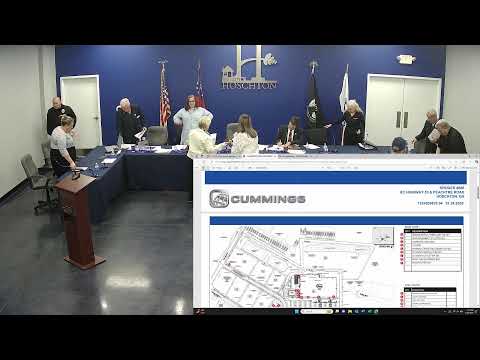
Hoschton council approves conditional use allowing daycare and potential retail after rejecting traffic‑study amendment
Summary
The Hoschton City Council approved conditional use CU‑24‑1 for a proposed daycare and removed a prior restriction prohibiting retail on the parcel. A proposed amendment to require an independent traffic study and to replace the use limitation failed, after council members split on the safety analysis and local traffic concerns.
Council member Tina Brown proposed and then lost an amendment to approve conditional use CU‑24‑1 only after adding a traffic‑study requirement; the council later approved the conditional use with the alternative change Tina Brown had sought — removing condition 12 that prohibited retail — but without requiring an independent traffic study.
The vote followed more than an hour of discussion about peak‑period traffic near Eagles Bluff Way, the proximity of West Jackson Elementary School, a new charter school, a car wash and a proposed daycare. Council members and residents warned that concentrated arrival and pick‑up times could create backups on Highway 53 and trigger unsafe turning movements; others said existing DOT research suggests a study is not warranted.
Why it matters: The decision changes permitted uses for the parcel next to the proposed daycare, allowing the developer the option to add retail uses that could generate sales tax revenue for the city. Opponents argued the site’s concentrated trip generators make additional study necessary to protect schoolchildren and commuters; supporters said the city already has DOT data and that denying retail would eliminate a potential local sales‑tax source.
Council member Tina Brown framed the safety argument in detail and asked the council to restore the traffic‑study condition that had appeared in the Planning and Zoning Commission minutes. “The traffic study needs to include the car wash, West Jackson Elementary School,” Brown said, adding that the daycare operator had stated “638 average daily trips” and that county HOAs’ camera counts showed “1,082 average daily trips currently coming in and out of Eagles Bluff Way.” She cautioned that concentrated morning drop‑offs between about 7 and 8 a.m. could overload short turn lanes on Highway 53.
Councilman Dave Brown said he also supported removing the use limitation (condition 12) but said he was conflicted about the site location because of traffic. “Our city desperately needs a day care,” he said, “but as I look at the way our city’s growing … I think we’re doing an injustice to our citizens by not doing a traffic study.”
City staff and others noted recent contacts with the Georgia Department of Transportation. The mayor reread GDOT guidance the council had received: the department’s last reported crash at the intersection was in 2018; a traffic study typically begins at roughly $20,000 and would be paid by the developer; GDOT told staff it would consider approving a signal when a continuous 8‑hour turning volume reaches roughly 75–100 vehicles per hour; and GDOT estimated a signal, if approved, could cost about $300,000 and also be paid by the developer. A staff summary also said GDOT had already researched this intersection and indicated a study was not warranted even if retail were included.
The council first voted on a motion by Tina Brown to approve CU‑24‑1 with the 13 conditions recommended by staff (Jerry White), but with two changes: strike condition 12 (the use limitation) and add back the Planning and Zoning Commission’s traffic‑study condition as the new condition 12. That motion failed (the mayor noted it received only two affirmative votes and four are required for passage).
A subsequent motion proposed removing condition 12 (so retail would be allowed on the site) and explicitly not requiring a stand‑alone traffic study; that motion was seconded and passed. The council did not adopt the independent traffic‑study requirement.
What the action does and does not do: The approved change removes the city’s restriction limiting the parcel to a daycare use and allows the developer to include retail, but it does not require a city‑commissioned or independent traffic analysis as a condition of development permit approval. The council’s approval does not itself obligate GDOT to install a signal or any other mitigation; GDOT approvals and any costs for infrastructure remain external to the city’s ordinance change.
Staff follow‑up and community next steps: City staff said they will continue to coordinate with GDOT and flagged that the city’s transportation planning work is underway. Council members asked staff and the applicant to keep communications open about safety mitigations; the council did not set a follow‑up requirement such as a specific report back date.
Speakers quoted or referenced in this report are identified in council minutes and the meeting transcript.