Get Full Government Meeting Transcripts, Videos, & Alerts Forever!
Get email alerts on the Parking Enforcement topic
No spam. Unsubscribe anytime.
Council committee presses DOT on staffing, license-plate readers and unified 311 process to revive parking enforcement
Summary
At an oversight hearing, Baltimore City Department of Transportation officials outlined a plan to “reimagine” the Safety Division — including 24-hour enforcement, license-plate readers, a single 311 service request and new shift schedules — while committee members pressed for staffing data, cost breakdowns and timelines.
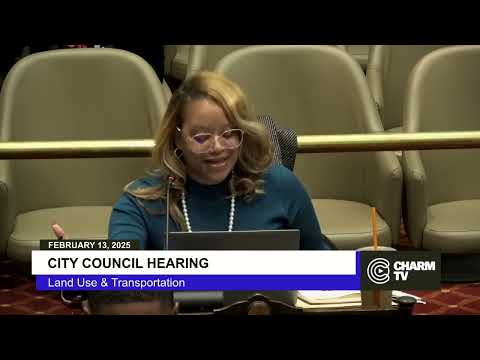
Baltimore City Council’s Land Use and Transportation Committee on Oct. 12 held the first in a series of oversight hearings on parking enforcement and the Department of Transportation’s plan to reorganize its Safety Division. Committee Chair Councilman Ryan Dorsey (Third District) led questioning of DOT Director Veronica McBeath and her staff on staffing, technology and enforcement priorities.
Committee members said the topic matters because enforcement has fallen sharply from pre-pandemic levels and because enforcement choices — when and where officers are deployed — shape neighborhood safety, traffic flow and commercial activity across the city.
Director Veronica McBeath told the committee the department is reimagining its Safety Division around three central goals: “to improve public safety, to promote commercial activity, and to ensure smooth traffic flows.” She described a suite of operational changes under consideration and in early deployment: cross-training traffic enforcement officers so they can handle all violation types, adoption of a Salesforce “worker” app to replace manual dispatching, use of license-plate readers (LPRs) to speed enforcement in residential permit zones (RPPs), and moving two separate 311 parking-related service requests into a single service request with one service-level agreement (SLA).
The hearing focused on capacity and timing. McBeath said DOT is increasing hiring: a September hiring blitz filled 27 of 28 TEO (traffic enforcement officer) vacancies and the department plans another recruitment round for 15 Traffic Enforcement Officer I/II positions with promotions planned over the next two months. The department plans a new shift schedule intended to provide continuous coverage with two-hour overlaps between shifts; McBeath told the committee the expanded overnight coverage is intended to start in March and LPR deployment is expected in the first quarter. The DOT said LPR devices are on hand but await vehicle mounts and training, which are provided through the Parking Authority as the LPR owner; DOT staff will operate the equipment.
Committee members questioned whether the same sworn TEOs should be pulled off parking enforcement to perform traffic-management duties. McBeath and Deputy Director Tavon Braxton said TEOs are sworn by the police commissioner to perform both parking and traffic enforcement and that some traffic-management assignments — outages, large events, emergency incidents — must take priority for public-safety reasons. DOT stressed cross-training and technology (LPRs and the Salesforce worker app) as tools to increase efficiency so officers can respond to more enforcement needs even when some are reassigned to traffic management.
The department presented a cost example for large sporting events, saying personnel costs for one season’s event deployments — staffing game-day traffic management rather than citywide citation activity — amount to about $12,900,000. Councilman Zac Blanchard said he had calculated a lower figure and asked DOT to produce the cost breakdown; McBeath agreed to provide the supporting numbers.
The committee pressed DOT for data and timelines. DOT agreed to several committee requests: (1) within two weeks, provide a breakdown of TEO person-hours spent on traffic management versus parking enforcement year-over-year and by time-of-day intervals (the committee requested 3-, 6- or 12-month aggregations and, separately, hour-of-day breakout); (2) within one week, deliver data from the Federal Hill nightlife enforcement pilot (November start) that McBeath said showed an average of 31 additional tickets per day during 8 p.m.–2 a.m. pilot deployment on Fridays and Saturdays; and (3) within one month, report back on the status of programming and deployment for the unified 311 service request (DOT said a BCIT-built test environment should be ready in about one week, with viability testing the week after, and that the SLA is to be determined). DOT also agreed to provide, within about four weeks, an assessment of how many additional personnel would be required to meet an aspirational two-hour response time for every 311 parking request.
On legal and administrative issues, DOT staff and the committee discussed enabling legislation that would allow tickets to be mailed and remove parking citations from the district court process (decriminalization). DOT argued decriminalization would let the city adjudicate parking violations outside district court (for example, through the Environmental Control Board or another administrative adjudicator), allow city-designed payment plans, and reduce the court backlog that DOT staff said leads judges frequently to dismiss or reduce cases — a pattern DOT said reduces city revenue. Committee members corrected and clarified the record during the hearing: toward the end, staff noted that neither a mailing bill nor a decriminalization bill had been introduced in the current General Assembly session and said they would follow up.
DOT described technology mechanics: LPRs will be used initially in RPP zones with virtual permits, and DOT will operate LPRs owned by the Parking Authority because Parking Authority staff are not sworn to issue citations. The Salesforce worker app consolidates service requests into queues by “post” and allows officers to be assigned to a queue on a given day; DOT said the app eliminates manual radio dispatch and allows officers to pick up real-time 311 requests and respond on the spot.
Council members repeatedly asked DOT to preserve equity in deployment — to ensure neighborhoods without meters or nearby stadiums also receive enforcement attention — and to provide explicit, verifiable measures of improvement. Committee chair Ryan Dorsey said the committee will reconvene on the topic and requested a monthly update as the unified service request and the overnight shift come online. The committee also set a follow-up private preparatory meeting on community engagement for Oct. 19.
Ending: DOT provided operational commitments and preliminary timelines but left several questions open: the exact SLA for a unified parking SR, a final documented staffing plan to meet the committee’s two-hour response target, and the legislative status of mailing/decriminalization measures. The committee scheduled future oversight work; DOT agreed to deliver the requested data and to report back with specific timelines and test results.