Get Full Government Meeting Transcripts, Videos, & Alerts Forever!
Get email alerts on the Homelessness Services topic
No spam. Unsubscribe anytime.
Board extends joint Marathon County–Wausau homelessness task force charter; adds member with lived experience
Summary
The board extended the joint Marathon County–City of Wausau homelessness task force charter to April 1 and approved an amendment adding a member who has experienced homelessness; two related funding resolutions were pulled for further committee review.
The Marathon County Board voted on Feb. 13 to extend and amend the charter for the joint City of Wausau–Marathon County Homelessness Task Force.
Supervisor Covelli (task force co‑chair) summarized the group’s work, saying the issue is “complex” and that the task force needs more time to complete its work. Covelli said the task force has been meeting roughly every two weeks since November, reviewed local data and short‑ and long‑term approaches, and recommended the extension.
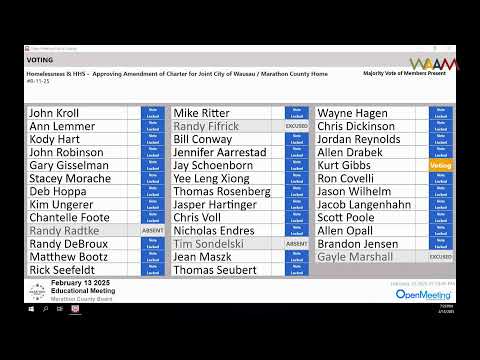
The board approved a resolution to extend the task force’s charter to April 1, 2025 (resolution R‑10‑25). The chair declared the motion carried but not unanimously. The board also approved an amendment to the charter (resolution R‑11‑25) to add an individual who has experienced homelessness; that amendment passed with one recorded abstention.
Board members and staff discussed funding, eligibility and program design during a lengthy debate. Supervisor Poole urged the task force to pursue alternative funding beyond public dollars and to emphasize pathways to self‑sufficiency for able‑bodied participants. Supervisor Hapa, who said she watched every task‑force meeting, expressed frustration with the pace of implementation and said she planned to vote against the extension because she did not believe it would produce timely results.
Administrator Leonard and task force members said the group had answered an intermediate question in the affirmative: demographic data suggests a need to develop a formal mechanism for resource sharing with surrounding municipalities. Leonard noted that a number of issues remain unresolved, including eligibility rules, the role of businesses and nonprofits, legal questions about assisted transport between jurisdictions and the scope of any county funding commitment.
Two resolutions that proposed matching or exceeding a funding commitment (R‑12‑25 and R‑13‑25) were pulled from the Feb. 13 agenda at the request of the health and human services and HR/finance chairs; the task force planned to reconsider them at its next meeting and HR/finance may take action after that review.
The board asked staff to keep supervisors informed and to return recommendations after the task force completes the additional work. The extension and charter amendment preserve the task force’s ability to continue work on short‑, intermediate‑ and long‑term policy recommendations.