Get Full Government Meeting Transcripts, Videos, & Alerts Forever!
Get email alerts on the Workforce Development topic
No spam. Unsubscribe anytime.
Office of Workforce Strategy details CT Health Horizons, Tech Talent and CareerConnect outcomes; proposes new Career Accelerator and WISE fund
Summary
Dr. Kelly Balares, director of the Office of Workforce Strategy, briefed the Higher Education Employment Advancement Committee on Oct. 12 about CT Health Horizons, the Tech Talent Accelerator, CareerConnect and a proposed Career Accelerator that would combine zero‑interest loans with supportive services to help people enter stackable credential programs.
Dr. Kelly Balares, director of the Office of Workforce Strategy (OWS), briefed the Higher Education Employment Advancement Committee on the agency’s major workforce programs and next steps, including CT Health Horizons, the Tech Talent Accelerator, CareerConnect and a proposed Career Accelerator to supply zero‑interest loans and supportive services for learners.
The update, delivered Oct. 12 during an informational hearing, detailed outcomes from ARPA‑funded investments and other grants and outlined a request to reauthorize a new Workforce Innovation and Sustainability (WISE) fund to preserve and scale programs after one‑time funding expires.
Why it matters
Balares told lawmakers the programs aim to expand training pathways tied to industry demand while removing barriers—child care, transportation and other supports—that prevent people from completing credentials and entering careers. "We want to make workforce work for everybody," Balares said, summarizing OWS’s mission and strategy.
What OWS reported
CT Health Horizons. Balares said CT Health Horizons was built to expand health‑care pipelines by increasing tuition support, boosting faculty capacity and piloting accelerated and practice‑based programs. Using $35,000,000 in ARPA funds administered through the Connecticut State Colleges & Universities (CSCU) system, OWS reported issuing "1,662 scholarships," which the presentation described as about 38% above an initial goal of 1,200. The program also expanded faculty capacity across institutions and created multi‑year faculty hires to sustain clinical instruction and placements, Balares said.
Tech Talent Accelerator. Balares described the Tech Talent Accelerator as an iterative, employer‑driven effort supported originally by the Tech Talent Fund at the Department of Economic and Community Development (DECD). The initiative has run three rounds of convenings involving employers, higher‑education leaders and intermediary groups to align curricula, embed short badges and work‑based learning, and adapt coursework to emerging needs such as AI integration. She said the third round will be funded from CareerConnect bond dollars allocated to OWS and will emphasize AI and employer‑higher education alignment.
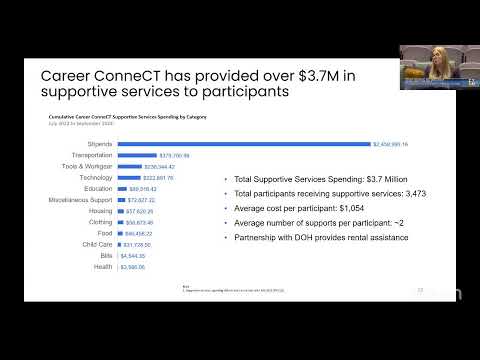
CareerConnect. CareerConnect is a statewide training and placement effort OWS said was funded with a $70,000,000 allocation and designed to scale proven local practices. Balares reported CareerConnect has enrolled more than 6,000 people for training, with roughly two‑thirds placed in what the presentation labels "quality jobs." The portal that markets and enrolls residents has more than 35,000 signups since launch. Balares said roughly 18,000 people remained in the portal queue as of the briefing and that participants are served by case managers in regional workforce boards and community‑based providers.
Career Accelerator design. OWS described a planned Career Accelerator to provide zero‑interest training loans plus no‑cost supportive services (child care stipends, housing stipends and stipends for learners). The design aims to reach learners who do not qualify for federal funds but still cannot afford industry‑recognized, non‑credit training. Balares said the proposal targets occupations that can move participants toward about $50,000 in annual wages — at which point modest monthly loan repayments would begin — and that the office will issue an RFP for an administrator and seek an initial $5,000,000 in CareerConnect bond funds to seed the program.
Regional sector partnerships and Good Jobs Challenge. Balares outlined 14 regional sector partnerships that engage roughly 500 businesses statewide. OWS receives and coordinates federal Good Jobs Challenge funding (a Department of Commerce/EDA grant program), which Balares said is currently contracted and being executed. She emphasized RSPs are intended to surface employer needs and scale training by coordinating regional resources and funders.
Funding continuity and WISE Fund proposal. Balares told the committee that one‑time ARPA and other funds are beginning to sunset and that much of the CareerConnect infrastructure—portal, marketing and cohort models—requires new sustainable funding to continue. OWS seeks authorization for a WISE fund (the presentation described a proposed $30,000,000 reauthorization) to provide ongoing seed and innovation funding, to be run via an advisory subgroup of the governor’s workforce council and to accept philanthropic contributions.
Committee questions and clarifications
Lawmakers asked about program details and outcomes. Representative Ackert asked whether scholarships required recipients to remain in Connecticut after completing training; Balares said residency was required to get the scholarship and that retention requirements remain an area of ongoing discussion and data collection. Multiple legislators pressed for more granular completion and placement demographics; Balares said some completion/placement reporting is manual today and OWS is working to improve its data systems to automate and share that breakdown.
Lawmakers also asked about faculty recruitment in health programs; Balares said employers are increasingly helping support faculty time or part‑time teaching while remaining employed in clinical roles. On technology workforce needs, several members urged continued engagement on AI and quantum workforce planning; Balares said OWS is participating in a Quantum CT workforce working group and emphasized "durable learning skills" (critical thinking, adaptability, lifelong learning) as essential complements to technical training.
No formal actions taken
The hearing was informational; no formal committee votes, appointments or ordinance actions were recorded during this session.
What’s next
Balares said OWS will proceed with the Career Accelerator RFP, seek the CareerConnect bond allocation to seed that program, continue to administer Good Jobs Challenge contracts, and pursue WISE Fund authorization to sustain successful CareerConnect models and other innovations. She also committed to provide more automated demographic completion and placement reports to the committee as the agency builds its data systems.
Ending
Committee members thanked Balares for the briefing and asked OWS to return with more detailed completion and placement data and with the Career Accelerator RFP timeline and WISE fund design details.