Get Full Government Meeting Transcripts, Videos, & Alerts Forever!
Get email alerts on the Hoa Signs Free Speech topic
No spam. Unsubscribe anytime.
Panel approves bill clarifying HOA rules on political flags and signs, allowing names not on ballot
Summary
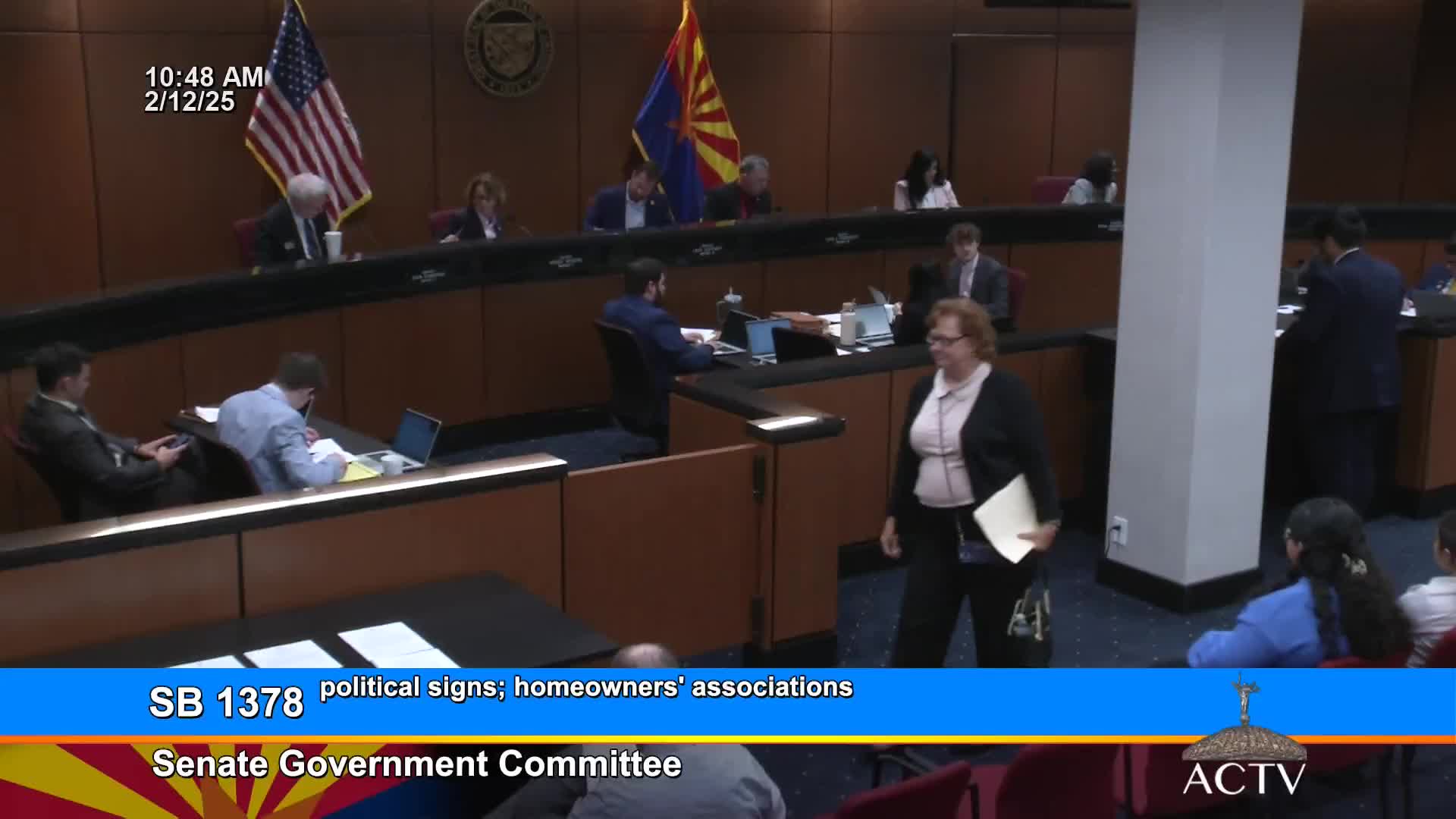
Senate Bill 13‑78, which expands the statutory definition of "political sign" to include flags and to cover names of individuals who are not on the upcoming ballot, advanced from committee. Sponsor Senator Mesnard said the narrow change responds to HOAs fining residents for draped or flag-like signs such as "Jesus 2024." Testimony
The Senate Committee on Government voted to advance Senate Bill 13‑78, a measure that clarifies the statutory definition of a political sign to include flag‑style displays and to specify that a political sign for a candidate may refer to a named person regardless of whether that person appears on the next ballot (with one statutory exception for primary candidates who do not advance).
Sponsor Senator Mesnard said the change grew from constituent complaints and municipal enforcement actions in which homeowners were fined for nontraditional or "wavy" displays and for putting names on signs when the named person was not a ballot candidate. Mesnard said the bill is narrowly tailored to address the enforcement problem without changing timing, size limits or other existing restrictions on political signs.
Testimony included Dennis Legere of the Arizona Homeowners Coalition, who framed the issue as a free‑speech concern and asked the Legislature to protect homeowners’ ability to display political messages. Jason Bridal of the Arizona Association of Community Managers urged caution, warning that broadening the definition could empower nefarious actors to post offensive or inflammatory displays and suggested a mechanism to tie named persons to declared candidacies. The sponsor replied that the statute already uses the standard "attempts to influence the outcome of an election," and the purpose of the bill was to prevent uneven enforcement where residents were fined for putting a name on a display.
After discussion, the committee adopted the measure and recorded a do‑pass recommendation by a vote of 5 ayes and 2 nays. Supporters said the language preserves the standard that the display must attempt to influence an election and does not change time‑in‑placement rules that limit political signs to windows near an election, while opponents warned of unintended consequences and asked for clarifying language.