Get Full Government Meeting Transcripts, Videos, & Alerts Forever!
Get email alerts on the Open Records topic
No spam. Unsubscribe anytime.
CT Freedom of Information Commission briefs oversight committee on records law, exemptions and complaint process
Summary
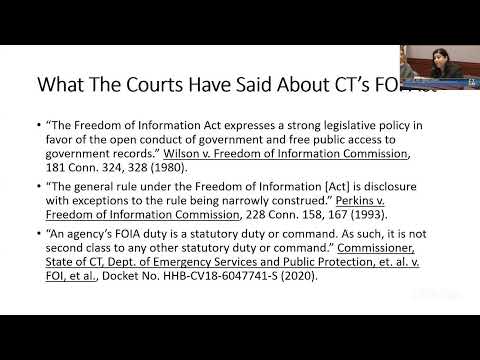
Russell Blair, director of education and communications for the Freedom of Information Commission, told the Government Oversight Committee at an informational forum Feb. 13 that Connecticut celebrates the 50th anniversary of its Freedom of Information Act in 2025 and that the statute and related case law remain central to public access to government records and meetings.
Russell Blair, director of education and communications for the Freedom of Information Commission, told the Government Oversight Committee at an informational forum Feb. 13 that Connecticut—elebrates the 50th anniversary of its Freedom of Information Act in 2025 and that the statute and related case law remain central to public access to government records and meetings.
Blair said the commission is a small but active enforcement and education agency, with nine commissioners, 18 staff attorneys and more than 800 complaints in 2024. "We got 855 such complaints in 2024," he said, adding that about two‑thirds of those were resolved through the commission
The commission nd its staff, Blair said, operate as an administrative appeals body: a requester must first seek records from the agency that maintains them, and if dissatisfied may file a complaint with the commission, which can hold contested‑case hearings, issue written findings and, ultimately, see cases reviewed in superior court and, in some matters, by the state Supreme Court.
Why it matters
The briefing came as committee members pressed about bills that would expand nondisclosure of public employees ddresses and as legislators asked for clarity about response timelines and so‑called vexatious requesters. Those issues affect how local and state agencies balance transparency with safety, privacy and administrative burden.
Key points from the presentation
- What counts as a public record: Blair summarized the statutory standard as records "relating to the conduct of the public's business," whether emails, handwritten notes or video. He emphasized that exemptions and other statutes can limit disclosure.
- Exemptions and safety: Blair described a safety and security exemption in state law and the process agencies use when they believe disclosure would create a safety risk. He said public agencies typically consult a security expert (for state agencies, often the Department of Administrative Services or state police) and that the commission gives substantial weight to those determinations. "There's an exemption ... that says any public agency does not have to disclose information when there are reasonable grounds to believe disclosure may result in a safety risk, including the risk of harm to any person," Blair said.
- Examples: Blair cited past matters in which disclosure was withheld after security review, including disputes over researcher names in litigation initiated by an advocacy group, requests to incarcerated persons for police records and a Darien request for sewer maps tied to drinking‑water infrastructure. He also described how body‑worn camera law makes footage available but exempts videos of minors, medical treatment or certain sensitive crime scenes.
- Personnel, legal and trade‑secret protections: Blair said personnel and medical records can be withheld where disclosure would be an invasion of privacy, noted attorney‑client privilege for government legal strategy, and described the trade‑secrets exemption that can protect business submissions made to agencies for regulatory purposes.
- Appeals and remedies: The commission handles complaints, conducts hearings and issues written decisions. Blair described the commission s both an adjudicator and an educator, noting the office conducted 125 educational workshops in 2024 and that many complaints resolve through the Ombudsman Mediation Program rather than contested hearings.
- Promptness standard: There is no universal deadline for responding to records requests; the commission applies a fact‑specific legal standard called "promptness." Larger or more complex requests may reasonably take longer; requesters who believe an agency delayed may file a promptness complaint with the commission, which can order disclosure within a specified period (Blair said the commission sometimes sets 60‑ or 90‑day deadlines for remaining records).
- Personal email and public business: Blair said that communications sent or received on a personal account are records if they pertain to public business: "If it deals with public business, if it's on a personal email, it's still a public record." He urged public employees to use official accounts to simplify searches.
- Vexatious requesters: A statutory mechanism lets a public agency petition the commission to restrict compliance with a particular requester for up to one year when there is a pattern of abusive requests or interference with agency operations. Blair said the statute does not define "vexatious" but directs the commission to consider volume, scope and pattern of requests and other communications.
Questions from legislators
Senator Sampson, the committee's ranking member, asked about nondisclosure of addresses and whether the statutory protections for certain categories of public employees still make sense given today—ha nge d public information sources. Blair said the nondisclosure list predates the internet and that exemptions do not always shield information from other public records (for example, voter, land and tax records are not covered by the nondisclosure list). "I think that protection in some ways gives people a false sense of security," he said.
Committee member Miss Dressler, who identified herself as a former journalist, said addresses can be relevant for verification in reporting and gave a published example in which publicly available address information led a municipality to collect unpaid property taxes from an incoming official.
Senator Hanson asked about tracking trends in FOI requests. Blair said the commission tracks complaints filed with the office but not all FOI requests across agencies. He noted state agencies using an online platform called GovQA may be able to extract statistics, while many smaller municipalities record requests in less centralized ways.
Process and context notes
Blair described the commission as an executive‑branch agency with considerable independence: nine commissioners are appointed so no more than five may belong to the same political party. The commission receives and investigates complaints, can subpoena records to review their contents in camera and issues decisions that create a body of administrative law, sometimes reviewed by the courts.
What the presentation did not do
The forum was informational; no legislation was adopted and there were no committee votes during the session. Blair said the commission will testify on specific bills at subsequent hearings and encouraged municipalities and legislators to consult the commission before drafting new exemptions.
Next steps
The committee recessed the informational forum to begin its public hearing at 11 a.m., after a question period in which members raised nondisclosure of addresses, promptness standards and potential increases in request volume.