Get Full Government Meeting Transcripts, Videos, & Alerts Forever!
Get email alerts on the Cryptocurrency Policy topic
No spam. Unsubscribe anytime.
Arizona senators advance virtual-currency measures amid floor objections and constitutional debate
Summary
The Arizona SenateCommittee of the Whole reported several bills affecting virtual currency for further consideration, and the full Senate later approved a related constitutional referral (SCR 1,001) after extended floor debate.
The Arizona SenateCommittee of the Whole reported several bills affecting virtual currency for further consideration, and the full Senate later approved a separate constitutional referral to exempt "virtual currency" from property tax on the ballot after extended floor debate.
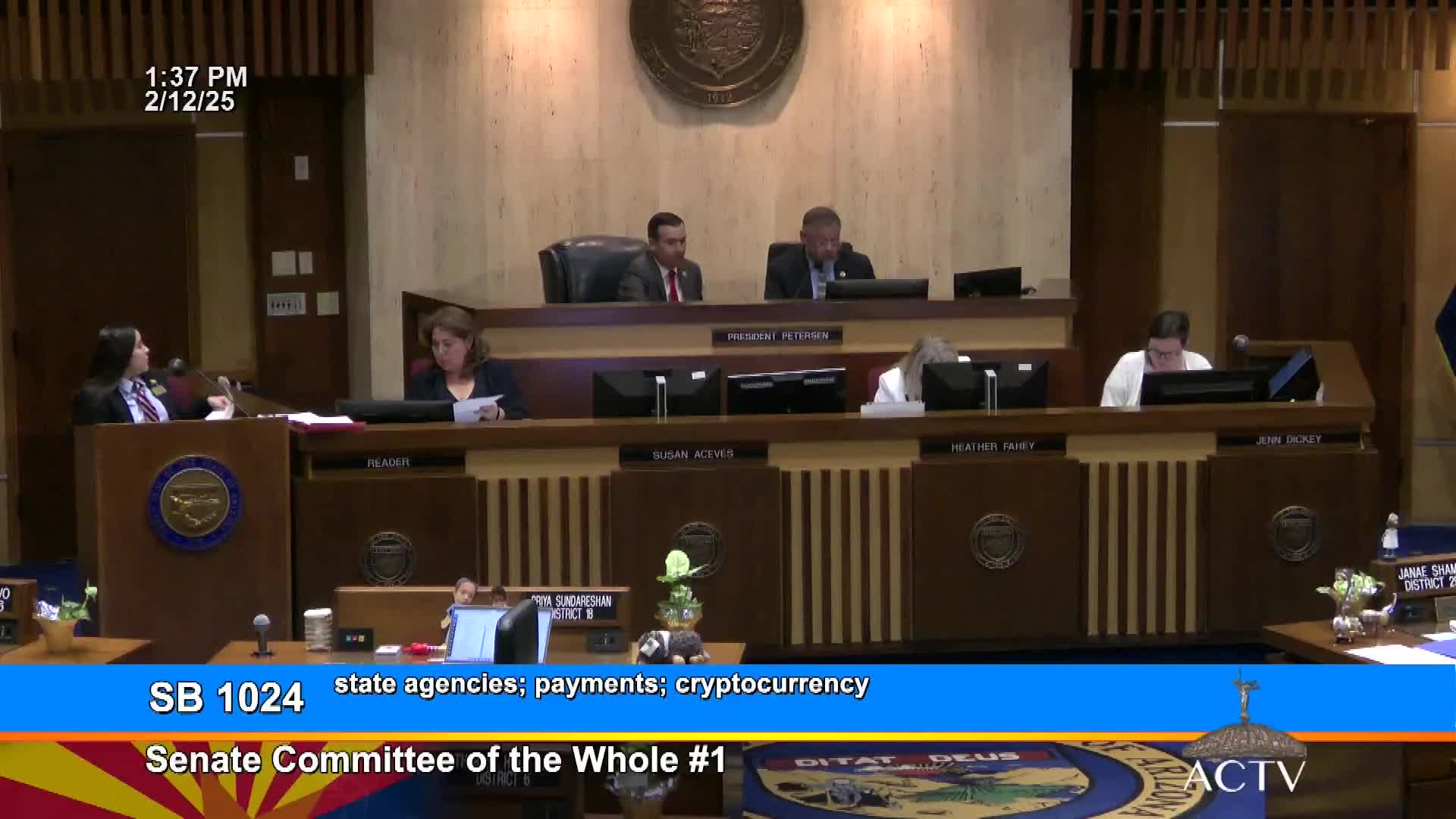
The Committee of the Whole recommended that Senate Bill 10-24 (state agency payments and cryptocurrencies), Senate Bill 10-25 (public moneys investment: virtual currency), and Senate Bill 10-26 (virtual currency property-tax exemption, as amended) "do pass," according to committee reports entered into the record. Sponsors on the floor moved the committee recommendations when the committee rose to report.
Lawmakers pressed the sponsor and spoke at length about consumer protection, market volatility and constitutional questions. "Cryptocurrency may at some point reach a point be something that is regulated and safe and stable and that people use as a currency. It is not there now. Not at all," Senator Epstein said on the floor, arguing the state should not grant privileged status to digital assets. Epstein also raised practical concerns about third-party processors and customer complaints, referencing exchanges such as Coinbase.
Epstein questioned how the state could value crypto receipts when markets swing within a single day. "Just today, Bitcoin has fluctuated between 95,000 and $97,000. . . . Are we accepting it at 95? Are we accepting it at 97?" she asked. She and other senators repeatedly said sponsors on the floor declined to yield to detailed questions.
Senate debate later returned to a related measure, Senate Concurrent Resolution 1,001, a ballot referral that would amend Article IX, Section 2 of the Arizona Constitution to add virtual-currency property-tax exemptions. Multiple senators objected to placing that exemption in the constitution. "Why this bill supporters think that Bitcoin and other cryptocurrencies deserve to be in that list of noble pursuits, I do not know," Senator Epstein said during her explanation of vote on SCR 1,001, citing ransomware, fraud and other criminal uses of cryptocurrency. She also argued the referral may raise constitutional issues because it would define a medium of exchange that is not U.S. legal tender.
Despite objections, the Senate voted to transmit SCR 1,001 to the ballot. The clerk recorded the final tally as 18 ayes, 10 nays and 2 not voting on SCR 1,001; the measure will proceed as a ballot referral. Committee reports recommending "do pass" for the related bills were adopted by the Committee of the Whole and entered into the journal; the committee's report listed SB10-24, SB10-25 and SB10-26 (as amended) among bills that received do-pass recommendations.
No final floor passage for SB10-24, SB10-25 or SB10-26 was recorded in the transcript provided; the record shows committee recommendations and floor discussion but not the bills' third-reading votes in each case. Floor discussion included repeated refusals by sponsors to answer questions on the floor: on at least two occasions a speaker rose to ask the sponsor to yield, and the response recorded was "Negative. I do not yield." The exchange left several senators to offer extended comments instead of sponsor responses.
What the measures would do (as reported in committee): SB10-24 would permit state agencies to accept payments in cryptocurrencies under the statutory framework named in the bill; SB10-25 would add provisions for investment or custody of public moneys in virtual currency; and SB10-26 (as amended in finance committee) would create a property-tax exemption for virtual currency. The committee reports cite the relevant Arizona Revised Statutes sections being amended or added but do not include detailed fiscal notes or implementation language in the floor record excerpt.
Senators who spoke most directly on the record in the provided transcript included Senator Wendy Rogers (who moved committee recommendations on criminal-justice and finance bills on the floor), Senator Epstein (floor critic and questioner), and J.D. Messner (chair of the Committee on Finance, whose committee reported SB10-24/SB10-25/SB10-26). The Committee of the Whole report was delivered and later adopted by the chamber.
The measures remain subject to further floor action. SCR 1,001 will appear on the ballot if it completes the legislative and administrative steps for placement; the subject matter and the floor debate make passage before voters likely to draw further discussion about whether state constitutional language is the appropriate place for tax treatment of digital assets.
Votes recorded in the transcript relevant to virtual-currency items: the Committee of the Whole list of recommendations (adopted by the committee) includes SB10-24 and SB10-25 as "do pass" and SB10-26 "do pass as amended." The transcript does not contain a third-reading vote count for those three bills in the provided excerpt.
The record shows senators voiced concerns about consumer protections, exchange reliability, price volatility and constitutional limits on states declaring what constitutes tender or property for tax purposes. No implementation directions (for example, assignment to a state agency to draft rules) were recorded in the excerpt provided.
The committee report and the floor discussion together indicate the bills are moving forward but also that key questions remain unanswered on valuation, custodial arrangements and legal exposure that senators said should be resolved before giving digital assets privileges equivalent to longstanding property-tax-exempt entities.
Ending: Committee recommendations for the virtual-currency bills were adopted in committee and entered in the Senate journal; the measures will proceed through the legislative process. SCR 1,001 was approved by the Senate as a ballot referral and will go to the ballot process; senators on the floor said they expect further scrutiny by colleagues, stakeholders and voters.